Get quick appointment for technical support!

Zambia Urban Power Network Upgrade Project
Discover how Westhomes Electric modernized Zambia’s urban power grid using ACBs, MCCBs, and MCBs to resolve blackouts and ensure selective coordination.
- Time: 2013
- Location: Zambia
- Industry: Urban medium-low voltage power distribution
- Products: MCB, MCCB, ACB
Project Background
Zambia’s urban centers experienced rapid population growth in the early 2010s, placing enormous pressure on electrical distribution networks originally designed for much smaller loads. Commercial districts, residential high-rises, and public facilities all demanded more power than the existing infrastructure could safely deliver. Overloaded transformers, overheating switchgear, and frequent blackouts were daily realities.
In 2013, Westhomes Electric partnered with local contractors on a major urban power network upgrade program. The objective was to modernize medium and low-voltage distribution across several Zambian cities, replacing undersized protection devices with equipment rated for current and future load demands.
The Challenge
The urban distribution networks faced a distinct set of problems compared to rural installations:
- Distribution panels operating beyond their rated capacity, with circuit breakers frequently tripping during peak hours
- No coordination between upstream and downstream protection devices, meaning a single fault could black out an entire commercial block
- Aging air circuit breakers at main substations with worn contacts and unreliable trip mechanisms
- Limited space in existing electrical rooms, requiring compact equipment that could fit without major civil works
- Growing commercial load from new office buildings, shopping centers, and hotels that had been connected without load studies
The Westhomes Solution
Westhomes supplied a tiered protection scheme designed to create reliable selectivity from the main substation down to individual branch circuits:
Air Circuit Breakers (ACB)
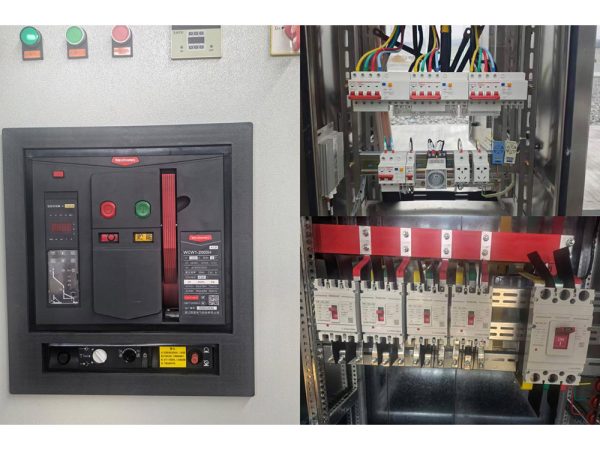
At the top of the distribution hierarchy, Westhomes ACBs were installed at main incoming substations to handle the highest fault currents. Their microprocessor-based trip units allowed precise coordination with downstream devices. The ACBs featured built-in energy-reducing maintenance switches, giving technicians a safer working environment during routine inspections and testing.
Molded Case Circuit Breakers (MCCB)
At the distribution panel level, Westhomes MCCBs provided the backbone of the protection scheme. Adjustable thermal-magnetic trip units were set to discriminate with both upstream ACBs and downstream MCBs, creating a cascade that confined faults to the smallest possible section. Higher-rated frames handled feeder circuits to commercial buildings, while standard frames covered residential distribution.
Miniature Circuit Breakers (MCB)
Westhomes MCBs at the final distribution level protected individual lighting circuits, socket outlets, and small equipment loads. Their consistent trip characteristics meant downstream faults were cleared locally without affecting other tenants in the same building, a critical requirement for multi-occupancy commercial properties.
Results
- Selective coordination between ACBs, MCCBs, and MCBs eliminated cascading blackouts; faults were isolated to the affected circuit rather than tripping upstream breakers
- Distribution panels operated within rated capacity after load balancing and device sizing
- Compact equipment footprints allowed installation in existing electrical rooms without structural modifications, reducing project costs
- The ACB energy-reducing maintenance mode improved technician safety during scheduled inspections
- Urban businesses reported fewer power interruptions during peak hours, directly supporting commercial activity and economic growth
The Zambia urban upgrade demonstrated the value of protection coordination in dense electrical networks. By installing devices with well-matched trip characteristics across all three levels (ACB, MCCB, MCB), the project achieved both safety and continuity of supply, two goals that poorly coordinated systems often force operators to trade off against each other.
--- END ---
Related Projects
Get A Free Quote
