Get quick appointment for technical support!

Indonesia Java Industrial Park Power Distribution Project
Learn how Westhomes Electric protected Indonesia’s Java Industrial Park using advanced MCCBs, MCBs, and SPDs to prevent overloads and lightning surges. (154 chars)
- Time: 2012
- Location: Indonesia
- Industry: Industrial park power supply and distribution
- Products: MCB, MCCB, Surge Protection Device (SPD)
Project Background
Indonesia’s Java Island is the country’s industrial heartland, home to manufacturing plants, processing facilities, and logistics hubs operating around the clock. In 2012, a newly developed industrial park on Java required a complete electrical distribution infrastructure to serve dozens of factory units, each with heavy machinery, motor loads, and sensitive control equipment.
Industrial parks present unique electrical challenges. High motor starting currents, harmonic-rich loads from variable frequency drives, and the constant risk of lightning strikes in tropical climates demand protection strategies that go beyond standard commercial installations. Westhomes Electric was selected to supply the core protection components for the park’s medium and low-voltage distribution network.
The Challenge
The industrial park’s electrical design had to address several concurrent risks:
- Large motors and production equipment drawing high inrush currents during startup, which could nuisance-trip standard circuit breakers.
- Frequent thunderstorms during Java’s wet season creating transient overvoltages that damaged unprotected equipment.
- High ambient temperatures and humidity inside factory electrical rooms accelerating insulation degradation.
- Multiple tenants with different load profiles sharing common distribution infrastructure, requiring each unit to be independently protected.
- Production downtime translating directly into financial losses, making power continuity a commercial imperative.
The Westhomes Solution
Westhomes designed a three-layer protection strategy that addressed overload conditions, fault currents, and transient overvoltages simultaneously:
Molded Case Circuit Breakers (MCCB)
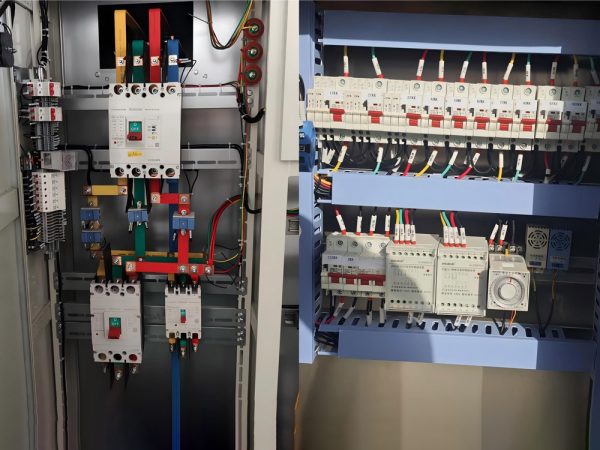
Westhomes MCCBs with adjustable thermal-magnetic trip units were installed at the main distribution panels serving each factory unit. The adjustable trip curves allowed engineers to set pickup thresholds high enough to tolerate motor inrush currents while still providing genuine overload protection. Higher-rated MCCB frames protected main busbar feeders, with electronic trip units enabling fine-grained coordination across the park’s entire distribution hierarchy.
Miniature Circuit Breakers (MCB)
Individual machine circuits, lighting, and auxiliary power were protected by Westhomes MCBs. Their consistent tripping performance ensured a fault on one production line did not interrupt power to neighboring equipment. The compact DIN-rail format allowed dense packing in control panels, keeping panel dimensions manageable despite the high circuit count typical of industrial installations.
Surge Protective Devices (SPD)
This was the critical differentiator for the Java project. Westhomes Type 1+2 SPDs were installed at the main incoming supply of each factory unit to divert lightning-induced surge currents safely to ground. Secondary Type 2 SPDs at sub-distribution boards provided additional protection for sensitive control electronics, PLCs, and variable speed drives that were most vulnerable to even moderate transient overvoltages. The coordinated SPD deployment created a cascaded protection zone that limited residual voltage at equipment terminals to survivable levels.
Results
- Factory units equipped with MCCBs sized for motor inrush experienced minimal nuisance tripping, keeping production lines running through startup sequences.
- Surge protection at both main and sub-distribution levels reduced equipment damage claims during Java’s thunderstorm season.
- The layered protection architecture allowed individual tenant faults to be cleared locally without affecting other factories in the park.
- Standardized breaker families across the park simplified spare parts inventory for the facility management team.
- Park operators reported higher tenant satisfaction due to improved power reliability compared to older industrial estates in the region.
The Java Industrial Park project illustrated that industrial power distribution in tropical climates requires more than just circuit breakers. By integrating surge protection into the core design rather than treating it as an afterthought, the installation achieved both equipment longevity and operational continuity, two metrics that directly impact the bottom line for manufacturing tenants.
--- END ---
Related Projects
Get A Free Quote
