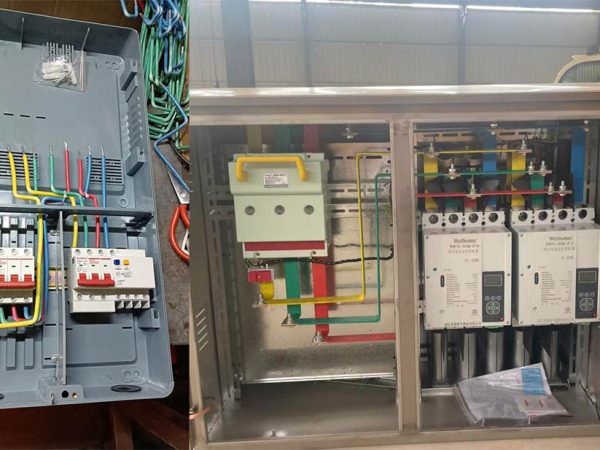
2P WH5-125 Isolator Switch | Double Pole Disconnector
Durable 2P isolator switch for AC230/400V circuits. Features double-break contacts, fast action, and DIN-rail installation for reliable dual-pole isolation.
Get quick appointment for technical support!

The WH5-125 2P Isolator Switch provides secure double-pole disconnection for AC230V/400V power circuits rated between 20A and 125A.



Durable 2P isolator switch for AC230/400V circuits. Features double-break contacts, fast action, and DIN-rail installation for reliable dual-pole isolation.

The WH5-125 2P Isolator Switch, built with flame-retardant reinforced nylon insulation and a double-break contact system, it delivers dependable isolation performance with smooth, quick switching enabled by its spring-loaded mechanism.
Its modular construction supports easy DIN-rail installation and allows seamless integration with MCBs and RCCBs. This 2-pole isolator is ideal for commercial distribution units, industrial control equipment, and multi-story building electrical systems requiring enhanced safety and clear isolation status.
| Model | WH5-125 |
| Current rating | 20A, 25A, 32A, 40A, 50A, 63A, 80A, 100A, 125A |
| Poles (p) | 1P, 2P, 3P, 4P |
| Rated Voltage Ue | AC230V/400V (1P); 400V (2P-4P) |
| Rated short-time withstand current Icw | 2kA |
| Rated short-time connecting capacity Icm | 2.84kA |
| Hydrothermal resistance | Category 2 |
| Uilization Catagory | AC-22A |
| Electrical life | 8000 times |
| Mechanical life | 20000 times |
| Pollution degree | Level 2 |
| Cabling capacity | 1~50mm2 |
| Quality certificate | CCC certificated |
| Standard | IEC60947-3, GB14048.3 |
| Model NO. | WH5-125 |
| Arc-extinguishing Medium | Air |
| Structure | MCB |
| Type | Circuit Breaker |
| Certification | ISO9001-2000, CCC |
| Ka: Icm | 2.84ka |
| Width | 18, 36, 54, 72mm |
| Specification | IEC60947-3, GB14048.3 |
| Origin | Prc |
| Production Capacity | 15, 000, 000 |
| Speed | Normal Type Circuit Breaker |
| Installation | DIN Rail |
| Poles Number | 1p, 2p, 3p, 4p |
| Function | Conventional Circuit Breaker |
| Voltage | AC230/400V |
| AMPS | 20A, 25A, 32A, 40A, 50A, 63A, 80A, 100A, 125A |
| Transport Package | Paper Box |
| Trademark | Westhomes |
| HS Code | 8536200000 |
| Package Size | 22.00cm * 10.00cm * 10.00cm |
| Package Gross Weight | 2.000kg |
For a closer look at disconnector, read Isolator vs Switch Disconnector: Key Differences & Selection Guide.
For a closer look at isolation, read 1P WH5-125 DIN Rail Isolator Switch | Single Pole Disconnect.
A double pole isolator switches two conductors simultaneously (typically phase and neutral in a single-phase circuit) through a single handle. When turned off, both lines are physically separated, giving true double-pole isolation. It is commonly used as the main switch for single-phase distribution boards, inverters, EV chargers, and dedicated appliance circuits.
Yes. A 2P device breaks both poles together. This is safer than a 1P isolator, which leaves the neutral connected even when the switch is off. With a 2P isolator, both sides of the load are isolated, eliminating the risk that a back-fed or shared neutral remains live during maintenance.
As a switch-disconnector, it can make and break its rated current under normal operating conditions (typically AC-22A). It is not a fault-interrupting device and cannot clear short circuits. Upstream MCBs or fuses must provide overcurrent and short-circuit protection; the isolator handles routine on/off and isolation only.
A 1P isolator switches one conductor (the phase) only and occupies one DIN module. A 2P isolator switches both phase and neutral, occupies two DIN modules, and provides complete isolation of the single-phase circuit. Use 2P where the neutral must be isolated for safety, such as at the main incomer of a consumer unit or on equipment that could be back-fed from an inverter.
125 A per pole is the maximum continuous current each pole can carry. At 230 V single phase this supports up to about 28.75 kW of load. Both poles are rated equally — there is no "protected" and "unprotected" pole distinction as there is on a 1P+N MCB; both are pure switch contacts.
Connect incoming phase and neutral to the top terminals 1 and 3 (line side), and outgoing phase and neutral to the bottom terminals 2 and 4 (load side). Observe the N marking on the neutral pole so the neutral is not reversed. Use copper conductors appropriate for 125 A (around 25–35 mm²), strip to the marked depth, and torque to the manufacturer's specification.
Yes. The handle has a padlock provision in the OFF position, typically accepting up to three padlocks, allowing multiple workers to apply personal locks. After locking, verify zero voltage on both load terminals with a two-pole tester before working on the circuit downstream.
It is designed to IEC 60947-3, the standard for low-voltage switch-disconnectors, covering rated currents up to 125 A, AC-22A utilization, isolation distances, and temperature rise. CE marking indicates conformity with the EU Low Voltage Directive. Always verify the marking on the actual datasheet for your specific SKU.
No. The isolator cannot protect cables or equipment from overload or short circuit. It should always be installed in series with upstream MCBs, MCCBs, or fuses. A common arrangement is: supply → main MCB/MCCB → 2P isolator → downstream branch MCBs. The isolator gives visible isolation; the MCBs give fault protection.
The 2P WH5-125 is used as the main single-phase isolator in residential consumer units, solar inverter and battery storage AC isolation switches, EV charger disconnects, workshop and garage sub-mains, pump and HVAC local isolators, and dedicated appliance circuits requiring simultaneous phase and neutral disconnection.
* indicates a required field


 155 MB