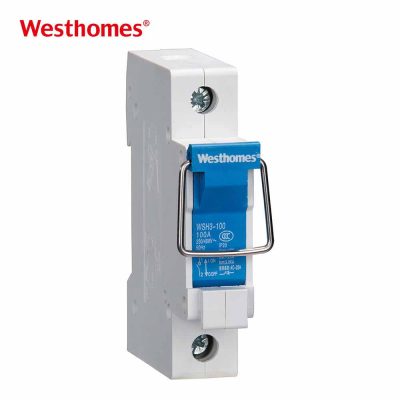
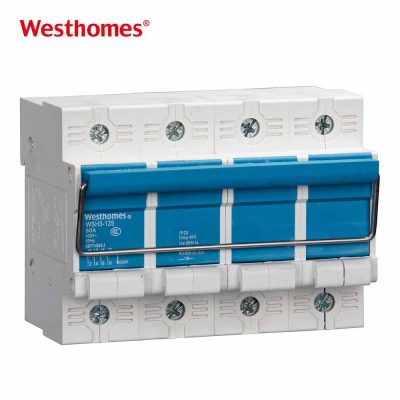
DIN Rail 125A Isolator Switch | MCB-Type Power Disconnector
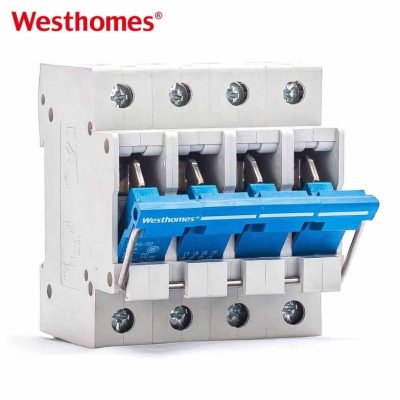
Reliable 4P isolator switch for AC230/400V systems, offering complete four-pole isolation with fast action, durable contacts, and easy DIN-rail installation.
Get quick appointment for technical support!

The WH5-125 Series heavy-duty 4-pole disconnect is suited for industrial distribution networks, commercial power panels, and large-scale building installations requiring complete and safe isolation.



Reliable 4P isolator switch for AC230/400V systems, offering complete four-pole isolation with fast action, durable contacts, and easy DIN-rail installation.

The WH5-125 4P Isolator Switch offers full four-pole isolation for three-phase + neutral systems operating at AC230V/400V with rated currents from 20A to 125A.
Constructed with a flame-retardant insulated nylon shell, bridge-type double-break contacts, and a rapid-response spring mechanism, it ensures high stability and dependable switching performance.
Its modular frame fits standard DIN rails, enabling quick installation and compatibility with other protective devices.
| Model | WH5-125 |
| Current rating | 20A, 25A, 32A, 40A, 50A, 63A, 80A, 100A, 125A |
| Poles (p) | 1P, 2P, 3P, 4P |
| Rated Voltage Ue | AC230V/400V (1P); 400V (2P-4P) |
| Rated short-time withstand current Icw | 2kA |
| Rated short-time connecting capacity Icm | 2.84kA |
| Hydrothermal resistance | Category 2 |
| Uilization Catagory | AC-22A |
| Electrical life | 8000 times |
| Mechanical life | 20000 times |
| Pollution degree | Level 2 |
| Cabling capacity | 1~50mm2 |
| Quality certificate | CCC certificated |
| Standard | IEC60947-3, GB14048.3 |
| Model NO. | WH5-125 |
| Arc-extinguishing Medium | Air |
| Structure | MCB |
| Type | Circuit Breaker |
| Certification | ISO9001-2000, CCC |
| Ka: Icm | 2.84ka |
| Width | 18, 36, 54, 72mm |
| Specification | IEC60947-3, GB14048.3 |
| Origin | Prc |
| Production Capacity | 15, 000, 000 |
| Speed | Normal Type Circuit Breaker |
| Installation | DIN Rail |
| Poles Number | 1p, 2p, 3p, 4p |
| Function | Conventional Circuit Breaker |
| Voltage | AC230/400V |
| AMPS | 20A, 25A, 32A, 40A, 50A, 63A, 80A, 100A, 125A |
| Transport Package | Paper Box |
| Trademark | Westhomes |
| HS Code | 8536200000 |
| Package Size | 22.00cm * 10.00cm * 10.00cm |
| Package Gross Weight | 2.000kg |
See 1P WH5-125 DIN Rail Isolator Switch | Single Pole Disconnect for a deeper dive into isolation.
A power isolator (or switch-disconnector) is a manually operated mechanical switching device mounted on a 35 mm DIN rail. It provides a visible, positive break in the circuit so the downstream installation can be safely de-energized for maintenance. Unlike an MCB, it has no thermal or magnetic trip elements — it simply connects or isolates the load when the operator moves the handle.
An MCB automatically trips on overload or short circuit; an isolator does not. The isolator is a manual on/off switch whose job is to create a safe, visible gap for isolation. It must always be paired with upstream fuses or MCBs that provide overcurrent and short-circuit protection. Think of the isolator as the "master switch" and the MCB as the "protection guard."
125 A is the rated operational current (Ie) — the maximum continuous current the device can carry through its closed contacts without exceeding allowable temperature rise. It is also the maximum current it can make and break on load under its assigned utilization category (typically AC-22A for mixed resistive/inductive switching at 240/415 V). Do not size loads above 125 A without moving to a larger frame.
A true switch-disconnector can safely make and break its rated current under normal operating conditions (AC-22A or AC-23A). A simple disconnector (no arc control) must only be operated when no current is flowing. The WH5-125 / 125 A DIN isolator is built as a load-break switch-disconnector, so it can switch normal load current, but it is not designed to interrupt short-circuit currents — that remains the job of upstream protection.
It clicks onto a standard TH35-7.5 mm DIN rail, same as an MCB. Hook the upper lip over the rail, then push the lower part until the retaining latch clicks. Keep the panel vertical within about 5° as specified in the instruction manual, and leave a small air gap around the device for heat dissipation at full 125 A load.
The supply (incoming) cables connect to the top terminals marked LINE (1, 3, 5…), and the outgoing load cables connect to the bottom terminals marked LOAD (2, 4, 6…). Observe phase sequence L1–L2–L3–N across corresponding terminals. Use copper conductors sized to 125 A (typically 25–35 mm² depending on installation method), strip to the marked depth, and torque screw terminals to the manufacturer's value.
Yes. The handle has a padlocking facility in the OFF position, usually accepting up to three padlocks. This is essential for lockout/tagout (LOTO) procedures: each person working on the circuit applies their own personal padlock so the switch cannot be re-energized until everyone has removed their lock. Always verify zero voltage on the load side with a tester before touching conductors.
No. An isolator has no bimetal, solenoid, or fuses of its own. It will not trip automatically on overload or fault current. Overcurrent protection must come from upstream MCBs, MCCBs, or fuses in series with the isolator. The isolator's role is purely to make, break, and visibly isolate the circuit.
It is designed and type-tested to IEC 60947-3, the IEC standard for low-voltage switchgear and controlgear — switches, disconnectors, switch-disconnectors, and fuse-combination units. The standard covers rated currents, making/breaking capacity, isolation distances, temperature rise, and utilization categories (AC-21/22/23). CE marking confirms conformity with the EU Low Voltage Directive.
Common uses are the main isolator at the head of a distribution board, the service disconnect for a workshop or machinery panel, the on/off switch for HVAC and pump systems, rooftop PV and battery storage DC-coupled AC isolation, generator changeover switches, and any circuit where personnel must work on de-energized equipment.
* indicates a required field


 155 MB