Get quick appointment for technical support!

What are the three basic types of air circuit breakers?
Nov 10, 2025
The Air Circuit Breaker (ACB) is the primary switching device, employing atmospheric air for both arc extinction and insulation. It is designed to safely interrupt high-intensity currents resulting from faults like overloads, short circuits, and ground faults. This action safeguards expensive equipment and ensures personnel safety.
However, ACB technology is not monolithic. Based on its arc extinction principle and application voltage level, ACBs are precisely divided into different types. Understanding these basic classifications, along with the underlying physics and international standard requirements, is fundamental for system engineers and design experts.
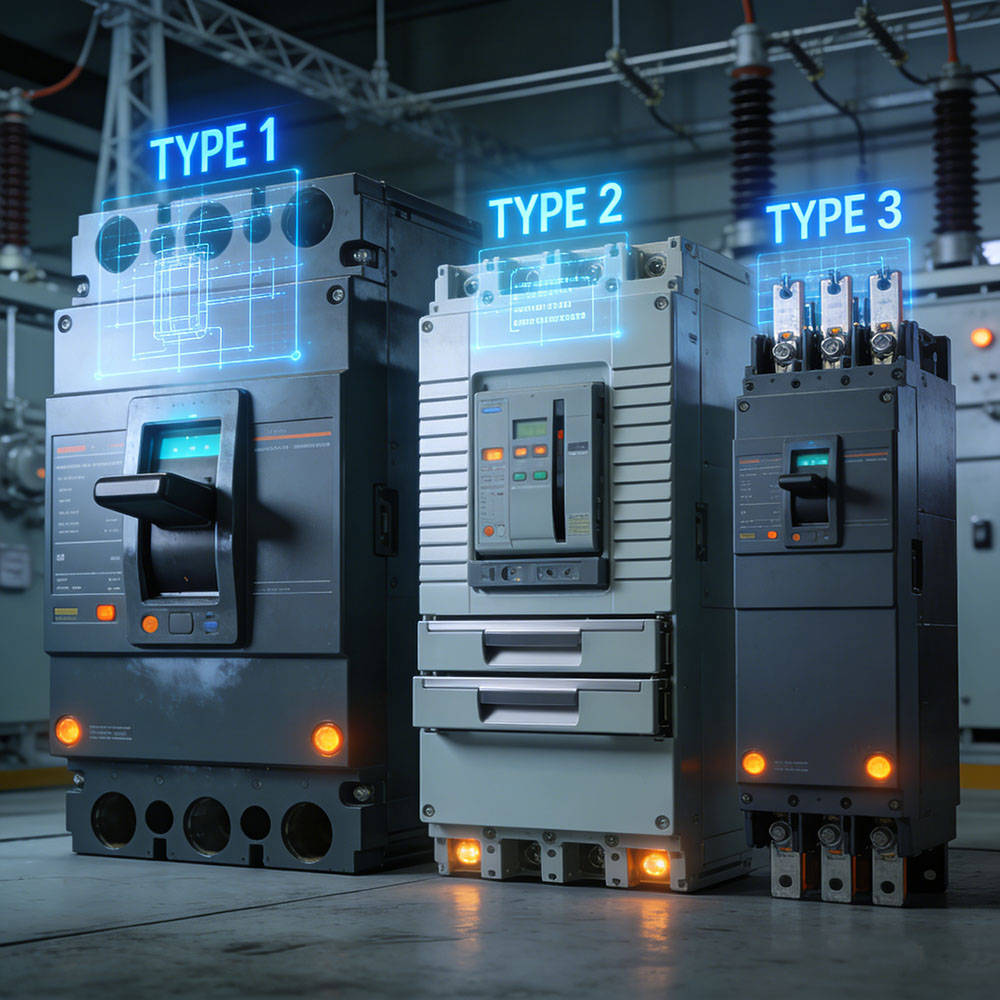
The Context of Air Circuit Breaker Basics and Classification
Main Function and Arc Extinction Principle of Air Circuit Breakers (ACB)
A main advantage of the Air Circuit Breaker is its inherent safety, as it eliminates the fire hazards associated with Oil Circuit Breakers (OCB).
Although air has a lower dielectric strength, sophisticated mechanical and electromagnetic designs allow ACBs to achieve efficient fault interruption in low-voltage, high-current applications.
ACB arc extinction is based on three fundamental physical principles:
- Arc Cooling (Cooling): Reducing the temperature of the arc plasma decreases particle motion, thereby increasing the voltage gradient required to sustain the arc.
- Arc Lengthening (Lengthening): Increasing the length of the arc path raises the path resistance, increasing the arc voltage until it exceeds the system voltage, causing extinction.
- Arc Splitting (Splitting ): Dividing a single arc into multiple small arcs connected in series, which rapidly increases the total arc voltage.
Dual Classification System of Air Circuit Breakers
In industrial applications, the classification of air circuit breakers is generally based on two dimensions: voltage level and the arc extinction mechanism.
Classification by Voltage Level
International standards, like IEC and ANSI, are the first step in differentiating circuit breaker applications. This classification determines the performance and design standards that the circuit breaker must follow:
Low Voltage ACB (LV ACB): Applicable to systems with voltage ratings up to 1,000. LV ACBs primarily adhere to the IEC 60947-2 standard. They are most common in industrial facilities and large commercial buildings, with a wide range of rated currents, typically between 100 A and 6,300 A
Medium/High Voltage ACB (Air Blast Circuit Breaker, ABCB): Applicable to systems with voltage ratings above 1 kV , including Medium Voltage (1 kV to 36 kV) and High Voltage (>36kV). Historically, these high-voltage applications used Air Blast Circuit Breakers (ABCBs) and adhered to the IEC 62271-100 standard.
| ACB Type (Type) | Voltage Range (Voltage Rating) | Typical Rated Current Range (Rated Current Range) | Standard Jurisdiction (Standard Jurisdiction) |
| Low Voltage (LV ACB) | <= 1,000 V AC | 100 A – 6,300 A | IEC 60947-2 |
| Medium Voltage (MV) | 1 kV – 36 kV | 6,300 A – 25,000 A | IEC 62271-100 |
| High Voltage (HV) | > 36 kV | Typical value > 25,000 A | IEC 62271-100 |
Table 1: ACB Classification and International Standard Jurisdiction
The Three Basic Arc Extinction Mechanisms of Air Circuit Breakers
In engineering practice, distinguishing the “basic types” of air circuit breakers relies primarily on how they employ physical and electromagnetic forces to control and eliminate the arc. These three mechanisms define the ACB’s performance and scope of application.
Type 1: Plain Break / Air Chute ACB
This is the most fundamental ACB mechanism, also referred to as Plain Break or Air Chute ACB.
Construction and Process The Plain Break circuit breaker uses a meticulously designed Arc Chute to extinguish the arc. The arc chute is made of heat-resistant insulating material and contains multiple metal separator plates (Splitter Plates).
When the contacts separate and form an arc, the arc is driven into the arc chute by air currents or the mechanical force of the contact action. The purpose of these splitter plates is to divide the single, high-energy arc into a series of shorter, smaller arcs connected in series.
Extinction Efficiency and Application Splitting the arc significantly increases the total resistance and arc voltage, while the surface of the metal plates cools the arc, accelerating the de-ionisation of the arc plasma. When the AC current reaches a zero-crossing point, the arc cannot reignite, thereby achieving interruption.
Due to its relatively low arc extinction efficiency, this type is mainly used in low-voltage, low-breaking capacity applications. It is typically used below 1 kV, or even below 450 V, such as in panels, uninterruptible power supplies (UPS), and small generating stations. In modern heavy industrial applications, this purely plain break mechanism has been superseded or combined with more powerful technologies.
Type 2: Magnetic Blowout ACB
The Magnetic Blowout technology introduces active electromagnetic control based on the Plain Break design.
Working Principle: This circuit breaker incorporates Blowout Coils connected in series with the main circuit. When a fault occurs, the high current flowing through these coils generates a powerful magnetic field.
This magnetic field is designed to be perpendicular to the arc path. According to the principle of Lorentz force, the magnetic field exerts a force on the current (i.e., the arc), rapidly and forcefully driving and stretching the arc into the deeper air chutes of the arc chamber.
Key Advantage: Current-Adaptive Drive The strength of the magnetic blowout force is directly proportional to the magnitude of the fault current. This means that the larger the fault current, the stronger the magnetic field generated, and the faster the arc is pushed into the arc chute. This current-adaptive driving force quickly interrupts short-circuit faults and is the physical basis for modern low-voltage ACBs achieving high short-circuit breaking capacities.
Type 3: Air Blast Circuit Breaker (ABCB)
The Air Blast Circuit Breaker (ABCB) is a solution historically designed for High Voltage systems, and its arc extinction principle is fundamentally different from that of LV ACBs. It does not rely on electromagnetic force or the air currents generated by contact movement but on externally stored high-pressure energy.
Structure and Working Principle
The construction of an ABCB is relatively complex, requiring a continuously operating compressed air system, including an air reservoir, compressor, air valves, and hollow insulator assemblies.
When a fault occurs, the operating mechanism triggers the air valve to open, and high-pressure air stored in the reservoir is blasted directly onto the arc path formed between the contacts.
The powerful airflow forcibly breaks the arc and rapidly sweeps away the high-temperature ionised gases and particles in the arc channel, quickly rebuilding the dielectric strength between the contacts and preventing the arc from reigniting. ABCBs fall into the category of external extinguishing energy type circuit breakers, as the arc extinction energy is supplied by the high-pressure air, independent of the current being interrupted.
ABCB Sub-Types
Airflow Direction ABCBs can be classified based on the direction of the airflow relative to the arc path:
- Axial Blast: The airflow is directed along the axis of the arc, maximizing cooling and de-ionization efficiency.
- Radial/Cross Blast: The airflow is directed radially or perpendicular to the arc path, forcing the arc into splitter plates or exhaust chambers. Radial blast often relies on a double blast principle to improve arc extinctionefficiency in Extra High Voltage systems.
| Basic Type (Mechanism Type) | Extinction Principle (Extinction Principle) | Typical Voltage Level | Key Advantages |
| Plain Break / Air Chute | Physical cooling, lengthening, and splitting of the arc | Low Voltage (< 1 kV) | Simplest structure, low cost |
| Magnetic Blowout | Magnetic force drives the arc into the air chute for cooling | Low Voltage (< 1 kV) | Fast arc extinction, self-adaptive to fault current magnitude |
| Air Blast (ABCB) | Forced de-ionisation of the contact gap by external high-pressure airflow | High Voltage (> 15 kV) | Extremely fast operation, short and consistent arcing time |
Table 2: Technical Comparison of the Three Basic ACB Types
Technical Evolution: Obsolescence and Intelligence
The ABCB was largely replaced in HV markets by SF6 and Vacuum Circuit Breakers (VCB) due to the Current Chopping Effect. This technical flaw caused severe overvoltages , risking insulation failure. Furthermore, ABCBs required complex, noisy air systems.
Conversely, modern LV ACBs have become intelligent through Electronic Trip Units. These microprocessor units provide precise, adjustable protection (L, S, I, G), essential for System Selectivity. They also integrate communication (Modbus) for monitoring, transforming the ACB into a data node for smart distribution.
Standards and Selectivity in LV ACB Selection
Proper LV ACB selection demands adherence to IEC 60947-2 ratings:
- lUltimate Breaking Capacity: Maximum safe interruption current.
- lService Breaking Capacity: Current interrupted while remaining operational.
- lShort-Time Withstand Current: Current the breaker can withstand while closed for a specified delay, essential for Time Selectivity.
To achieve intentional selectivity, the breaker must comply with Utilization Category B. Category A breakers lack this delay.
Air Circuit Breakers in the Modern Power System
Modern low-voltage air circuit breakers combine magnetic blowout and air chute technology for strong short-circuit handling. With electronic trip units, they provide precise, intelligent protection for today’s digital power systems. Want to Learn more? Contact us now to learn how Westhomes can help you upgrade your system with reliable, standards-compliant ACBs.

--- END ---
In this blog
Featured Articles
Get A Free Quote
