Get quick appointment for technical support!

Why MCB is Tripping? Top 6 Causes and How to Fix Them
Jan 05, 2026
What is MCB Tripping?
MCBs are designed to automatically switch off the electrical circuit when they detect abnormal conditions like overcurrent or short circuits. They operate on a thermal-magnetic trip mechanism. The thermal element responds to prolonged overcurrent situations, while the magnetic element reacts to sudden high current surges, such as those caused by short circuits.
There’s a difference between “Nuisance Tripping” (when the MCB trips without a clear reason, often due to sensitivity or aging) and “Safety Tripping” (when it trips in response to a genuine electrical fault, protecting your home from danger).
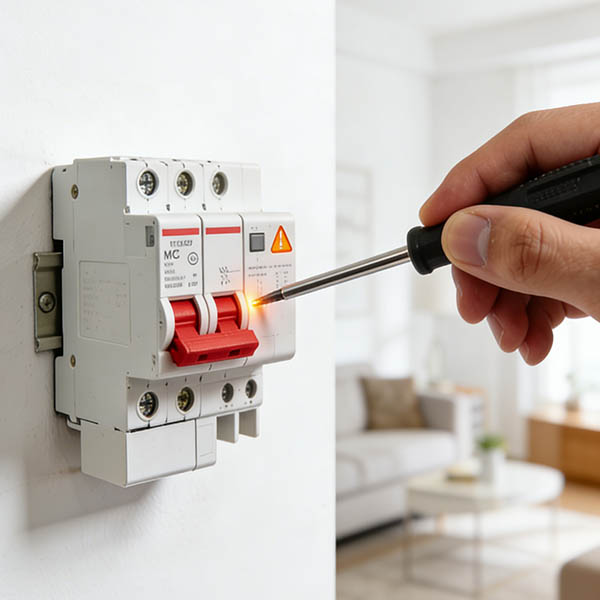
Before assuming the device has failed, checking the breaker rating against the circuit usually explains the trip within a few minutes.
Top 6 Causes of MCB Tripping
Cause 1: Overloaded Circuit (Circuit Overload)
- Most Common Cause: This occurs when the total current drawn by appliances exceeds the MCB’s rated current capacity (e.g., running 25A worth of devices on a 20A breaker).
- Typical Scenario: Simultaneously using high-power appliances like an air conditioner, microwave, heater, and electric kettle.
- Signs: The MCB trips after a few minutes of high-power appliance usage (due to the thermal protection mechanism needing time to build up heat).
Cause 2: Short Circuit (Short Circuit vs Overload)
- Explanation: A direct contact between the live wire (L) and neutral wire (N), causing a sudden surge in current.
- Signs: Immediate MCB tripping, often accompanied by sparks, popping sounds, or a burning smell. Blackened or charred marks around the MCB or outlets are common indicators.
Cause 3: Ground Fault / Earth Leakage
- Explanation: Similar to a short circuit, but current leaks to the ground wire or metal casing instead of the neutral wire.
- Typical Scenarios: Occurring in damp areas like kitchens or bathrooms, or when insulation on wires is damaged and touches metal pipes.
Cause 4: Defective Appliances
- Explanation: The issue lies not with the circuit but with a specific appliance plugged into it (e.g., a fan with a burnt-out motor or a microwave with internal short circuits).
- Troubleshooting Approach: This is an external factor, easily verified by unplugging devices one by one.
Cause 5: Loose Connections
- Explanation: Screws at connection points not being tightened properly, leading to increased resistance, heat generation, and ultimately thermal trip activation.
- Troubleshooting Approach: Check for loose screws at terminals and tighten them securely.
Cause 6: Faulty or Old MCB
- Explanation: MCBs have a mechanical lifespan. If they’re too old, with weakened springs or burnt internal contacts, they may become overly sensitive or fail to reset.
Step-by-Step Troubleshooting Guide
Step 1: Isolate the Issue
Turn off all switches and unplug all appliances on the affected circuit.
Step 2: Reset the Breaker
Push the MCB back to the “ON” position.
- Case A: If it trips immediately – likely a short circuit or MCB damage (consult a professional electrician).
- Case B: If it stays on – the circuit is likely fine; the issue may be with an appliance.
Step 3: The Appliance Test
Plug appliances back in one by one and turn them on. When the MCB trips after plugging in a specific appliance, that device is the culprit.
Safety Warning (Electrical Safety)
If you smell burning, see sparks, or are unsure about any step, STOP immediately and contact a professional electrician. Never attempt to fix a tripped MCB with tape or force the switch!
Prevention & Maintenance Tips
- Distribute Loads: Avoid plugging too many high-power appliances into one outlet via extension cords.
- Regular Inspections: Check wires for damage (especially if they’ve been chewed by rodents or crushed by furniture).
- Upgrade Equipment: If you’ve added high-power devices like central air conditioning, consider upgrading your distribution board and cables.
- Use High-Quality MCBs: Invest in reputable MCB brands for durability and precise protection. Explore our MCB product series for reliable options.
Conclusion
MCB tripping is a protective mechanism, not something to ignore. Understanding these causes and solutions can help you maintain a safe and efficient electrical system in your home.

Call to Action (CTA): Looking for a durable circuit breaker supplier? Browse our MCB product series to find the perfect solution for your electrical safety needs.
Nuisance tripping is rarely a fault in the device itself. Troubleshooting an RCBO that keeps tripping usually leads back to the circuit, and testing an MCB for proper functioning separates a genuine fault from a device that is simply doing its job.
Where the symptoms look different, the wider picture helps. Surge protectors and circuit breakers guard against different threats, an overview of how a breaker operates explains the trip mechanism itself, and the essential knowledge for electrical safety covers the cases where a breaker degrades without ever tripping. Catching the warning signs of a failing breaker early is what keeps a nuisance trip from becoming an outage.

--- END ---
In this blog
Featured Articles
Get A Free Quote
