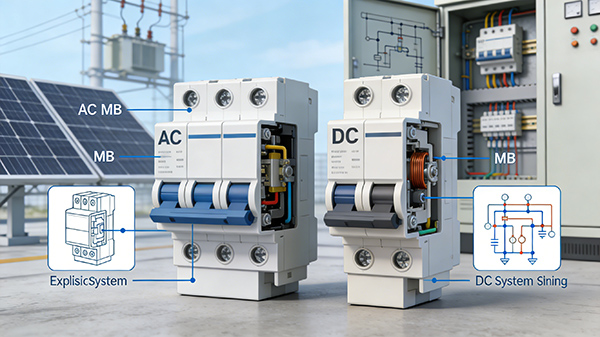
When designing or maintaining a power system, it is necessary to understand the specific role of each protection device. A common point of confusion involves the choice between Alternating Current Miniature Circuit Breakers and Direct Current Miniature Circuit Breakers. While they share a similar outward appearance, their internal mechanisms and intended environments are fundamentally different.
DC circuit breakers refer to circuit breakers used in DC power distribution systems. These devices are generally applicable to solar photovoltaic power generation and power distribution systems, battery energy storage systems, and new energy vehicle DC charging systems. A system in which the input power supply terminal of the circuit breaker is DC current requires these specific components to ensure safety and reliability.
The Physical Nature of AC and DC Currents
The primary reason for the different designs of these breakers lies in how the current behaves.
Alternating Current Characteristics
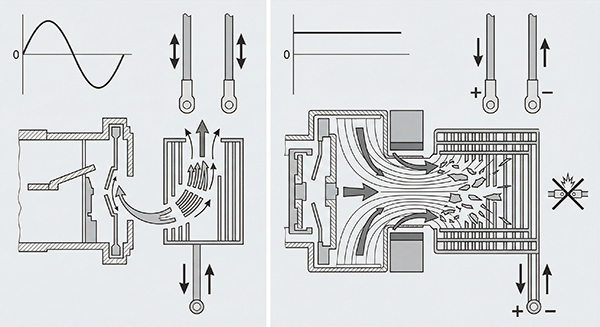
Alternating Current, or AC, changes its direction and magnitude constantly. In a standard 50 Hertz or 60 Hertz system, the current passes through a zero voltage point 100 or 120 times every second. This moment is known as the zero crossing. When a fault occurs and the contacts open, the electrical arc that forms is naturally extinguished when the current hits this zero point.
Direct Current Characteristics
Direct Current, or DC, flows in a single direction with a steady magnitude. It does not possess a zero crossing point. Because the current is constant, an electrical arc formed in a DC system does not extinguish itself naturally. It continues to burn with high intensity, making it much harder to stop than an AC arc.
For more detail about ac or dc current you can read our blog Difference Between DC and AC power
Arc Extinguishing Mechanisms
Because DC arcs are more persistent, the internal construction of a DC MCB is more complex than that of an AC MCB.
- AC Arc Quenching: An AC breaker relies mainly on the natural zero crossing of the sine wave to dissipate the arc. It uses simple arc chutes to split and cool the spark.
- DC Arc Quenching: A DC breaker must actively force the arc to extinguish. These devices include permanent magnets that create a magnetic field to blow the arc into a specialized, larger arc chute. This magnetic blowout stretches the arc until it breaks, preventing damage to the internal contacts.
Polarity and Wiring Requirements
Another key distinction involves how the devices are connected to the power source.
Most AC circuit breakers are non-polarized, which means you can connect the power supply to either the top or bottom terminals without affecting performance. However, many DC circuit breakers are polarized. They feature specific positive and negative markings on the casing. Connecting a polarized DC breaker with the wrong polarity can lead to a failure in arc quenching, potentially causing the device to catch fire or explode during a fault.
Comprehensive Comparison Table
The following table summarizes the technical differences between these two types of circuit protection.
| Feature |
AC Miniature Circuit Breaker |
DC Miniature Circuit Breaker |
| Input Power |
Operates on Alternating Current systems. |
Operates on Direct Current systems. |
| Arc Quenching |
Uses natural zero crossing to stop arcs. |
Uses magnets to force and stretch arcs. |
| Circuit Type |
Grid power, lighting, and HVAC. |
Solar PV, batteries, and EV chargers. |
| Polarity |
Generally non-polarized. |
Often polarized with fixed +/- markings. |
| Internal Design |
Standard arc chutes. |
Enhanced magnets and larger arc chutes. |
| Breaking Difficulty |
Low, due to oscillating current. |
High, due to constant current flow. |
The Danger of Swapping Breakers
It is a dangerous mistake to assume that an AC MCB can protect a DC circuit.
If you install an AC breaker in a DC system, such as a solar array or a battery bank, the breaker will likely fail during a short circuit. Since the AC breaker lacks the magnets needed to pull the DC arc away, the arc will remain between the contacts. This leads to continuous arcing, which melts the plastic housing and creates a high risk of an electrical fire. Conversely, using a DC breaker on an AC circuit is technically possible but usually avoided because it is more expensive and unnecessary for standard household wiring.
FAQ: Common Questions About AC and DC MCBs
What is the main difference between AC MCB and DC MCB?
The main difference is the ability to extinguish the electrical arc. AC breakers use the natural zero crossing of the current, while DC breakers use magnets to blow the arc into a cooling chamber.
Roy
Technical Specialist & Industrial Systems Contributor
Roy is a seasoned professional in the electrical distribution industry, specializing in low-voltage protection and industrial automation. With a deep understanding of IEC/EN standards and years of experience in power system configurations (from SP to 4P TPN systems), he provides clarity on complex electrical components for global engineers and B2B procurement managers. Roy’s insights help businesses bridge the gap between technical requirements and cost-effective industrial solutions.
Can I use an AC breaker for a solar panel system?
No, you should not use an AC breaker for solar panels because solar systems produce DC power. An AC breaker cannot safely stop a DC fault arc, which creates a major fire hazard.
Roy
Technical Specialist & Industrial Systems Contributor
Roy is a seasoned professional in the electrical distribution industry, specializing in low-voltage protection and industrial automation. With a deep understanding of IEC/EN standards and years of experience in power system configurations (from SP to 4P TPN systems), he provides clarity on complex electrical components for global engineers and B2B procurement managers. Roy’s insights help businesses bridge the gap between technical requirements and cost-effective industrial solutions.
Where are DC circuit breakers typically used?
They are used in DC power distribution systems including solar photovoltaic arrays, battery energy storage systems, and DC charging stations for electric vehicles.
Roy
Technical Specialist & Industrial Systems Contributor
Roy is a seasoned professional in the electrical distribution industry, specializing in low-voltage protection and industrial automation. With a deep understanding of IEC/EN standards and years of experience in power system configurations (from SP to 4P TPN systems), he provides clarity on complex electrical components for global engineers and B2B procurement managers. Roy’s insights help businesses bridge the gap between technical requirements and cost-effective industrial solutions.
What happens if a DC MCB is wired with reversed polarity?
If a polarized DC circuit breaker is wired incorrectly, the internal permanent magnets will pull the electrical arc in the wrong direction. Instead of being pushed into the arc chute to be extinguished, the arc may be drawn toward the device’s internal mechanism, which can cause the breaker to fail, melt, or lead to an explosion during a short circuit.
Roy
Technical Specialist & Industrial Systems Contributor
Roy is a seasoned professional in the electrical distribution industry, specializing in low-voltage protection and industrial automation. With a deep understanding of IEC/EN standards and years of experience in power system configurations (from SP to 4P TPN systems), he provides clarity on complex electrical components for global engineers and B2B procurement managers. Roy’s insights help businesses bridge the gap between technical requirements and cost-effective industrial solutions.
Can a DC MCB be used for both AC and DC applications?
Some manufacturers produce specialized “Universal” or “Dual-Rated” circuit breakers designed to handle both types of current, but a standard DC-only breaker should not be used in an AC system without explicit approval from the manufacturer. While a DC breaker is technically capable of extinguishing an AC arc, its trip characteristics may differ, and it is usually much more expensive than a standard AC MCB.
Roy
Technical Specialist & Industrial Systems Contributor
Roy is a seasoned professional in the electrical distribution industry, specializing in low-voltage protection and industrial automation. With a deep understanding of IEC/EN standards and years of experience in power system configurations (from SP to 4P TPN systems), he provides clarity on complex electrical components for global engineers and B2B procurement managers. Roy’s insights help businesses bridge the gap between technical requirements and cost-effective industrial solutions.
Why are DC MCBs more expensive than AC MCBs?
DC MCBs are generally more expensive because they require more sophisticated internal components to manage constant current. These include high-strength permanent magnets and larger, more complex arc-extinguishing chambers that are not necessary for AC breakers, which rely on the natural zero-crossing of the current wave.
Roy
Technical Specialist & Industrial Systems Contributor
Roy is a seasoned professional in the electrical distribution industry, specializing in low-voltage protection and industrial automation. With a deep understanding of IEC/EN standards and years of experience in power system configurations (from SP to 4P TPN systems), he provides clarity on complex electrical components for global engineers and B2B procurement managers. Roy’s insights help businesses bridge the gap between technical requirements and cost-effective industrial solutions.
Conclusion
Choosing the correct circuit breaker is a fundamental step in ensuring the safety of your electrical installation. AC and DC currents behave in different ways, and their protective components must match those behaviors. Always verify the current type of your power source before selecting a miniature circuit breaker.
To find high-quality, certified protection for your next project, visit westhomes to browse our full selection of AC and DC circuit breakers designed for modern energy systems.