Choosing the right circuit breaker is a critical balance between electrical safety and system reliability. This guide provides a professional breakdown of standard sizes, technical parameters (IEC 60898-1 for MCB, IEC 60947-2 for MCCB/ACB), and application-specific selection logic to ensure your electrical infrastructure meets global safety standards.
Quick Reference: Core Selection & Safety Rules

Standard Ratings (IEC): Covering 21 standard specifications from 16A to 1600A. Selection is governed by frame size, which determines the breaking capacity (Icu/Ics).
Breaker Categories:
- MCB (1-125A): Ideal for residential and commercial terminals.
- MCCB (100-1600A): The standard for industrial power distribution.
- ACB (630-6300A): Built for large-scale utility and power systems.
- RCD/RCCB (100-630A): Specialised for earth leakage and shock protection.
The Golden Rule: Breaker size must match wire gauge, not appliance power. Never upgrade a breaker to a higher capacity without first upgrading the wiring.
The 80% Law: For continuous loads (running 3+ hours), the load should not exceed 80% of the breaker’s rated capacity.
Understanding IEC 60947-2
IEC 60947-2 is the international benchmark for low-voltage circuit breakers (including MCCBs).
When selecting a unit, focus on these four parameters:
- Rated Current (In): The maximum continuous current the breaker can carry at a reference temperature (usually 40°C).
- Rated Operational Voltage (Ue): The system voltage the breaker is designed for (e.g., 400V AC or 250V DC).
- Ultimate Short-Circuit Breaking Capacity (Icu): The maximum fault current the breaker can safely interrupt once.
- Service Short-Circuit Breaking Capacity (Ics): The level of fault current the breaker can interrupt and still remain operational. For critical infrastructure, Ics = 100% is recommended.
Utilization Categories
- Category A: Instantaneous tripping with no intentional delay (Standard MCCBs).
- Category B: Features an intentional time delay for selectivity with downstream devices.
Frame Types and Application Comparison
Breakers are categorised into three primary “frames” based on load and environment:
| Frame Type |
Current Range (In) |
Key Features |
Best Application |
| MCB (Miniature) |
1A – 125A |
Compact, 18mm module width, thermal-magnetic trip. |
Homes, offices, terminal distribution boards. |
| MCCB (Molded Case) |
16A – 1600A |
Adjustable trip settings, high breaking capacity (up to 150kA). |
Commercial buildings, factories, motor feeders. |
| ACB (Air Circuit) |
630A – 6300A |
Superior arc quenching, draw-out maintenance, and micro-processor protection. |
Power plants, large data centres, and main switchgear. |
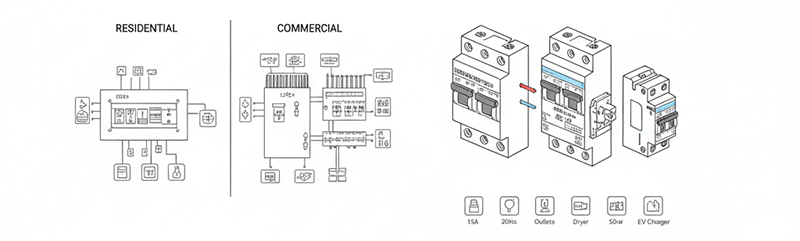
Residential & Commercial Terminal Protection
For everyday loads, precision and safety are paramount.
Common Household Ratings (10A – 63A)
- 10A: Standard for lighting circuits and small electronics.
- 20A: Required for “high-demand” areas like kitchens and bathrooms (must use 12-gauge wire).
- 32A – 50A: Dedicated to heavy appliances (Dryers, Ovens, EV Chargers).
- 63A: Main switches or high-power heat pump units.
RCD/RCCB (Leakage Protection)
Protects against electric shock and electrical fires. Standard widths are 35mm for 2P and 70mm for 4P units.
Industrial & Heavy Distribution (MCCB Selection)
Frame size tiers categorize molded Case Circuit Breakers (MCCB):
- Small Frame (16A – 250A): Used for lighting panels and small motor protection. Usually 90mm (W) x 150mm (D) x 200mm (H).
- Medium Frame (250A – 630A): The core of commercial distribution. Features electronic trip units and BMS communication. Usually 120mm (W) x 180mm (D) x 250mm (H).
- Large Frame (630A – 1600A): Protects main busbars and heavy industrial loads. Offers advanced metering and ground fault protection. 1600A units can be up to 300mm (W).
The “Golden Rules” of Professional Installation
The 80% Continuous Load Rule
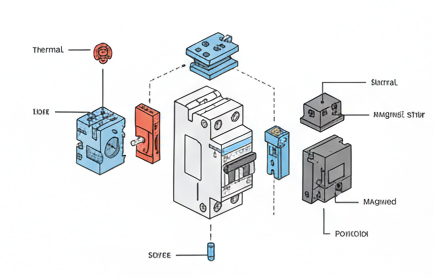
Circuit breakers are precision thermal-magnetic devices. According to the National Electrical Code (NEC) and IEC standards, any load operating for three hours or more is classified as a “continuous load.” Because these devices generate internal heat over time, running them at 100% of their nameplate rating will eventually reach the breaker’s thermal tripping point, even in the absence of a fault.
To maintain Thermal Equilibrium, a safety buffer is required: a 20A breaker should handle no more than 16A of continuous load, and a 100A MCCB should be capped at 80A. Neglecting this rule is the leading cause of “nuisance tripping,” where the system loses power simply due to heat accumulation rather than a genuine short circuit.
Wire-First Principle
A critical misconception in electrical safety is that a breaker exists to protect the end-device. In reality, the circuit breaker is a guardian of the building’s wiring. The principle of Infrastructure Integrity dictates that the trip setting must always be less than or equal to the “ampacity” of the smallest wire in the circuit.
For instance, a 20A breaker must be paired with at least a 12-gauge wire. If an installer mistakenly places a 20A breaker on a 14-gauge wire, the wire effectively becomes a heating element inside the walls. The insulation may melt or ignite before the breaker ever senses an overload, making this mismatch a primary driver of electrical fires in both residential and industrial settings.
Environmental Derating
Precision calibration for circuit breakers typically occurs in controlled environments at a standard ambient temperature of 40°C (104°F). However, real-world conditions often demand Environmental Adaptability.
When an electrical panel is situated in an uncooled factory or a high-temperature desert region, the breaker’s effective capacity must be “derated” to prevent premature failure. This effect is compounded when multiple breakers are mounted tightly in a distribution board. This “Grouping Effect” causes them to share heat, further reducing their efficiency. In such cases, professional engineers apply a derating factor (typically between 0.7 and 0.9).
Conclusion
Understanding circuit breaker sizing is a meticulous blend of calculating load currents, verifying fault levels, and adhering to strict international standards. Choosing the right frame and amperage ensures your system remains efficient, stable, and—most importantly—safe.
Are you planning a new electrical installation or upgrading your current system? Trust Westhomes to deliver the reliability and expertise your project demands. Our products are engineered to exceed IEC safety standards. Explore our full range of circuit protection products or contact our technical team today to find the perfect fit for your environment.