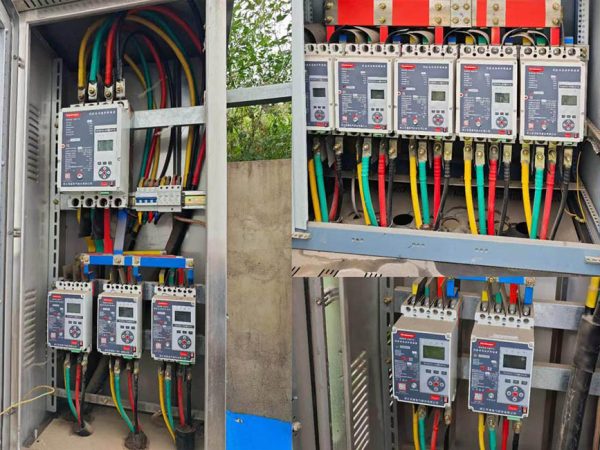
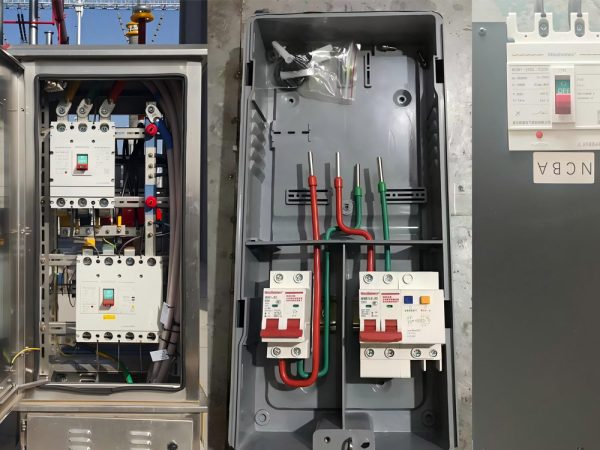
GL Type 100A 3P/4P Circuit Isolator | Modular Terminal Disconnect Switch
Industrial GL Type Isolator Switch – Heavy-Duty Power Isolation for 3-Phase Industrial Applications.
Get quick appointment for technical support!

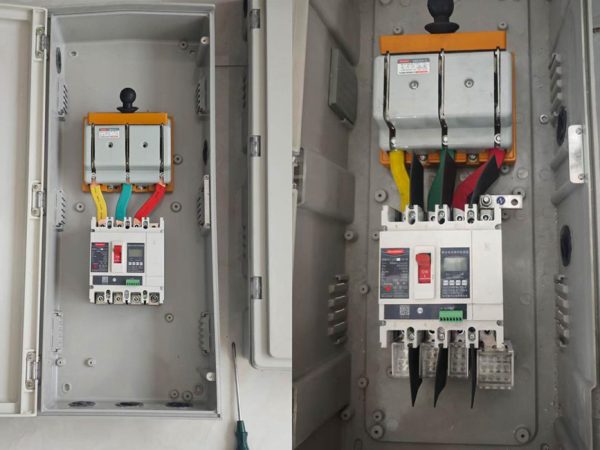
Industrial GL Type Isolator Switch 3P 4P 100A – AC400V power disconnector. 20kA short-time withstand. DIN rail mount. Reliable isolation for industrial machinery.


Industrial GL Type Isolator Switch – Heavy-Duty Power Isolation for 3-Phase Industrial Applications.

The Industrial GL Type Isolator Switch is a high-performance power disconnector designed for safe and reliable electrical isolation in industrial, commercial, and infrastructure installations. Engineered for durability and safety, this switch ensures complete circuit disconnection for maintenance and emergency shutdowns across three-phase systems.
Key Features:
Wide Current Range: Available from 20A up to 3200A, with the 100A model being ideal for medium-sized industrial loads, machinery, and distribution boards.
Flexible Pole Configurations: Choose between 3P (three-pole) for three-phase loads or 4P (four-pole) for systems requiring neutral disconnection, providing maximum installation flexibility.
High Insulation Voltage: Rated insulation voltage of 400V AC, ensuring high safety standards and reliable performance in industrial electrical systems.
Robust Short-Time Withstand Capacity: Withstands short-time currents up to 20kA, providing excellent protection against overcurrent and fault conditions without damage.
Applications:
Main isolating switches for industrial machinery
Distribution board incomers
Motor control centers (MCC)
Commercial building power supplies
| Items | Parameters | ||||||||||
| Shell Frame Rated Current Inm(a) |
100 | 160 | 250 | 400 | 630 | 800/1000 | 1250 | 1600 | 2000 | 2500 | 3200 |
| Rated Current In(a) | 20、25、32、 40、50、63、 80、100 |
20、25、32、 50、63、80、 100125、160 |
125、160、 200、225、250 |
400、500、630 | 400、500、630 | 800、1000 | 1250 | 1600 | 2000 | 2500 | 3200 |
| Poles | 3P/4P | 3P/4P | 3P/4P | 3P/4P | 3P/4P | 3P/4P | 3P/4P | 3P/4P | 3P/4P | 3P/4P | 3P/4P |
| NominalInsulation Voltage Ui(v) |
800 | 800 | 800 | 800 | 800 | 800 | 800 | 800 | 800 | 800 | 800 |
| Rated Operational Voltageue(m) |
AC400V | AC400V | AC400V | AC400V | AC400V | AC400V | AC400V | AC400V | AC400V | AC400V | AC400V |
| Rated Impulse Withstand Voltage Uimp(kv) |
6 | 8 | 8 | 8 | 8 | 8 | 8 | 8 | 8 | 8 | 8 |
| Rated Short Time Current Icw(ka/1s) |
5 | 10 | 12 | 20 | 20 | 20/H type 40 | 20/H type 40 | 20/H type 40 | 40 | 40 | 40 |
| Rated Short-circuit Ability Lcm(ka) |
8.5 | 17 | 24 | 40 | 40 | / | / | I | 84 | 84 | 84 |
| Use Classes | AC-21B、 AC-22B |
AC-21B AC-22B |
AC-21B AC-22B |
AC-21B AC-22B |
AC-21B AC-22B |
AC-20A | AC-20A | AC-20A | AC-21B、 AC-22B |
AC-21B、 AC-22B |
AC-21B、 AC-22B |
| Boundary Dimension(mm) |
85/108 | 140/170 | 180/230 | 230/290 | 230/290 | 378/498 | 378/498 | 378/498 | 378/498 | 378/498 | 378/498 |
| 106 | 135 | 170 | 240 | 260 | 312 | 338 | 338 | 455 | 455 | 505 | |
| 96 | 116 | 128 | 169 | 169 | 240 | 240 | 240 | 340 | 340 | 340 | |
| Mounting Dimension(mm) |
32.5/54 | 120/150 | 160/210 | 210/270 | 210/270 | 353/473 | 353/473 | 353/473 | 353/473 | 353/473 | 353/473 |
| 58 | 65 | 90 | 140 | 140 | 280 | 280 | 280 | 280 | 280 | 280 | |
| Selling Units | Single item |
| Quantity (pieces) | 1 – 6 | > 6 |
| Lead time (days) | 15 | To be negotiated |
| Rated Voltage | 400 V |
| Material | Copper |
| Place of Origin | Zhejiang, China |
| Type | Switches |
| Model Number | GL-100 |
| Brand Name | Westhomes |
A circuit isolator is a mechanical switching device that provides a safe, visible open gap between the supply and the equipment when open, so that maintenance can be performed on a dead circuit. The GL Type 100A is a low-voltage isolating switch rated up to 100 A, available in 3P and 4P configurations.
It depends on its exact rating: a device called a "switch-disconnector" may be rated for limited load break, while a pure disconnector must only be opened off-load. Because the naming varies, always check the nameplate/IEC 60947-3 category — if it is not rated for on-load operation, switch off the circuit (or open an upstream device) before isolating.
A 3P isolator breaks the three phase conductors, leaving the neutral continuous; a 4P isolator also breaks the neutral. Use 4P when the installation requires the neutral to be fully isolated for safety or measurement, and 3P when the neutral must remain connected to avoid losing downstream reference.
The 100 A rating is the maximum continuous current the isolator can carry at rated ambient temperature. Size the connected cables and lugs to at least this current and match them to the terminal capacity, and keep the actual circuit load below 100 A so the switch does not overheat.
When opened, the moving contacts withdraw a defined physical distance from the fixed contacts — often visible through an inspection window or confirmed by the handle position. Under IEC 60947-3, this gap must meet isolation (overvoltage and creepage) requirements so it can be relied on as the point of disconnection for safety.
Fix the isolator to the panel backplate or appropriate rail, connect line and load conductors to the marked terminals with correctly sized lugs tightened to nameplate torque, and earth the enclosure. Ensure the operating handle is accessible and its ON/OFF indication is unambiguous after the door is closed.
Inspect contacts and the visible gap, check for overheating at terminals (infrared or thermal check), retighten connections, and operate the mechanism to confirm it moves crisply without stiffness. In dusty or damp industrial environments, keep the enclosure sealed and clean to preserve both contact life and the isolating gap integrity.
An MCB switches and protects a circuit but does not always provide a clearly visible isolating gap, so for formal isolation a dedicated isolator or switch-disconnector is often required. The isolator gives a certified, visible break, while the MCB provides automatic overcurrent protection — they frequently complement each other in the same panel.
Common uses are local isolation for machine control panels, sub-main switch isolation in distribution boards, isolation of smaller three-phase loads and MCCBs/contactors upstream of equipment, and as a maintenance disconnect where load switching is occasional. Its 100 A rating suits smaller industrial feeders and machine supplies.
It is governed by IEC 60947-3, which classifies switches and disconnectors and sets the requirements for the isolating function — including the clearances, creepage distances, and impulse withstand that make an "OFF" position a safe isolation point. A device that satisfies these requirements is designated as an isolating device (symbol often shown on the nameplate).
* indicates a required field

 155 MB