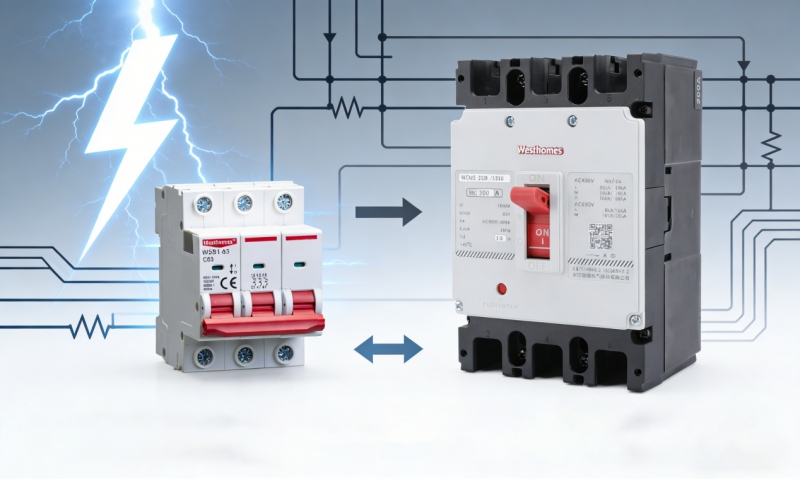
What Is the Difference Between MCB and MCCB?
| Comparison Item |
MCB |
MCCB |
| Full Name |
Miniature Circuit Breaker |
Molded Case Circuit Breaker |
| Main Function |
Protects circuits against overload and short circuit |
Protects circuits against overload and short circuit, while some models also support ground fault protection |
| Rated Current Range |
Usually 6A to 125A |
Usually 100A to 2500A |
| Breaking Capacity |
Generally 6kA to 10kA |
Generally 25kA to 100kA or higher |
| Protection Settings |
Usually fixed and not adjustable |
Adjustable in most models |
| Size |
Smaller, modular design |
Larger |
| Installation Method |
Usually installed in DIN rail distribution boards |
Usually installed in distribution cabinets or panels |
| Application Scenarios |
Homes, offices, lighting circuits, and small equipment |
Industrial systems, large buildings, motors, and main power distribution systems |
| Cost |
Lower |
Higher |
| Maintenance and Operation |
Easy to install and maintain |
Installation and commissioning are more complex |
What Are RCB, RCD, and RCCB?
RCB
RCB, which stands for Residual Current Breaker, is a device that detects residual current in a circuit and cuts off the power supply under abnormal leakage conditions. Residual current is the difference between the outgoing current and the returning current. Under normal operation, the live and neutral currents are equal, but leakage through the human body or grounding will create an imbalance.
Based on a current transformer, RCB monitors the current balance. When leakage occurs, the magnetic flux becomes unbalanced and generates a signal to trigger the trip mechanism, disconnecting the circuit quickly.
RCB is widely used in residential, commercial and equipment protection to prevent electric shock and fire caused by leakage. However, RCB does not provide overload or short circuit protection, so it must be used with other circuit breakers.
RCD
RCD, which stands for Residual Current Device, is a general term for leakage protection devices, including RCCB and RCBO. It monitors the current difference between live and neutral conductors and trips rapidly when abnormal leakage is detected.
The working principle is similar to RCB: it detects current imbalance and disconnects the circuit once leakage reaches a preset value such as 30mA, 100mA or 300mA.
RCD is widely used in household distribution, bathrooms, kitchens, outdoor sockets, power tools and industrial equipment. It provides effective anti-shock protection with fast response. However, most RCDs do not offer overload or short circuit protection alone and are usually used together with MCB.
RCCB
RCCB, which stands for Residual Current Circuit Breaker, is a typical type of RCD used for leakage protection and electric shock prevention.
It detects current imbalance between live and neutral conductors through an internal current transformer. Once the leakage exceeds the set value, the trip mechanism operates immediately to cut off power.
RCCB is widely applied in residential, commercial, industrial and public places, especially in high-risk areas such as kitchens, bathrooms and outdoor power supplies. It is sensitive, fast and reliable, but does not protect against overload or short circuit. Therefore, it is often used with MCB or MCCB to form a complete protection system.
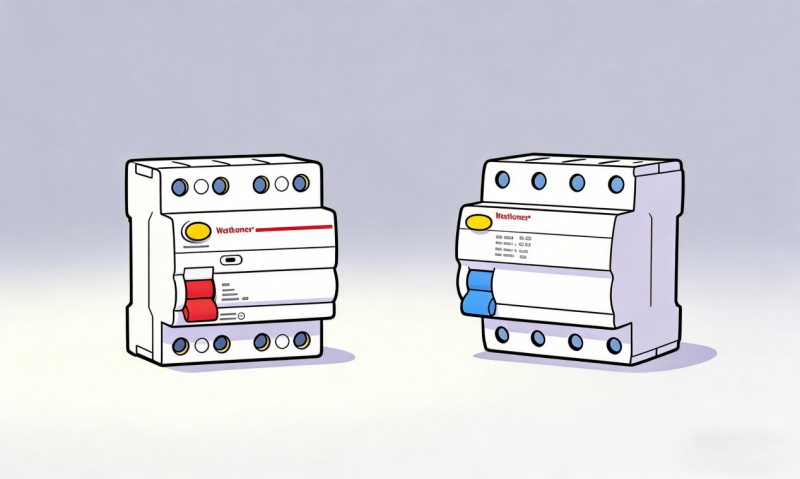
What Is the Difference Between RCB, RCD, and RCCB?
| Comparison Item |
RCB |
RCD |
RCCB |
| Full Name |
Residual Current Breaker |
Residual Current Device |
Residual Current Circuit Breaker |
| Definition |
A broad term for protective devices that detect leakage current and disconnect the circuit |
A general term for devices that detect current imbalance and disconnect the power supply, which includes multiple types |
A specific type of leakage protection circuit breaker |
| Whether It Is a General Term |
Usually used as a general name |
Yes, it is the most common broad term |
No, it is a specific type of RCD |
| Main Function |
Detects residual current and disconnects power when leakage occurs |
Detects leakage and provides electric shock protection |
Detects leakage and disconnects the circuit automatically |
| Whether It Provides Overload or Short Circuit Protection |
Usually no |
Usually no |
No, and it needs to be used with MCB |
| Working Principle |
Detects the current difference between the live conductor and the neutral conductor |
Detects current imbalance through a current transformer |
Detects residual current through a current transformer |
| Common Rated Leakage Current |
30mA, 100mA, 300mA |
30mA, 100mA, 300mA |
30mA, 100mA, 300mA |
| Typical Applications |
Electrical safety protection systems |
Household and industrial leakage protection systems |
Residential and commercial building distribution systems |
| Coordination with Other Breakers |
Usually used with MCB or MCCB |
Usually used with MCB or MCCB |
Usually used together with MCB |
What Is RCBO?
RCBO integrates both residual current leakage protection and overcurrent protection. It combines the functions of RCCB and MCB in one unit, automatically cutting off power under leakage, overload, or short circuit to provide comprehensive electrical protection. It is widely used in modern distribution systems requiring high safety levels.
RCBO uses both residual current detection and thermal‑magnetic tripping. A current transformer monitors the balance between live and neutral current. If leakage causes an imbalance, it triggers rapid tripping.
RCBO is widely used in residential, commercial, and light industrial systems, especially where both leakage and overcurrent protection are needed. Common applications include household socket, kitchen, bathroom, and outdoor circuits. It is also used in commercial buildings to protect important equipment and improve electrical safety.
RCBO offers high functional integration, eliminating the need for separate RCCB and MCB, simplifying wiring and reducing components. It provides independent protection for each circuit, so only the faulty circuit is disconnected while others remain unaffected, improving system reliability.
RCBO is more expensive due to its complex structure and functions. It is also larger than a single MCB, which can be a limitation in small distribution boards. If the unit fails, the whole device often needs replacement rather than just one module, increasing maintenance cost.
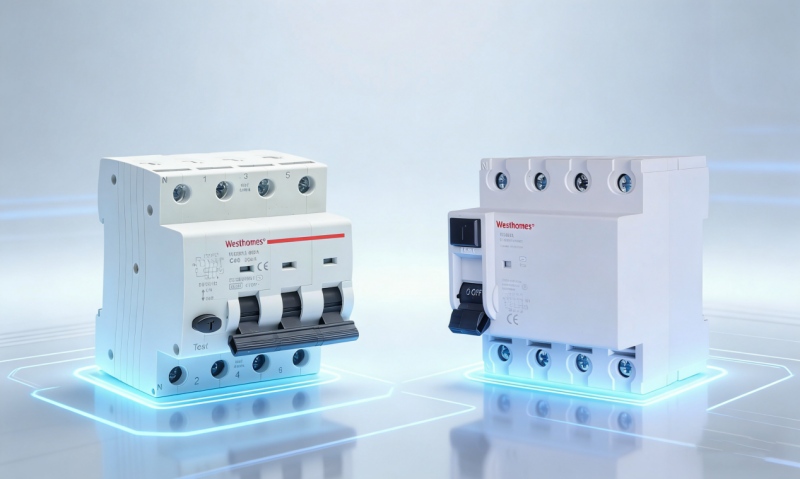
MCB vs. MCCB vs. RCB, RCD, RCCB vs. RCBO
| Comparison Item |
MCB |
MCCB |
RCB, RCD, RCCB |
RCBO |
| Full Name |
Miniature Circuit Breaker |
Molded Case Circuit Breaker |
Residual Current Breaker, Residual Current Device, Residual Current Circuit Breaker |
Residual Current Circuit Breaker with Overcurrent Protection |
| Chinese Name |
Miniature Circuit Breaker |
Molded Case Circuit Breaker |
Leakage protection device or residual current circuit breaker |
Residual current circuit breaker with overcurrent protection |
| Main Function |
Overload protection and short circuit protection |
Overload protection and short circuit protection |
Leakage protection and electric shock protection |
Leakage protection, overload protection, and short circuit protection |
| Detects Leakage |
No |
No |
Yes |
Yes |
| Provides Overload Protection |
Yes |
Yes |
No |
Yes |
| Provides Short Circuit Protection |
Yes |
Yes |
No |
Yes |
| Rated Current Range |
Usually 6A to 125A |
Usually 100A to 2500A |
Commonly 16A to 125A |
Commonly 6A to 63A or higher |
| Breaking Capacity |
About 6kA to 10kA |
About 25kA to 100kA or higher |
Generally lower |
Similar to MCB |
| Protection Settings |
Usually not adjustable |
Adjustable in most models |
Usually not adjustable |
Usually not adjustable |
| Main Use |
Household lighting, power sockets, and small equipment |
Industrial power distribution systems and large equipment |
Preventing electric shock and leakage fires |
Providing comprehensive protection for individual circuits |
| Typical Installation Location |
Residential distribution boards |
Industrial distribution cabinets |
Used in distribution boards together with MCB |
Residential or commercial distribution boards |
| Cost |
Low |
Higher |
Medium |
Higher |
| Usage Features |
The most common circuit protection breaker |
Used for high current and industrial systems |
Specifically used for leakage protection |
Integrates multiple protection functions |
How to Choose the Right Circuit Breaker?
When choosing a circuit breaker, first consider the load current and rated current. The rated current should be slightly higher than the normal operating current, ensuring stable operation and timely protection during faults. Household circuits usually use small MCBs, while industrial systems need higher-rated MCCBs.
Select the protection functions based on possible faults. For overload and short-circuit protection, choose MCB or MCCB. For electric shock or leakage risks (kitchens, bathrooms, outdoors), use RCCB or RCBO. For full protection (leakage, overload, short circuit), RCBO is the most comprehensive solution.
Check the breaking capacity, which is the maximum short-circuit current the breaker can safely interrupt. High short-circuit environments such as industrial sites require breakers with high breaking capacity, typically MCCBs.
Also consider the installation environment and space. Compact devices like MCB or RCBO suit home and small commercial distribution boards. Large distribution cabinets and industrial systems prefer MCCB for higher capacity and performance.
Balance cost, maintenance and reliability. Although RCBO is more expensive, its integrated functions reduce components and improve safety. The final choice should match the system scale, safety requirements and budget for long-term safe and stable operation.
Conclusion
MCB, MCCB, RCB, RCD, RCCB, and RCBO are all common protective devices in electrical systems, but their functions and application scenarios are different. In practical applications, the right circuit breaker should be selected according to the circuit current, the operating environment, and the required level of safety, so that the electrical system can operate safely, stably, and efficiently.
Westhomes offers a wide range of circuit breakers. Please visit our product page to find the product that suits your needs.
FAQs
Q Can MCB and MCCB replace each other?No, they cannot fully replace each other. MCB is for low-current residential and small commercial use, while MCCB is for high-current industrial systems.
Q Can RCCB and MCB be used together?
Yes, they are often used together. RCCB provides leakage protection, and MCB offers overload and short-circuit protection, forming complete protection.
Q What is the difference between RCBO and RCCB?
RCCB only protects against electric leakage. RCBO combines leakage, overload, and short-circuit protection in one device.
Q Why do household circuits need leakage protection devices?
They quickly cut off power when leakage or electric shock occurs, preventing electric shock and fires caused by current leakage.
Q Is RCBO better than MCB?
RCBO is not always better, but it has more complete protection. It adds leakage protection compared with MCB, though it costs more. It is better for high-safety circuits.

