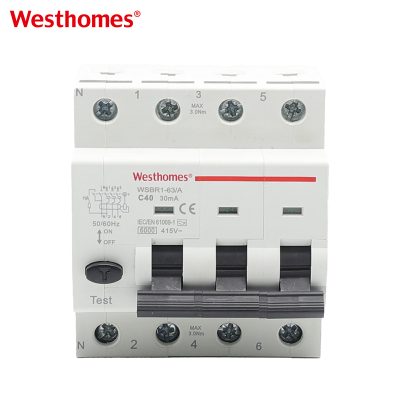
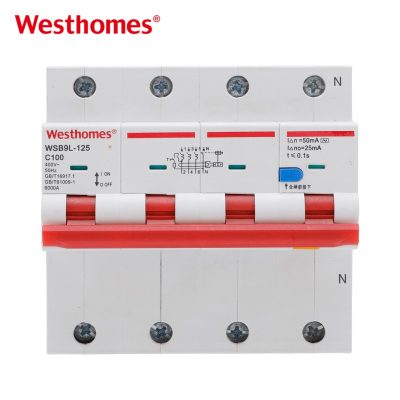
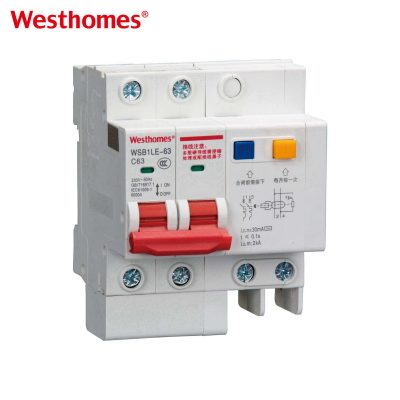
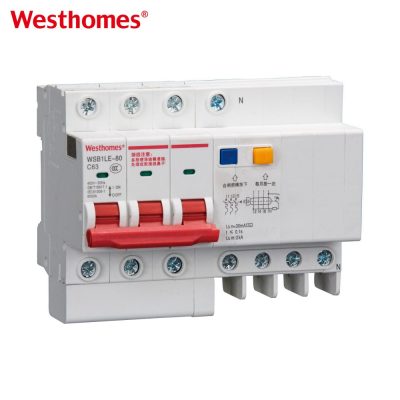
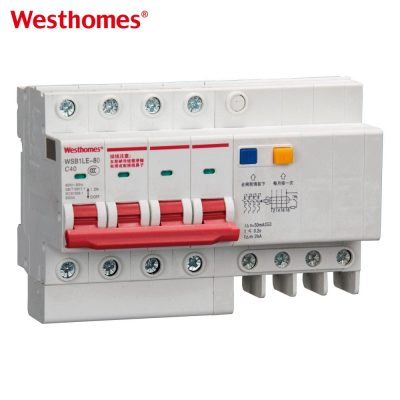
WSB1-80 Moulded case circuit breaker
WSB1-80 series MCB is one of updated type MCCBs researched and developed by the company by using advanced design and manufacture technology internationally.
Get quick appointment for technical support!

WSB1-80 series MCB is one of updated type MCCBs researched and developed by the company by using advanced design and manufacture technology internationally.



WSB1-80 series MCB is one of updated type MCCBs researched and developed by the company by using advanced design and manufacture technology internationally.
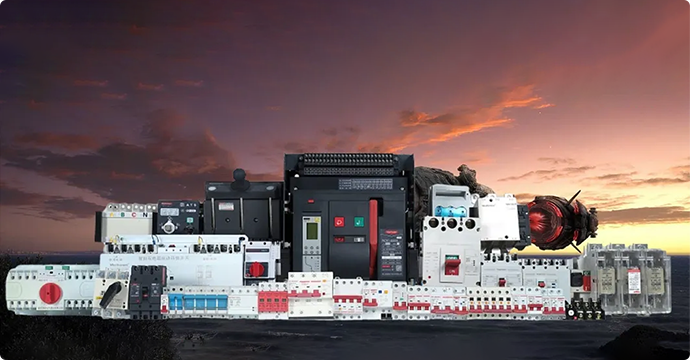
WSB1-80 series MCBs are mainly applied at lines of AC 50Hz or 60Hz, rated operation voltage AC230/400V, rated current upto 80A, for overload and short circuit protection to the lines, also for changeover of infrequent operation to the lines. The MCBs are used at places of commercial office building, residential and similar building etc.
The product meets standards of GB 10963.1 and IEC 60898-1, at international advanced level.

| Frequency | 50Hz/60Hz |
| Pole | 1, 2, 3, 4 |
| Voltage | AC230V/400V |
| kA | 6kA, 10kA |
| Amps | 6, 10, 16, 20, 25, 32, 40, 50, 63,80 |
| Width | 18, 36, 54, 72mm |
| Mounting | Din rail |
| Standard | IEC/EN 60898 |
| Item No. | WSB1-80 |
| Rated current In(A) | 6, 10, 16, 20, 25, 32, 40, 50, 63,80 |
| Pole number | 1P, 2P, 3P, 4P |
| Trip characteristics | C type(5-10In); D type(10-20In) |
| Rated insulating voltage Ui(V) | 690 |
| Rated operating voltage Ue(V) | AC230V/AC400V |
| Rated impulse voltage Uimp(kV) | 4 |
| Breaking capacity Icu(kA) | 6 |
| Mechanical life(times) | 20000 |
| Electrical life(times) | 4000 |
| No. | Rated current | Initial state | Test current | Time limit | Expected result |
| 1 | In≤63 | Cold state | 1.13In | t≤1h | Not tripping |
| In>63 | t≤2h | ||||
| 2 | In≤63 | Just followed the last test item | 1.45In | t<1h | Tripping |
| In>63 | t<2h | ||||
| 3 | In≤32 | Cold state | 2.55In | 1s | Tripping |
| In>32 | 1s | ||||
| 4 | Type C | Cold state | 5In | t≤0.1s | Not tripping |
| 10In | t<0.1s | Tripping |

A 2P MCB opens both the line (L) and neutral (N) conductors of a single-phase circuit at the same time. It is preferred over a 1P breaker for main incomers, cooker circuits, shower circuits, garage and outbuilding supplies, and any installation where full pole-to-neutral isolation is needed during maintenance. It also prevents "neutral-only" voltage surprises that can occur if the neutral becomes open upstream.
Yes. The thermal element (bimetal) responds to RMS current and is essentially frequency-independent, and the magnetic solenoid coil has enough margin to operate correctly at both 50 Hz and 60 Hz. The same WSB1-80 2P breaker can therefore be deployed on 50 Hz mains (e.g. Europe, China, most of Asia) and on 60 Hz mains (e.g. North America, parts of South America and Asia) without derating.
Each pole contains a current path through a bimetallic heater and an electromagnet coil. Under mild overload the bimetal heats, bends and releases a latch after a delay that depends on how far the current exceeds In. Under short circuit, the high current pulls the solenoid armature instantly, tripping the common mechanism. A mechanical tie between the two poles ensures both contacts open together.
The WSB1-80 series is available in 6 kA and 10 kA breaking capacities at 230/400 V AC. For a 2P single-phase breaker this is the maximum prospective short-circuit current across L–N that the unit can safely interrupt. Homes fed by a typical 100–250 kVA transformer usually see a PSCC well below 6 kA, while urban apartments fed through a large transformer may need the 10 kA version.
Use the standard rule Ib ≤ In ≤ Iz: Ib is the load design current, In is the MCB rating, and Iz is the cable's current-carrying capacity. For a 2P house main, a common choice is 40 A or 63 A depending on the incoming supply fuse, while 2P cooker or shower breakers are typically 32 A or 40 A matched to the rated current of the appliance and the cable size.
B-curve (3–5 In magnetic trip) suits domestic lighting, socket-outlet and general resistive circuits. C-curve (5–10 In) is the safe default for mixed commercial loads, small refrigeration, boilers and pumps. D-curve (10–20 In) is reserved for loads with very high start-up current, such as large air-conditioning compressors, transformers and bench tools. For a 2P main incomer in a typical home, B or C is appropriate.
Yes. The series is manufactured and type-tested to IEC 60898-1, which defines the tripping thresholds, temperature rise, impulse withstand, endurance and short-time withstand requirements for household MCBs. CE marking on the nameplate confirms conformity with the applicable EU low-voltage and EMC directives, so the breaker can be legally installed in EU/EEA distribution boards.
Connect the supply live (L) and neutral (N) to the top (line) terminals, matching the L and N markers on the front of the breaker. Connect the load L and N to the bottom terminals. The breaker is not polarity-sensitive inside, but keeping L on the marked pole and observing line-in-from-top ensures the arc chute works as designed. Always isolate the upstream supply before wiring.
It is a workhorse for single-phase domestic and light-commercial distribution: main incomer in residential consumer units, dedicated 2P feed to an electric shower, cooker, immersion heater or air-conditioner, double-pole isolation for a garage or summer house, and branch protection in small commercial switchboards. Its 50/60 Hz rating also makes it convenient for export projects spanning different regional grids.
MCBs are sealed, no-maintenance devices under normal conditions, but good practice is to: (a) check that the toggle moves freely once or twice a year; (b) inspect for discoloration, cracking or buzzing; (c) retorque terminals to the nameplate value every few years, especially if the installation has experienced several fault trips; and (d) replace the breaker after any short-circuit interruption near its rated breaking capacity, because the contacts and arc chute may be worn even if the unit still operates.
* indicates a required field

 2 MB