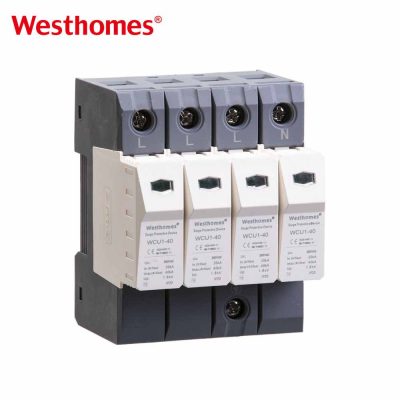
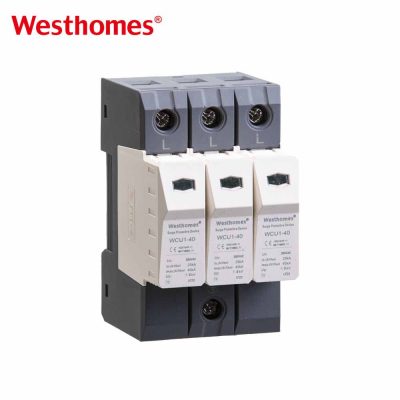
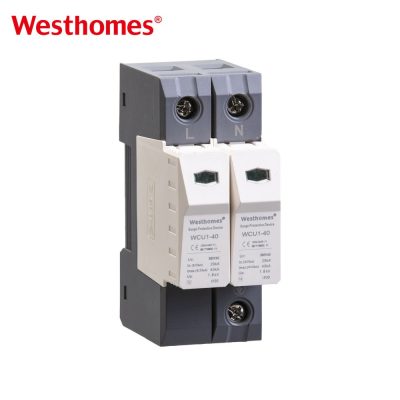
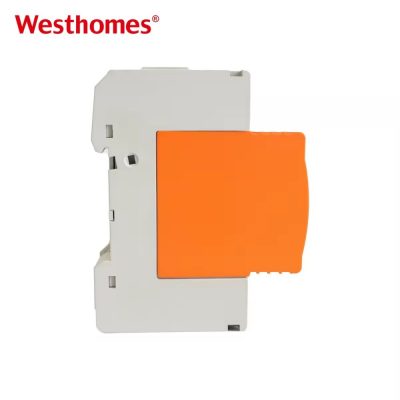
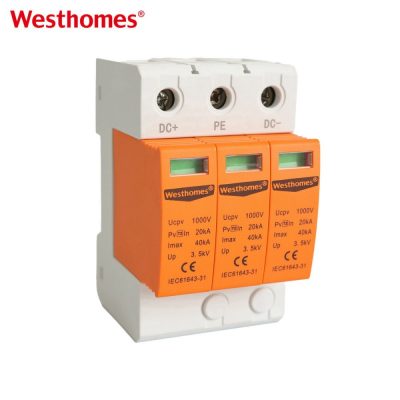
WCU8-D 1P 20kA DIN Rail Surge Protection Device
Enhance your electrical safety with the Westhomes WCU8-D 1p 20ka SPD, a smart and scalable surge protection solution for modern electrical infrastructures.
Get quick appointment for technical support!

With a maximum discharge current (Imax) of 20kA, the WCU8-D offers dependable surge suppression performance for single-phase applications, is also ideal for terminal protection where refined voltage control is critical.


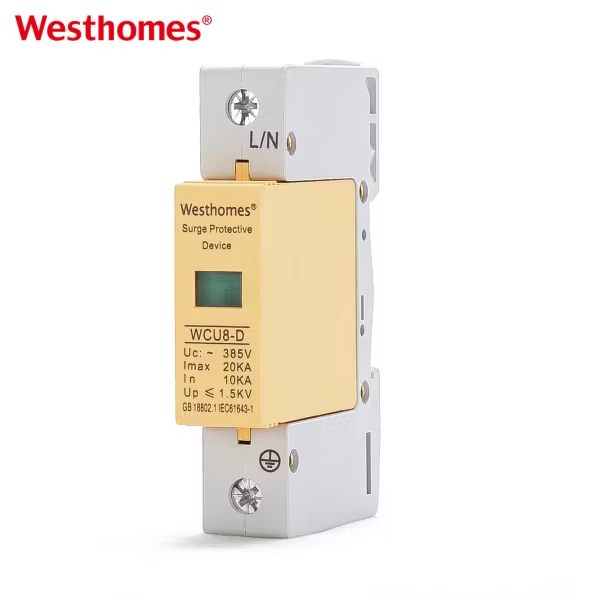
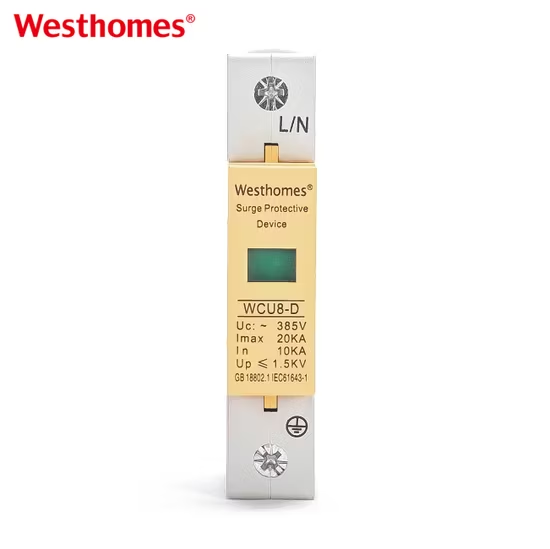
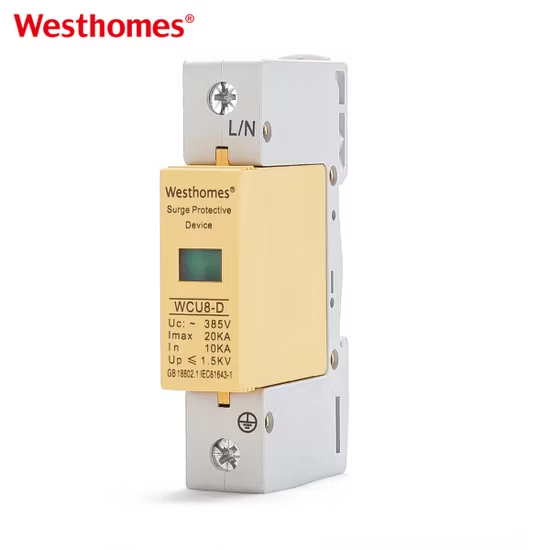
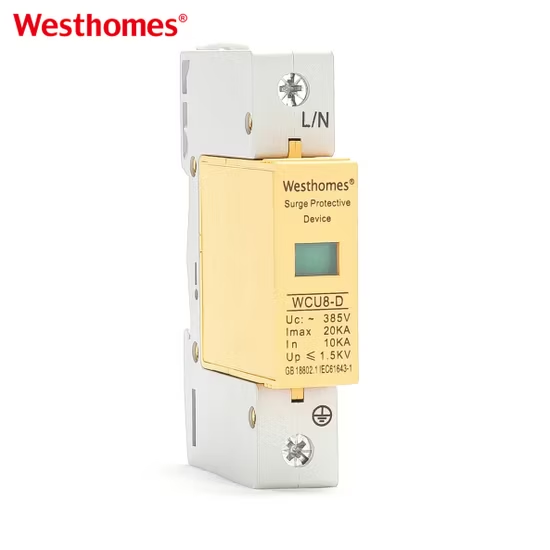
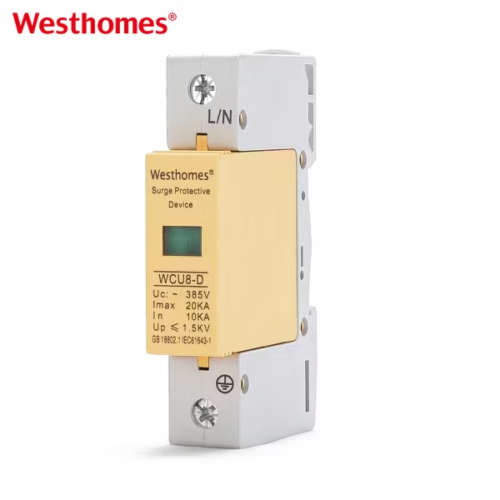
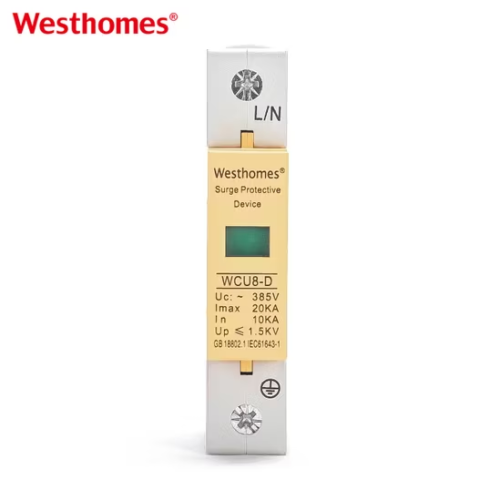
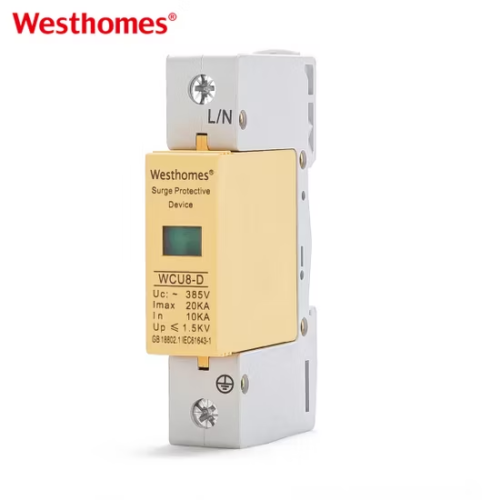
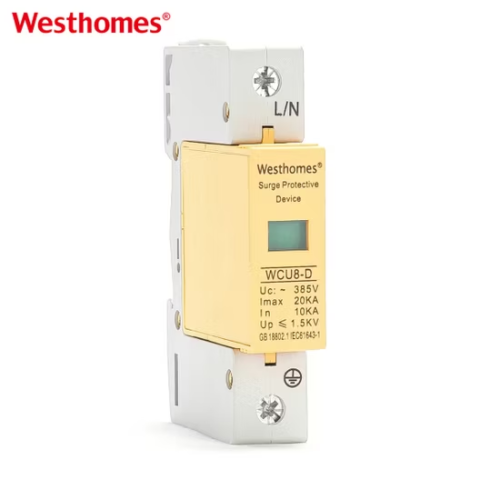
Enhance your electrical safety with the Westhomes WCU8-D 1p 20ka SPD, a smart and scalable surge protection solution for modern electrical infrastructures.
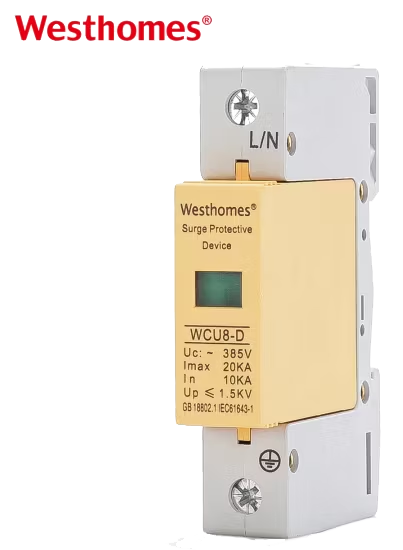
The Westhomes WCU8-D Surge Protection Device (SPD) is a compact and reliable 1-pole (1P) surge arrester engineered for DIN rail mounting, ideal for AC 50Hz/60Hz power systems with 230V and 400V operational voltage.
Designed for both residential and light commercial use, this SPD provides targeted protection against transient over-voltages caused by lightning surges and switching operations.
It acts as the first line of defense in safeguarding sensitive electronics like televisions, computers, sound systems, air conditioners, and other household appliances by minimizing over-voltage exposure and extending equipment lifespan.
Its modular structure allows easy integration into existing power panels and compatibility with digital and analog protective devices.
Mounting Style: Standard DIN rail
Application: Surge protection for residential and light commercial systems
Protected Devices: TVS, PCS, air conditioners, audio systems, and more
Compatibility: Works with modular and digital protection modules
Installation Location: Power panels, control cabinets, or terminal circuits
| Model | WCU8-D10 | WCU8-D20 | WCU8-C30 | WCU8-C40 | WCU8-C60 | WCU8-B80 | WCU8-B100 |
| Rated operation voltage Uo | 230V/400V | 230V/400V | 110V/230V/400V | 230V/400V | 230V/400V | 230V/400V | 230V/400V |
| Max continuous operation voltage Ue | 275V/385V | 320V/385V | 320V, 400V, 420V, 440V | 140V, 320V, 400V, 420V, 440V | 320V, 385V, 420V | 320V, 385V, 420V | 320V, 385V, 420V, 440V |
| Holding level Up | 0.7/1.0kV | 1.2/1.5kV | 1.4/1.8kV | 1.4/2.0kV | 1.5/2.0kV | 2.0/2.4kV | 2.2/2.8kV |
| Max discharge current Imax | 10kA | 20kA | 30kA | 40kA | 60kA | 80kA | 100kA |
| Nominal discharge current | 5kA | 10kA | 15kA | 20kA | 30kA | 40kA | 60kA |
| Response time S | <25 | ||||||
| Operation environment | -40ºC~+85ºC | ||||||
| Selection area of enter wire | 6mm2 | 6mm2 | 10mm2 | 10mm2, 16mm2 | 10mm2, 16mm2 | 10mm2, 16mm2 | 16mm2, 25mm2 |
| Section area of enter ground lead mm2 | 10mm2 | 10mm2 | 16mm2 | 10mm2, 25mm2 | 16mm2, 25mm2 | 25mm2 | 25mm2, 35mm2 |
| Type selection of fuse, circuit breaker | 10A, 16A | 16A, 25A | 25A, 32A | 32A | 32A, 63A | 63A | 63A |
| Model NO. | WCU8-D |
| Arc-extinguishing Medium | Air |
| Structure | SPD |
| Type | Circuit Breaker |
| Certification | ISO9001-2000, CE, CB, CCC |
| Ka | 20kA |
| Production Line | 100% Automatic |
| Payment | L/C, T/T, D/P, Western Union, Paypal, Money Gram |
| Transport Package | Paper Box |
| Origin | Prc |
| Production Capacity | 15, 000, 000 |
| Speed | Normal Type Circuit Breaker |
| Installation | DIN Rail |
| Poles Number | 1p |
| Function | Conventional Circuit Breaker, Circuit-Breaker Failure Protection, Overcurrent Protection, OVP(Overvoltage Protection) |
| Voltage | AC230V/400V |
| AMPS | 6, 10, 16, 20, 25, 32, 40, 50, 63, 80, 100, 125 |
| Factory | Own |
| Cooperation Type | ODM/OEM |
| Trademark | Westhomes |
| HS Code | 8536200000 |
It is a single-pole (phase-to-neutral/phase-to-earth) Type 2 DIN-rail surge arrester rated at 20 kA Imax, designed for single-phase domestic and light-commercial distribution boards. It protects a single incoming phase, making it ideal for homes, apartments, shops and small offices where the supply is 230 V single-phase. It mounts inside the consumer unit next to the MCBs rather than as a plug-in strip.
DIN rail mounting means the device clips onto the standard 35 mm-wide top-hat rail (EN 60715) found inside almost all modular consumer units. It slots in beside your MCBs/RCDs and removes by releasing the bottom latch, so no screws are needed. If your distribution board has spare modular ways on the rail, this SPD will fit directly.
A 4P SPD is built for three-phase boards with L1, L2, L3 and N; on a single-phase supply most of its poles would be unused and it would waste board space and cost. A 1P (or 1P+N) SPD is sized exactly for one live conductor, fits in one modular way, and clamps surge between line and neutral/earth. Choose 1P for single-phase dwellings and 4P only for three-phase commercial supplies.
It absorbs and diverts repetitive switching transients (from lifts, elevators, air-conditioning compressors, pumping equipment and power-factor correction) and lightning surges induced on overhead lines near the home. The 8/20 µs, 20 kA rating reflects this distribution-board duty. It is not a Type 1 arrester for direct strike current — that needs a separate service-entrance class device.
Under IEC 61643-11, a Type 2 (Class II) SPD is installed at distribution/sub-boards to absorb residual surge energy after the service entrance. It is tested with the 8/20 µs current wave using In and Imax. It is normally placed as the main surge stage in a domestic board; Type 3 point-of-use protectors may then be added later on IT/server circuits.
Connect the SPD across the supply terminals using the shortest possible cables (ideally under 0.5 m), avoid sharp bends, and provide a dedicated, solid earth bond to the board's PE bar — an SPD without reliable earthing offers no protection at all. Use the conductor cross-sections stated in the manual, and fit the manufacturer-recommended upstream backup device. All work should be done by a licensed electrician with the supply isolated.
An MCB provides overload and short-circuit protection by interrupting overcurrent; an RCD trips on current imbalance to earth for personal safety. Neither responds to nanosecond-scale voltage spikes. The SPD clamps transient overvoltage to a safe level without tripping and leaves normal supply intact. A correctly protected single-phase board contains all three: MCBs for circuits, an RCD for safety, and the SPD for surges.
Green means the metal-oxide varistor is healthy and the device is actively clamping. Red (or a visible flag) means the integral thermal disconnector has opened, usually after absorbing a large surge, and the module must be replaced — the home is then unprotected even though lights and sockets keep working. Replace it with an identical 1P 20kA module after isolating the supply.
Yes — it is a standard residential whole-of-house Type 2 SPD. It protects TVs, routers, Wi-Fi equipment, PC/home-office gear, heat pumps, induction hobs, inverter air conditioners and smart-home devices from repeated small surges and nearby lightning. It is best paired with plug-in Type 3 protectors (or UPS) for the most sensitive electronics such as servers or medical equipment.
It should be verified to IEC/EN 61643-11 (and any local wiring-regulation requirement that mandates SPDs at the intake). Inspect the status window at least once a year and after every thunderstorm, check that wiring and earth connections are tight, and keep a log of inspections. Replace the module on a red indicator or after a known severe surge event, even if the window still appears green.
* indicates a required field


 155 MB