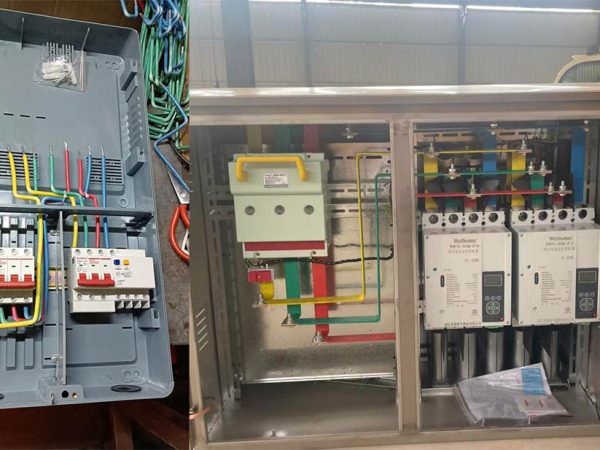
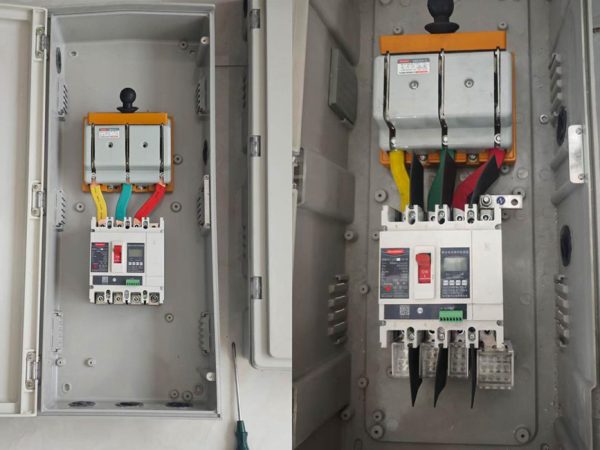
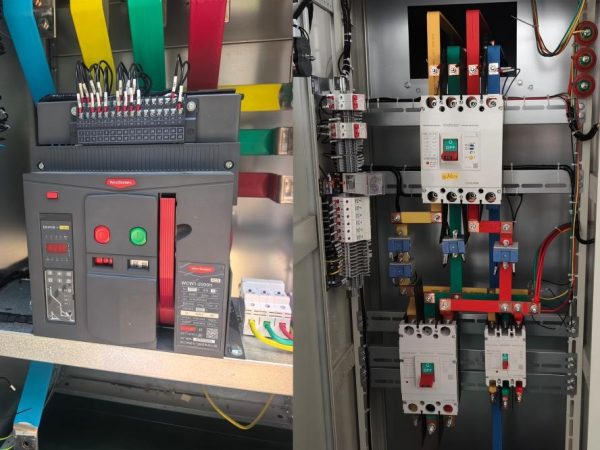
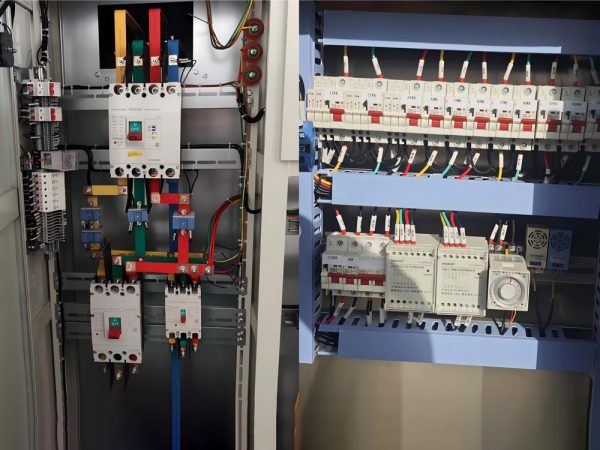
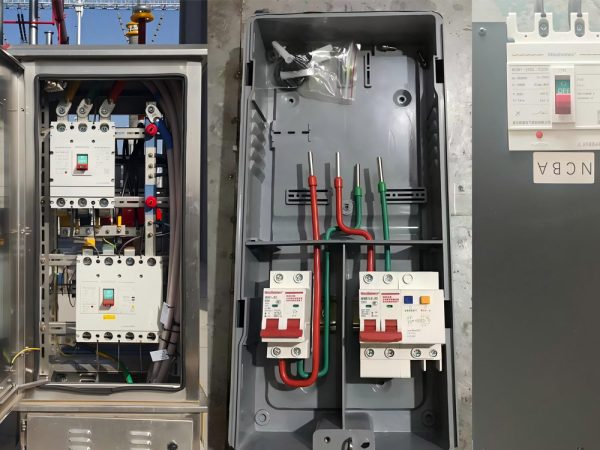
WH1-80 3P Switch Disconnector – For Industrial and Commercial Use
The WH1-80 series 3P switch disconnector is compatible with AC 50/60Hz lines, rated voltages of AC230V/400V, and rated current capacities ranging from 20A to 80A.
Get quick appointment for technical support!

The WH1-80 3P switch disconnector is compact, easy to install using a standard mounting rail, and offers configuration flexibility in 3P, 2P, 1P, or 4P setups.



The WH1-80 series 3P switch disconnector is compatible with AC 50/60Hz lines, rated voltages of AC230V/400V, and rated current capacities ranging from 20A to 80A.

The WH1-80 series 3P switch disconnector from Westhomes Electric ensures safe, efficient power isolation for various applications, including industrial, commercial, high-rise, and civil buildings. It serves as an essential solution for disconnecting power and performing infrequent switching for unloaded lines.
Constructed from a high-strength, flame-retardant nylon shell, the WH1-80 features an advanced contact system with bridge double breakpoints and an operational mechanism with a spring energy-saving fast-move design. These components ensure fast, reliable, and flexible performance.
The WH1-80 3P switch disconnector is also compatible with mini circuit breakers and earth leakage circuit breakers to enhance safety and protection.
Key Features:
3P Switch Disconnector – Reliable power isolation for triple-pole configurations
Rated Current – Suitable for 20A to 80A applications
Strong Design – Flame-retardant nylon shell for durability
Efficient Action – Quick and reliable switching with a spring energy-saving mechanism
Simple Installation – Compatible with standard mounting rails
Ideal for: Industrial, commercial, high-rise, and civil buildings
| Model | WH1-80 3p |
| Current rating | 20A, 25A, 32A, 40A, 50A, 63A, 80A |
| Poles (p) | 1P, 2P, 3P, 4P |
| Rated Voltage Ue | AC230V/400V (1P); 400V (2P-4P) |
| Rated short-time withstand current Icw | 2kA |
| Rated short-time connecting capacity Icm | 2.84kA |
| Hydrothermal resistance | Category 2 |
| Uilization Catagory | AC-22A |
| Electrical life | 8000 times |
| Mechanical life | 20000 times |
| Pollution degree | Level 2 |
| Cabling capacity | 1~50mm2 |
| Quality certificate | CCC certificated |
| Standard | IEC60947-3, GB14048.3 |

| Model NO. | WH1-80 |
| Arc-extinguishing Medium | Air |
| Structure | MCB |
| Type | Circuit Breaker |
| Certification | ISO9001-2000, CCC |
| Ka: Icm | 2.84ka |
| Width | 18, 36, 54, 72mm |
| Specification | IEC60947-3, GB14048.3 |
| Origin | Prc |
| Production Capacity | 15, 000, 000 |
| Speed | Normal Type Circuit Breaker |
| Installation | DIN Rail |
| Poles Number | 1p, 2p, 3p, 4p |
| Function | Disconnector |
| Voltage | AC230/400V |
| AMPS | 20A, 25A, 32A, 40A, 50A, 63A, 80A |
| Transport Package | Paper Box |
| Trademark | Westhomes |
| HS Code | 8536200000 |
| Package Size | 22.00cm * 8.00cm * 8.00cm |
| Package Gross Weight | 1.500kg |
This topic is covered in more detail in Isolator vs Switch Disconnector: Key Differences & Selection Guide.
A triple-pole (3P) power isolation switch is a mechanical device that opens all three phase conductors of a three-phase circuit at once, creating a visible break so the connected equipment can be worked on safely. It is designed to isolate motors, heaters, control panels, and other three-phase loads. Because it switches three phases together, it prevents the dangerous situation of one or two phases remaining live while equipment is being serviced.
Three-phase loads (motors, three-phase heaters, three-phase UPS) are connected across all three phases. A 3P switch disconnects L1, L2, and L3 simultaneously, which is required to fully de-energize the load and to keep phase relationships balanced when switching. Switching only one or two poles would leave the equipment live through back-feeds or phase-to-phase paths, creating a serious safety risk.
This triple-pole unit is part of the WH1-80 family, so it carries a rated current of 80A at low-voltage three-phase levels (typically up to 400 V AC / 415 V line-to-line). Confirm the exact In, Ue, and utilization category on the datasheet for your load. The rating defines the continuous current it can carry and the load it can safely break; it does not replace fuses or breakers for fault current protection.
As a switch-disconnector/isolation switch to IEC 60947-3, it is rated to make and break its rated load current (load-break capable), so it can be used as a local service switch to turn equipment on and off under normal load. Its duty for inductive loads like motors is limited by the utilization category—check whether it is rated AC-21, AC-22, or AC-23. A pure, unloaded disconnector (no load-break rating) must never be operated live.
Yes, it clips onto a standard 35 mm DIN rail inside a distribution enclosure or motor control panel. This keeps installation modular and consistent with other low-voltage switchgear. Ensure the panel has adequate space, derating for adjacent heat-producing devices, and correct ingress protection for the environment (e.g., dust/water protection in industrial settings).
Terminate the three incoming phases to the line terminals (IN) and the three outgoing phases to the load terminals (OUT), matching phase order L1-L2-L3 on both sides. Use conductors sized for 80A and torque terminals to the recommended value. Because the neutral is not switched, ensure the load's neutral (if present) is permanently connected and that the earthing arrangement provides a safe earth path. Label the switch to identify the isolated circuit.
Yes. Triple-pole isolation switches are the designated LOTO point for three-phase equipment, and the handle can be padlocked in the OFF (open) position to prevent accidental re-energization. After opening, prove the circuit is dead with a two-pole (phase-phase and phase-earth) test before starting work. This positive isolation of all three phases is essential for motor and three-phase panel maintenance.
Typical uses include the local isolator for three-phase motors, compressor and pump disconnects, three-phase heater bank isolation, the main switch of a motor control center (MCC), and isolation of three-phase UPS or inverter systems. It is often installed right next to the machine being serviced so a single, obvious switch makes the equipment dead. In these roles it is paired with an upstream MCCB/breaker for fault protection.
An MCB automatically trips on overload/short circuit but is not a dedicated, lockable isolation device; a contactor is an electrically operated switch used for automatic/remote control and frequent switching, not for safe manual isolation. A 3P isolation switch is a manual, positively-opening, lockable device whose purpose is safety isolation. It is not intended for frequent automatic switching and does not provide overcurrent protection.
It is designed to IEC 60947-3 for switches and switch-disconnectors. Maintenance consists of periodic visual inspection, checking terminal tightness, exercising the operating handle, and verifying the isolating gap and LOTO facility during routine electrical testing. For motor-duty installations, also confirm the utilization category matches the locked-rotor current of the connected motor to avoid premature contact wear.
* indicates a required field


 155 MB