Get quick appointment for technical support!

What Are the Two Types of ATS?
Apr 18, 2026
Automatic Transfer Switch ATS is a device that ensures continuous power supply in electrical systems and is widely used in industrial, commercial, and critical infrastructure applications. When the main power source fails, ATS can quickly switch to a backup power source so that equipment continues to operate. Based on different switching methods, ATS can be divided into two main types. This article introduces their features, differences, and applications.
What is ATS?
ATS Automatic Transfer Switch is an automatic control device used in power systems. When the main power source fails or loses power, ATS switches the load to a backup source such as a generator or another supply, and switches back after the main power returns, so that power continuity and safety are maintained.
What is the basic working principle of ATS?
The basic working principle of ATS is to monitor the power status in real time and switch between power sources automatically to maintain continuous supply. The entire process is controlled by a controller, which operates without manual intervention so that reliability and continuity are ensured.
Open Transition ATS
Working principle
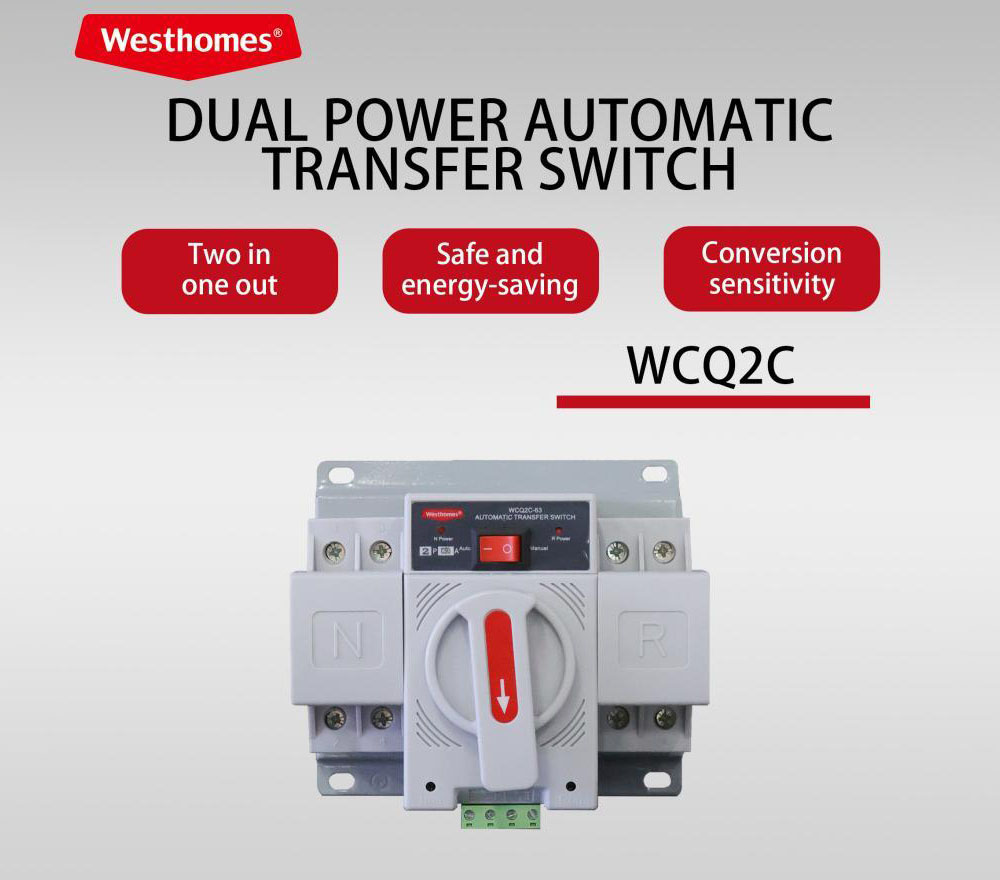
Open Transition ATS uses a break before make method. When the main power fails, the system disconnects the load from the main source first, and after confirming disconnection, it connects to the backup source. A short interruption occurs during the transfer.
Main features
- Two power sources are never connected at the same time
- Control logic is relatively simple
- Structure is mature and stable
- High level of electrical isolation
Advantages
- Simple structure and high reliability
- Lower cost and good cost performance
- Easy maintenance and lower failure rate
- No risk of parallel connection between power sources
Limitations
- Short interruption occurs during switching which may last milliseconds to seconds
- Not suitable for loads that require uninterrupted power
- Some sensitive equipment may restart or stop
Typical applications
- Commercial buildings such as offices and shopping centers
- Industrial equipment that can tolerate short interruptions
- Lighting systems
- General power loads such as fans and pumps
Closed Transition ATS
Working principle
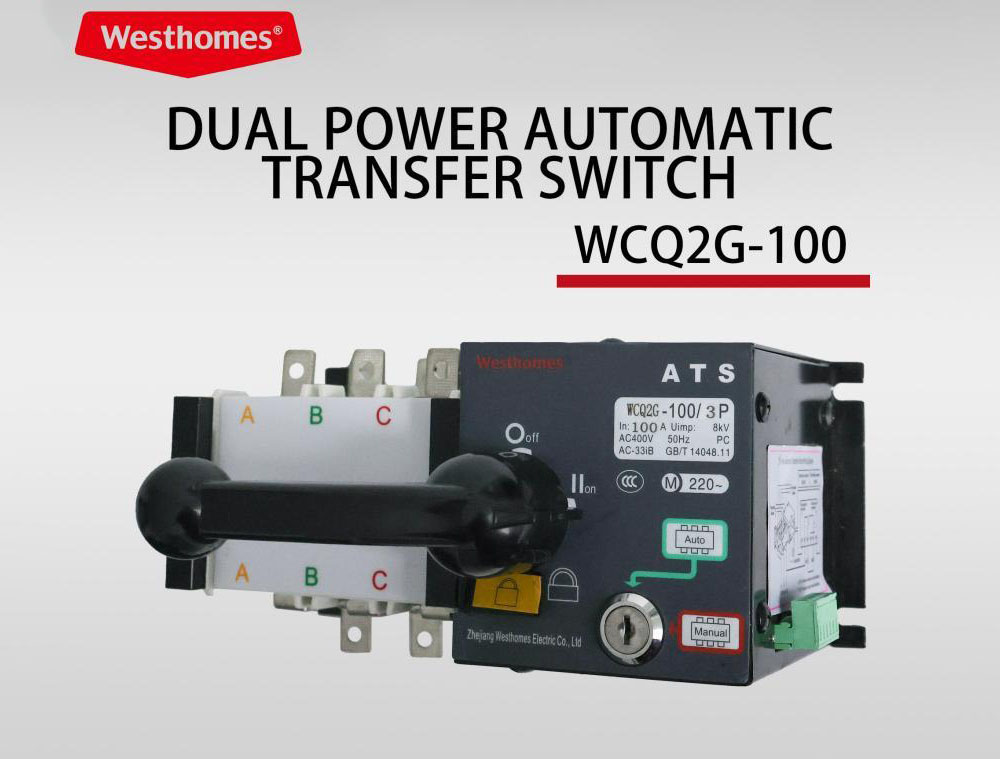
Closed Transition ATS uses a make before break method. During switching, the backup source connects to the load first and operates in parallel with the main source for a short time, and after synchronization is achieved, the main source is disconnected so that uninterrupted transfer is realized.
Main features
- Two power sources can operate in parallel for a short time
- Includes synchronization control for voltage, frequency, and phase
- Smooth switching without noticeable interruption
- More complex system structure
Advantages
- Seamless transfer without power interruption
- Continuous operation for critical equipment
- Reduced risk of restart or data loss
- Higher overall power reliability
Technical requirements and limitations
- High requirements for synchronization between power sources such as voltage, frequency, and phase
- More advanced control and protection systems are required
- Higher cost and more demanding installation and commissioning
- In some regions or systems, parallel connection of power sources is restricted
Typical applications
- Data centers and server rooms
- Hospital critical equipment such as operating rooms
- Financial systems and communication base stations
- High end manufacturing and continuous production lines
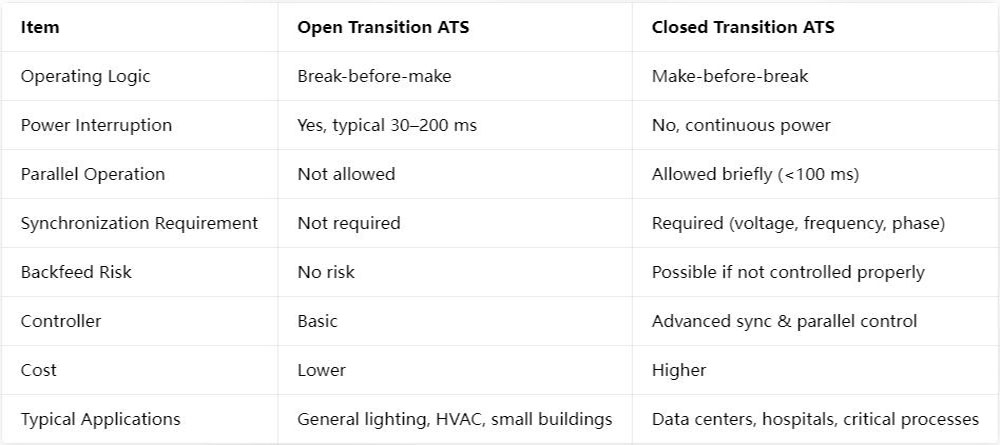
Comparison of the two ATS types
When selecting an Automatic Transfer Switch ATS, understanding the differences between types helps match the system with actual needs. Open Transition ATS and Closed Transition ATS differ in switching method, continuity, safety, and cost.
Whether parallel connection is allowed
Open Transition ATS avoids connecting both power sources at the same time and keeps them completely separated, while Closed Transition ATS allows both sources to operate in parallel for a short period so that transition is smooth.
Whether interruption occurs
Open Transition ATS causes a short interruption due to its break before make method, while Closed Transition ATS achieves seamless transfer through a make before break process so that interruption is avoided.
Safety and complexity
Open Transition ATS has a simple structure and clear control logic, which leads to stable operation, while Closed Transition ATS requires synchronization and parallel operation, which increases system complexity.
Cost difference
Open Transition ATS has lower equipment cost and simpler installation and maintenance, while Closed Transition ATS has higher cost due to advanced control and system complexity, which makes it suitable for applications with higher continuity requirements.
How to choose the right ATS?
In practical applications, selecting an ATS requires consideration of load demand, system requirements, and budget. Each type has its own advantages, and proper matching leads to better performance and cost balance.
Load type
Different loads have different sensitivity to power interruption. General equipment such as fans, pumps, and lighting can tolerate short outages, so Open Transition ATS is suitable, while precision equipment or critical systems such as servers and medical devices are better matched with Closed Transition ATS to avoid interruption.
Power continuity requirements
If the application requires continuous power such as data centers, hospitals, or communication systems, Closed Transition ATS is preferred. For general commercial or industrial use where short interruption is acceptable, Open Transition ATS can meet the demand.
Budget and system complexity
Open Transition ATS has a simple structure and lower cost, which fits projects with limited budget, while Closed Transition ATS requires synchronization control and more advanced protection, which increases cost and complexity. A balance between performance and cost should be considered.
Final Thoughts
Automatic Transfer Switch ATS supports reliable power supply in different scenarios. Open Transition and Closed Transition ATS have different features and application ranges. Selection should be based on load requirements, continuity needs, and budget so that efficient and stable power switching is achieved.
WESTHOMES provides both types of ATS with high quality and strong cost performance, and you are welcome to visit our homepage for more information.
FAQs
Q: What is the difference between ATS and UPS
ATS switches between power sources automatically, while UPS provides short term backup power during outages, and they are often used together.
Q: Do all ATS systems cause power interruption
No. Open Transition ATS causes a short interruption, while Closed Transition ATS allows seamless switching without interruption.
Q: Is Closed Transition ATS always better
Not always. It provides higher continuity but comes with higher cost and system complexity, so selection depends on actual needs.
Q: Can ATS be used in homes
Yes. It is commonly used in homes with generators so that power can switch automatically during outages.
Q: What factors should be considered when choosing ATS
It depends on load type, power continuity requirements, and budget.

--- END ---
In this blog
Featured Articles
Get A Free Quote
