Get quick appointment for technical support!

How to Calculate Single-Phase and Three-Phase Electricity Rates
Apr 20, 2026
In daily electricity use and industrial production, electricity costs are often a significant expense. When basic methods for calculating electrical power and electricity charges are understood, expenses can be estimated more accurately, and energy usage can be optimized to reduce costs. This article explains the calculation methods for single-phase and three-phase electricity rates, starting from fundamental concepts.
Do You Understand These Concepts?
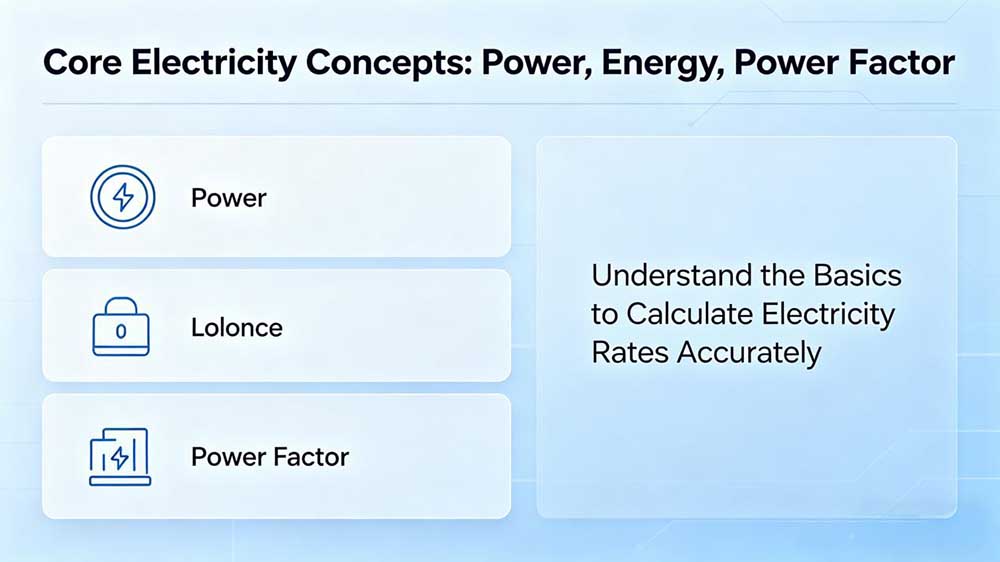
Power
Power refers to how quickly electrical energy is consumed by a device over time, and it is usually measured in watts or kilowatts. When the power is higher, electricity is consumed more quickly. For example, a 2000W electric kettle consumes electricity faster than a 100W light bulb.
Energy
Energy refers to the total amount of electricity consumed over a period of time, and it is measured in kilowatt-hours, which is commonly known as units of electricity. When a 1000W device runs for one hour, it consumes one unit of electricity. Electricity charges are calculated based on energy consumption.
Power Factor
Power factor measures how efficiently electrical energy is used, and its value ranges from 0 to 1. It represents the ratio between effective power and total power. When the power factor is closer to 1, energy is used more efficiently, while a lower value indicates that part of the energy is not effectively utilized, which is common in inductive loads such as motors. In industrial electricity use, especially in three-phase systems, power factor can affect electricity costs.
How to Calculate Single-Phase Electricity Cost?
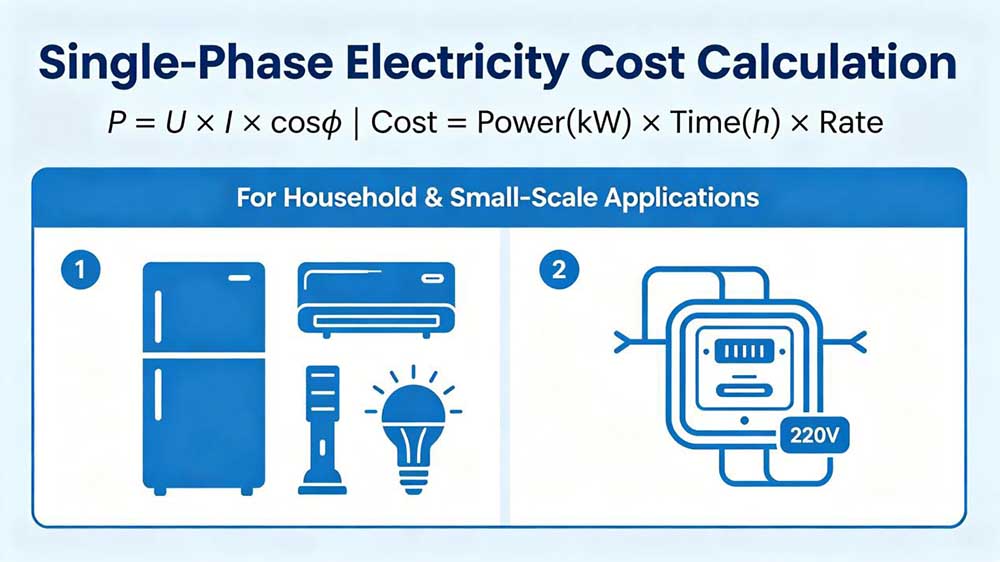
In daily situations, calculating single-phase electricity cost is relatively straightforward. The general approach is to determine the power of the device, calculate energy consumption based on usage time, and then multiply it by the electricity rate. When these steps are followed, electricity cost can be estimated efficiently for household and small-scale applications.
Basic Formula for Single-Phase Power
The basic formula for single-phase power is expressed as P equals U multiplied by I multiplied by cos phi, where P represents power, U represents voltage which is usually 220V in households, I represents current, and cos phi represents the power factor. Since the power factor of most household appliances is close to 1, calculations can often be simplified by using the rated power directly.
Steps for Calculating Single-Phase Power
The calculation process begins by determining the power of the device, which can usually be found on the nameplate, while it can also be calculated using the formula when not available. After that, power should be converted from watts to kilowatts because electricity charges are based on kilowatt-hours. Then, energy consumption is calculated by multiplying power by usage time. Finally, electricity cost is obtained by multiplying energy consumption by the electricity rate.
Common Mistakes
There are several common mistakes in practical calculations. Some people treat power as electricity cost, although power only indicates the rate of energy consumption rather than the total energy used. Others ignore usage time, which leads to inaccurate results. Unit conversion errors, such as failing to convert watts into kilowatts, can also cause large deviations. For household users, power factor does not need much attention, while focus should remain on power, time, and electricity price. In addition, electricity pricing may vary depending on peak and off-peak periods, which can influence the final cost.
Calculation Method for Three-Phase Electricity Cost
Compared with single-phase electricity, three-phase electricity is widely used in industrial equipment and high-power applications. Although the calculation method is more complex, the overall approach remains the same, since power is calculated first, followed by energy consumption, and then electricity cost is determined. When the basic principles and formulas are understood, electricity cost can be estimated with reasonable accuracy.
Basic Principle of Three-Phase Electricity
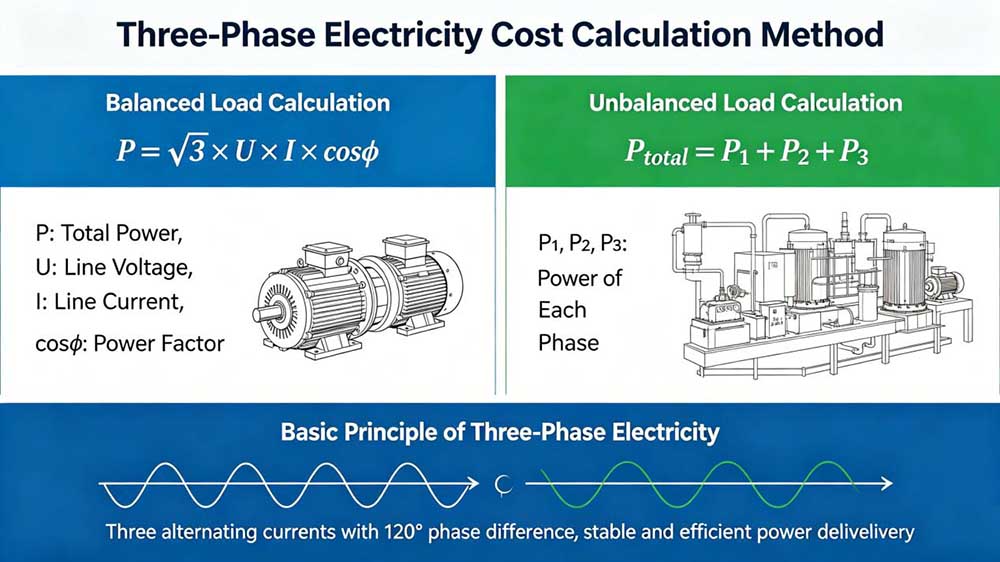
Three-phase electricity consists of three alternating currents with a phase difference of 120 degrees, which allows stable and efficient power delivery. Since power fluctuation is reduced and transmission efficiency is higher, it is commonly used in motors, industrial equipment, and high-power loads. In low-voltage systems, the line voltage is usually 380V, and although different connection methods can affect voltage and current relationships, the overall calculation approach remains unchanged.
Three-Phase Power Formula for Balanced Load
In most practical cases, the three-phase load is balanced, which means that currents and loads are equal across all phases. Under this condition, the total power can be calculated using the formula P equals square root of 3 multiplied by U multiplied by I multiplied by cos phi. In this formula, P represents total power, U represents line voltage, I represents line current, and cos phi represents power factor. Since the contribution of all three phases is included, this formula is widely used due to its simplicity.
Three-Phase Power Formula for Unbalanced Load
When the load is not balanced, the current, voltage, or power factor of each phase may differ, so a single formula cannot be used. Instead, the power of each phase is calculated separately and then summed. The total power equals P1 plus P2 plus P3. This method is more suitable for complex situations where loads are unevenly distributed, although the calculation process becomes more detailed.
Comparison Between Single-Phase and Three-Phase Electricity Cost
After understanding both calculation methods, differences can be analyzed from the perspectives of calculation approach, cost, and application scenarios, which helps in selecting the appropriate system.
Comparison of Calculation Methods
Single-phase electricity is simpler to calculate, since electricity cost can be obtained directly from power and usage time, which makes it suitable for households and small devices. Three-phase electricity involves multiple currents and voltages, so it requires the use of the square root of 3 formula for balanced loads, while unbalanced loads require separate calculations for each phase. Although the process is more complex, the principle remains based on power and time.
Analysis of Cost Differences
Single-phase electricity is usually used for low-power devices, so overall consumption and cost are relatively low. Three-phase electricity is used for high-power equipment, so total consumption may be higher under the same operating time. However, since energy loss is lower in three-phase systems, efficiency is higher, especially in motor applications. In industrial environments, a low power factor may lead to additional charges, while improving it can help reduce costs.
Comparison of Application Scenarios
Single-phase electricity is commonly used in households, small businesses, and light-load devices such as lighting and home appliances. Three-phase electricity is widely used in industrial production, large machinery, and high-power systems such as motors and compressors. In general, single-phase electricity is suitable for daily use, while three-phase electricity is suitable for heavy loads. Selecting the appropriate system can improve efficiency and control costs.
Factors That Affect Electricity Cost
Electricity cost is influenced by more than power and time. When these factors are understood, cost estimation becomes more accurate, and energy usage can be optimized.
Power Factor
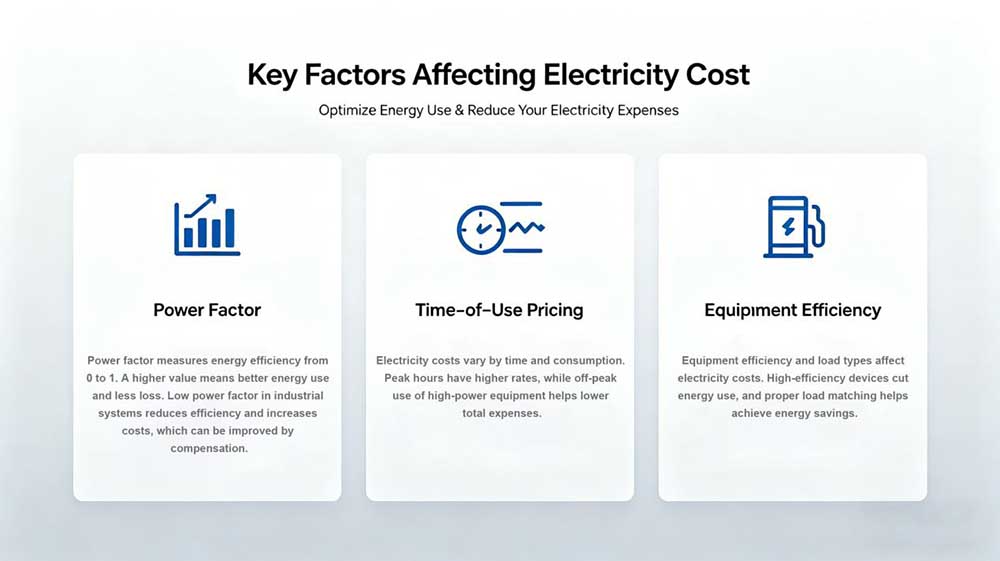
Power factor reflects energy efficiency, and its value ranges from 0 to 1. A higher value indicates better utilization, while a lower value suggests energy loss. In three-phase systems and industrial applications, a low power factor may reduce efficiency and lead to additional charges. By improving power factor through compensation methods, electricity cost can be reduced.
Electricity Usage Time and Pricing Structure
Electricity cost depends on usage time, since many regions apply time-based pricing or tiered pricing systems. Electricity rates may vary depending on the time of use or total consumption. Rates are often higher during peak hours and lower during off-peak periods. When high-consumption devices are used during off-peak hours, overall cost can be reduced.
Equipment Efficiency and Load Type
The efficiency of equipment and the type of load also influence electricity cost. High-efficiency equipment consumes less energy under the same conditions, while outdated equipment increases consumption. Different load types use energy differently, which affects overall usage. By selecting energy-efficient equipment and matching load types appropriately, energy savings can be achieved.
Conclusion
The calculation of electricity cost for both single-phase and three-phase systems follows the same principle, which is based on power, usage time, and electricity rate. Single-phase electricity is suitable for daily use, while three-phase electricity is better for high-power and industrial applications. When calculation methods are understood and factors such as power factor, usage time, and equipment efficiency are considered, electricity costs can be managed more effectively.
FAQs
Q: Which is more energy efficient, single-phase or three-phase electricity
Three-phase electricity does not inherently consume less energy, while its higher transmission efficiency and stable operation make it more efficient in high-power applications.
Q: How can I tell whether I am using single-phase or three-phase electricity
Households usually use single-phase electricity at 220V, while three-phase electricity at 380V is used for industrial or large equipment. When three live wires are present in the distribution panel, it is typically a three-phase system.
Q: Does a low power factor affect electricity cost
In industrial applications, a low power factor may result in additional charges, while its effect in household usage is usually minimal.
Q: Is electricity cost calculated based on power or energy consumption
Electricity cost is calculated based on energy consumption in kilowatt-hours, while power only indicates the rate of consumption.
Q: How can electricity costs be reduced
Costs can be reduced by limiting the use of high-power devices, selecting energy-efficient equipment, and shifting usage to off-peak periods.

--- END ---
In this blog
Featured Articles
Get A Free Quote
