Get quick appointment for technical support!

What’s the Difference Between ATS and STS?
Apr 23, 2026
In critical power systems, maintaining uninterrupted power is very important. Both Automatic Transfer Switches (ATS) and Static Transfer Switches (STS) transfer loads to an alternative source during a power disturbance, but they differ significantly in switching method, speed, applications, and cost. Understanding these differences helps determine the right solution for different systems.
What Is an ATS?
An Automatic Transfer Switch (ATS) is a device designed to automatically transfer a load between two power sources. When the primary power source fails, experiences voltage abnormalities, or loses supply, the ATS automatically switches the load to a backup source, such as a generator or secondary utility supply. Its primary purpose is to minimize downtime and improve overall power system reliability.
Core Working Principle
ATS typically operates based on a mechanical switching principle. It utilizes an electromagnetic drive mechanism and mechanical contacts to complete the transfer process. When the control system detects a fault in the primary source, it sends a command to switch to the backup source. Once the primary utility is restored, the system automatically transfers the load back according to its predefined settings.
Transfer Speed: Because it relies on mechanical contacts, ATS transfer times are typically in the millisecond-to-second range, making it highly suitable for applications where a brief power interruption is acceptable.
Typical Applications
Thanks to its proven reliability and cost-effectiveness, ATS is widely deployed across various sectors to ensure continuous power:
- Critical Facilities: Switching to diesel generators during utility failures in hospitals, office buildings, and data facilities.
- Commercial Real Estate: Managing automatic dual-source power transfer for large commercial building systems.
- Industrial Distribution: Protecting critical manufacturing equipment and maintaining stable power distribution lines.
Featured Solution: WESTHOMES WCQ2G Series ATS
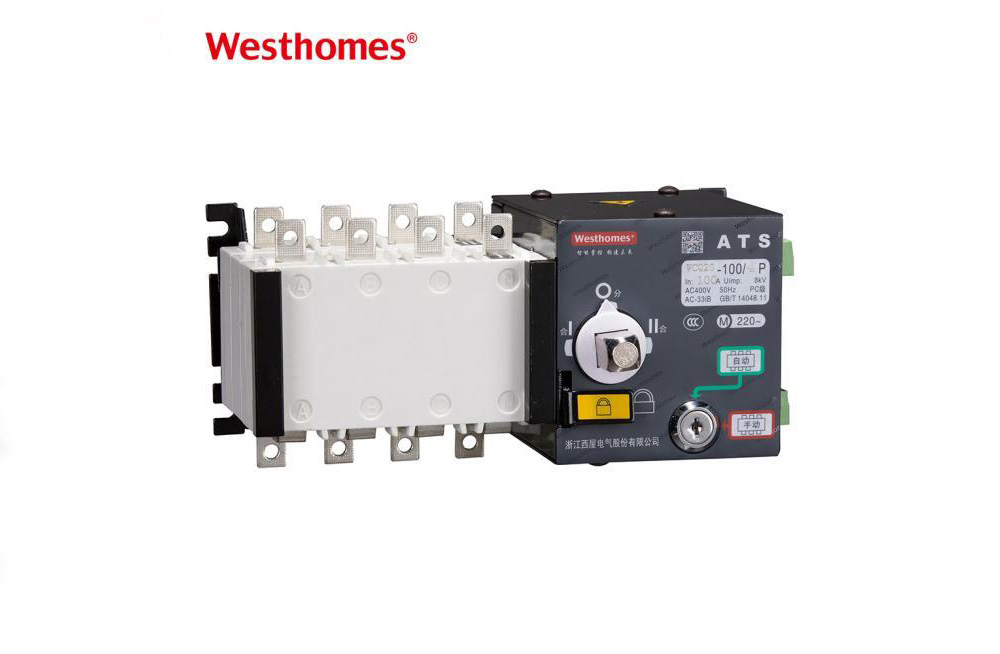
Popular Wcq2g ATS Isolated Type Double Power Supply Automatic Transfer Switch
For facilities requiring a dependable mechanical switching solution, the WESTHOMES WCQ2G Series Dual Power ATS provides true electromechanical integration.
Combining switching mechanisms and logic control into one compact unit, the WCQ2G seamlessly transfers loads to an alternate power source during primary failures. It is engineered for high-demand environments, offering:
- High Capacity: Suitable for 50Hz distribution systems with a rated current of up to 1600A.
- Advanced Safety: Equipped with both electrical and mechanical interlocks to prevent short circuits between sources.
- Smart Control: Features real-time voltage monitoring, communication interfaces, fully automatic remote control, emergency manual operation, and a forced “0” position setting.
- Global Standards: Fully compliant with IEC 60947-6-1, ensuring a robust power continuity solution for commercial and industrial applications.
What Is an STS?
Definition of a Static Transfer Switch
A Static Transfer Switch (STS) is a device designed to provide ultra-fast automatic transfer between two independent power sources, primarily used in critical load systems where power continuity is essential. When the primary source experiences voltage fluctuations, outages, or power quality disturbances, the STS transfers the load to an alternate source within an extremely short time, minimizing or even eliminating power interruption. Its primary purpose is to enhance reliability and switching speed for critical power applications.
How Does STS Work? (SCR/Thyristor Switching Principle)
STS typically operates based on SCR (Silicon Controlled Rectifier) or Thyristor solid-state switching technology, using semiconductor devices to perform source transfer without mechanical contacts. Compared with traditional mechanical switching, solid-state transfer offers faster response, no mechanical wear, and greater operational stability. Through electronic control, STS can achieve transfer times typically around 2–4 ms, often within a single power cycle, enabling near-seamless power transfer.
Typical Applications of STS
With its high-speed switching capability, STS is widely used in dual-source power systems, especially for applications that cannot tolerate even momentary interruption, such as data centers, medical equipment, telecommunications systems, semiconductor manufacturing, and advanced industrial control systems. In these applications, the STS connects to two simultaneously available power sources and rapidly transfers the load whenever one source becomes abnormal, ensuring continuous operation of critical loads.
When ATS May Be the Better Choice
While STS offers advantages in ultra-fast transfer applications, not every system requires millisecond-level switching. In generator backup, commercial buildings, and industrial power distribution systems, ATS is often a more cost-effective and proven solution. For applications that can tolerate brief transfer interruptions, the WESTHOMES WCQ2G automatic transfer switch can meet most continuity requirements while providing reliable backup power transfer.
ATS vs STS: Key Differences at a Glance
| Feature | ATS | STS |
| Switching Technology | Mechanical | Solid-state (SCR/Thyristor) |
| Transfer Speed | Milliseconds to seconds | Typically 2–4 ms |
| Power Interruption | Brief interruption possible | Near seamless |
| Cost | Lower | Higher |
| Typical Application | Generator backup | Critical loads / dual source |
The key differences between ATS and STS lie in switching technology, transfer speed, power continuity, cost, and application. ATS uses mechanical switching, with transfer times ranging from milliseconds to seconds, and may allow brief power interruption. It is a cost-effective and proven solution widely used for generator backup and general power distribution.
By contrast, STS uses SCR/Thyristor-based solid-state technology, providing ultra-fast transfer typically within 2–4 ms for near-seamless power continuity. It is better suited for critical loads and dual-source systems, though at a higher cost. In general, ATS is ideal for reliable backup power transfer, while STS is designed for applications where uninterrupted power is essential.
How to Choose: ATS or STS?
Choose ATS if:
- The load can tolerate brief power interruption.
- Generator backup transfer is required.
- The application involves commercial buildings or standard industrial distribution systems.
- Cost efficiency and practical reliability are priorities.
- A proven solution for backup source transfer is preferred.
Choose STS if:
- The load cannot tolerate any interruption.
- Dual live power sources are available.
- The application involves critical environments such as data centers, medical facilities, or semiconductor systems.
- Millisecond-level transfer is required for higher power continuity.
- Maximum protection for critical equipment is the priority.
In Summary:
- Choose ATS for reliable and economical backup power transfer.
- Choose STS when uninterrupted power for critical loads is essential.
Can ATS and STS Work Together?
In high-reliability power systems, ATS and STS are rarely an “either/or” choice. Instead, they are highly complementary, working together in a layered protection architecture to balance macro-level reliability with micro-level transfer speed.
A Layered Protection Architecture
By combining both technologies, facilities can achieve a comprehensive power continuity solution:
- The ATS Layer (Upstream Foundation): Positioned at the main distribution level, the ATS manages the heavy-duty power transfer between the primary utility grid and backup power sources (such as diesel generators).
- The STS Layer (Downstream Precision): Positioned closer to the critical loads, the STS handles ultra-fast, millisecond transfers between dual live sources (like two independent UPS systems), ensuring sensitive equipment never experiences a voltage drop.
Achieving Complete Power Security
In this coordinated approach, the ATS acts as the robust first line of defense against prolonged utility outages, while the STS serves as the precision safeguard against transient power quality issues. Together, they create a highly resilient power distribution strategy, ensuring that critical operations remain online and secure under all grid conditions.
Common Installation Considerations
Source Synchronization: For dual-source systems, source voltage, frequency, and phase synchronization should be verified to ensure stable transfer and avoid equipment stress during switching.
Transfer Coordination: Transfer logic should be properly configured to coordinate source priority, switching sequence, and time delay, preventing misoperation or unnecessary transfer events.
Short-Circuit Protection: Appropriate upstream protection devices, such as circuit breakers or fuses, should be selected to provide fault isolation and protect the transfer switch under abnormal conditions.
Bypass and Maintenance Design: A bypass arrangement should be considered for critical systems to allow maintenance or replacement without interrupting power to the load.
Wiring and Grounding: Proper conductor sizing, short wiring paths, and reliable grounding are essential to ensure safe operation and system performance.
Frequently Asked Questions (FAQ)
Q1: Is STS always better than ATS?
Not necessarily. STS offers advantages in transfer speed and power continuity, making it ideal for critical loads that cannot tolerate interruption. However, for most commercial buildings, industrial distribution systems, and generator backup applications, ATS is often sufficient and more cost-effective. The “better” choice depends on the application, not simply on the device type.
Q2: Can STS replace a generator ATS?
Generally, no. ATS is designed for automatic transfer between utility power and a generator, including source control, transfer logic, and backup power management. STS, on the other hand, is typically used for ultra-fast switching between two simultaneously available power sources and does not perform generator control. Their functions are different, and they are often complementary rather than interchangeable.
Q3: Which is better for data centers?
For critical data center loads where power continuity is essential, STS is often preferred because its millisecond-level transfer capability minimizes or avoids interruption risks. However, in practice, data centers often use both ATS and STS together: ATS for generator backup transfer and STS for ultra-fast switching between dual live sources, creating a higher-reliability power architecture.
Q4: Is STS more expensive than ATS?
In general, yes. STS systems typically have higher upfront costs due to solid-state switching technology, faster control systems, and higher performance requirements. However, for critical applications, the higher investment may be justified by reduced downtime risk.
Conclusion
Neither ATS nor STS is universally “better” — the right choice depends on load requirements, transfer speed expectations, system architecture, and budget considerations. ATS is typically the practical solution for reliable backup power transfer, while STS is designed for critical applications where uninterrupted power is essential. In many high-reliability systems, the two can also work together as part of a layered power continuity strategy. Ultimately, selecting the right transfer solution should be based on application needs, not device comparison alone, to ensure both operational reliability and long-term value.

--- END ---
In this blog
Featured Articles
Get A Free Quote
