Get quick appointment for technical support!

Isolators & Switch Disconnectors Guide
Jun 10, 2026
Introduction
In electrical systems, proper isolation is more than just switching the power off. A reliable isolation point is essential to ensure that equipment remains safely de-energized during maintenance and prevent unexpected energization that could lead to serious safety risks.To achieve this, isolators and switch disconnectors are widely used in power distribution systems.
While they may look similar and both serve isolation purposes, they are designed for different operating conditions—one for no-load isolation, and the other for controlled load switching as well.
This guide explains how they work, where they are used, and how to choose the right solution for different electrical applications.
What Are Isolators and Switch Disconnectors?
Although isolators and switch disconnectors are both designed to disconnect electrical circuits, they are not the same device. Both play an important role in electrical safety by providing a means of isolating equipment from the power supply, but they differ in their operating capabilities and intended applications.
What Is an Isolator?
An isolator is a mechanical switching device designed to completely disconnect a circuit from its power source when no load current is present. Its primary purpose is to create a visible isolation point, ensuring that electrical equipment can be safely inspected or maintained. Because it is intended for off-load operation only, an isolator should never be used to interrupt live current.
What Is a Switch Disconnector?
A switch disconnector combines the functions of a load switch and an isolator. In addition to providing electrical isolation, it is capable of making and breaking circuits under normal load conditions. This makes it suitable for applications where both switching and isolation are required, such as industrial distribution systems, motor control panels, and commercial electrical installations.
Why Are They Often Confused?
In real electrical installations, isolators and switch disconnectors often appear very similar in both structure and function. They are both used to disconnect circuits, and in many low-voltage systems, they are even installed side by side in the same distribution panels. This visual and functional overlap is the main reason they are frequently mistaken for one another.
In practice, the difference only becomes clear when considering how they operate under electrical load. An isolator is strictly intended to operate when the circuit is already de-energized, providing a safe physical separation. A switch disconnector, on the other hand, is designed to handle normal load current switching while still ensuring safe isolation when required.
This is why correct selection is important in system design. Using the wrong device in the wrong operating condition can lead to unsafe switching, equipment stress, or operational failure.
Isolator vs Switch Disconnector: What’s the Difference?
Although isolators and switch disconnectors are often discussed together, they are not interchangeable in electrical design. The real distinction is not about appearance, but about how each device behaves under electrical load and the level of switching capability it is designed to handle.
In practical applications, this difference determines where each device should be used within a system. The comparison below summarizes their core technical characteristics in a clear and structured way.
| Feature | Isolator | Switch Disconnector |
| Operating Condition | Off-load operation only | Can make and break rated load current |
| Arc Suppression | No arc extinguishing capability | Designed to safely switch load current with arc control |
| Primary Function | Electrical isolation for maintenance | Load switching and electrical isolation |
| Safety Function | Provides a visible isolation point | Combines switching capability with safe isolation |
| Typical Applications | Equipment maintenance, substations, electrical isolation | Distribution boards, motor control panels, industrial power systems, commercial installations |
How Do Isolators and Switch Disconnectors Work?
Isolators and switch disconnectors share a similar mechanical construction, but they are designed to operate under different electrical conditions. Both devices rely on manual mechanical switching to open or close electrical contacts, creating or removing a conductive path between the power source and the load.
Their difference is not in how they are physically operated, but in how much electrical load they are designed to handle during switching.
Mechanical Switching Principle
Both devices use a mechanical handle connected to internal conductive contacts. When the handle is operated, the contacts move between open and closed positions, enabling or interrupting current flow. This simple mechanical structure ensures high reliability and long service life in electrical distribution systems.
Visible Isolation Function (Isolator Feature)
In isolators, when the contacts are fully opened, a clear physical gap is formed between the supply and the load. This visible separation confirms that the circuit is completely de-energized, making it suitable for maintenance and inspection work.
Load Switching Capability (Switch Disconnector Feature)
Switch disconnectors are designed with enhanced contact systems that allow them to safely make and break rated load current. In addition, arc-control structures are integrated to manage electrical arcing during switching, making them suitable for operational switching in live systems.
Operating Sequence in Electrical Systems
In practical applications, isolators are typically operated only after upstream protection devices such as circuit breakers have disconnected the current. They are used as a secondary safety isolation point.
Switch disconnectors, however, can be operated under normal load conditions, making them suitable as both control and isolation devices within a system.
WESTHOMES Isolator & Switch Disconnector Solutions
Reliable electrical isolation is essential for protecting personnel, equipment, and power systems during operation and maintenance. WESTHOMES offers a complete range of isolator switches and switch disconnectors designed for residential, commercial, and industrial power distribution applications.
From compact DIN-rail isolators to heavy-duty load break switches, our products deliver dependable performance, long mechanical life, and compliance with international electrical standards.
WH1-80 Isolator Switch
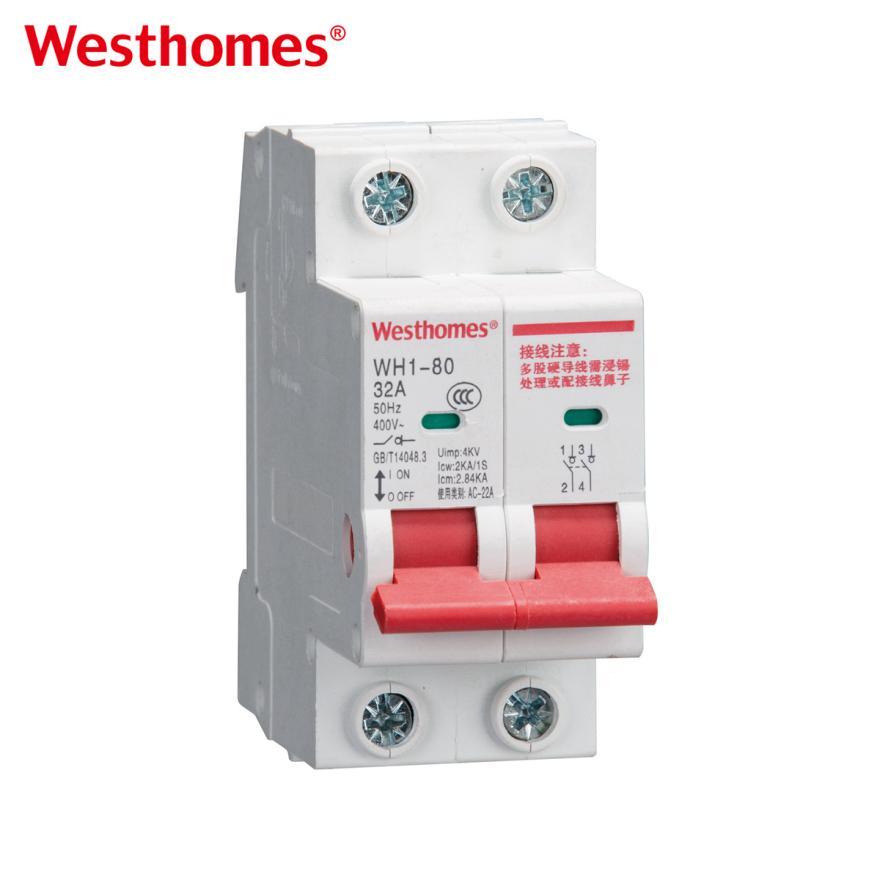
The WESTHOMES WH1-80 Isolator Switch is designed for low-voltage electrical distribution systems that require safe circuit isolation during maintenance and servicing. Manufactured in accordance with IEC 60947-3, it provides reliable off-load isolation and stable switching performance for residential, commercial, and light industrial applications.
Key Features
- IEC 60947-3 compliant
- Rated current from 6A to 80A
- Available in 1P, 2P, 3P and 4P
- Rated voltage up to AC415V
- Mechanical life up to 20,000 operations
- Compact design for distribution boards and control panels
Typical Applications:
- Residential distribution boards
- Commercial electrical panels
- Building electrical systems
- Equipment maintenance isolation
GL-630 Switch Disconnector
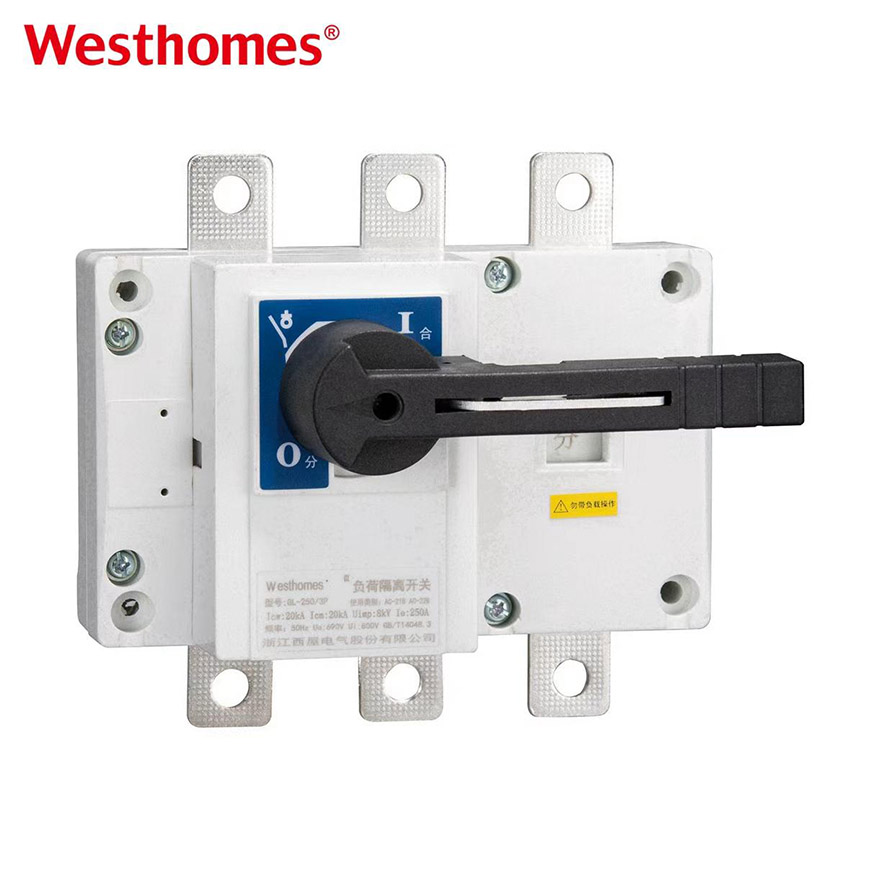
The WESTHOMES GL-630 Switch Disconnector is engineered for industrial power distribution systems that require both load switching and electrical isolation. Designed for demanding operating environments, it combines high current capacity with dependable switching performance, making it suitable for industrial plants, motor control centers, and main distribution cabinets.
Key Features
- Rated frame current 630A
- Rated current 400A / 500A / 630A
- Available in 3P and 4P
- Rated insulation voltage 800V
- Rated operating voltage AC400V
- Rated impulse withstand voltage 8kV
- Short-time withstand current 20kA / 1s
- Short-circuit making capacity 40kA
- Suitable for AC-21B / AC-22B applications
Typical Applications:
- Industrial power distribution systems
- Main switchboards
- Motor control centers (MCC)
- Manufacturing equipment
- Commercial electrical infrastructure
Why Choose WESTHOMES?
WESTHOMES provides comprehensive electrical isolation solutions covering both low-current and high-current applications. Whether you need a compact isolator switch for building distribution or a heavy-duty switch disconnector for industrial power systems, our products are engineered to deliver reliable performance, operational safety, and long-term durability.
Main Types of Isolators and Switch Disconnectors
Isolators and switch disconnectors are available in a wide variety of configurations to meet different electrical systems and installation requirements. They can be classified by the number of poles, current rating, and installation method. Understanding these classifications helps users select the most suitable device for their application.
By Number of Poles
The number of poles determines how many conductors can be disconnected simultaneously. Different pole configurations are designed for single-phase and three-phase electrical systems.
| Type | Description | Typical Applications |
| SP (Single Pole) | Disconnects one live conductor only. | Residential lighting and small single-phase circuits. |
| DP (Double Pole) | Disconnects both live and neutral conductors simultaneously. | Water heaters, air conditioners, and household appliances. |
| TP (Triple Pole) | Disconnects all three phases in a three-phase system. | Industrial motors and three-phase equipment. |
| 4P (Four Pole) | Disconnects three phases and the neutral conductor together. | Main distribution boards and generator systems. |
By Current Rating
Different current ratings are designed to match different load capacities. Selecting the correct current rating ensures safe operation and reliable electrical isolation.
| Current Rating | Typical Applications |
| 32A | Residential circuits, lighting systems, and small equipment |
| 63A | Commercial distribution boards and HVAC systems |
| 100A | Small industrial installations and commercial buildings |
| 250A | Industrial machinery and power distribution cabinets |
| 630A | Main switchboards, MCCs, and heavy industrial power systems |
By Installation Method
The installation method depends on the electrical equipment and available installation space. Different mounting options provide flexibility for various distribution and control systems.
| Installation Type | Description | Typical Applications |
| DIN Rail Mount | Installed on standard DIN rails for quick installation and replacement. | Distribution boards and modular electrical panels. |
| Panel Mount | Mounted directly onto electrical cabinet panels. | Industrial control cabinets and switchboards. |
| Rotary Isolator | Operated by a rotary handle for manual switching and isolation. | Machinery isolation and motor control systems. |
| Enclosed Isolator | Integrated into a protective enclosure for outdoor or harsh environments. | Factories, outdoor installations, and photovoltaic systems. |
Common Applications of Isolators and Switch Disconnectors
Isolators and switch disconnectors are widely used in modern electrical systems to provide safe isolation, reliable switching, and improved operational safety. They are found in residential, commercial, and industrial environments, supporting everything from routine maintenance to emergency power control. Below are some of the most common application scenarios.
Power Distribution Boards
Used in low-voltage distribution boards to isolate incoming or outgoing circuits, ensuring safe maintenance and reducing electrical risk during servicing.
Industrial Automation
Installed in control cabinets and automated production systems to disconnect equipment safely during maintenance, fault handling, or emergency shutdown procedures.
HVAC Systems
Provides local isolation for air conditioning units, ventilation systems, and heat pumps, allowing technicians to perform maintenance safely without affecting the entire system.
Solar PV Systems
Used in photovoltaic installations as AC or DC isolators to disconnect solar panels and inverters for maintenance, inspection, or emergency shutdown situations.
Motor Control Centers (MCCs)
Allows motors and drives to be safely isolated from the power supply during installation, maintenance, or troubleshooting activities.
Backup Generator Systems
Enables safe switching between utility power and standby generators, ensuring proper isolation and preventing backfeed during power transfer operations.
How to Choose the Right Isolator or Switch Disconnector
Selecting the right isolator or switch disconnector is essential for ensuring electrical safety, reliable operation, and long service life. The correct choice depends on the electrical characteristics of the system, installation conditions, and the intended application. Before making a selection, several key factors should be carefully evaluated.
Rated Voltage
The rated voltage of the device should be equal to or higher than the operating voltage of the electrical system to ensure safe insulation performance and reliable operation.
Rated Current
Choose a current rating that matches or exceeds the maximum load current of the circuit. Oversized loads may cause overheating and shorten the service life of the switch.
Number of Poles
The number of poles should correspond to the electrical system configuration. Single-phase systems typically use 1P or 2P devices, while three-phase systems commonly require 3P or 4P isolators or switch disconnectors.
AC or DC Type
AC and DC circuits have different electrical characteristics. Always select a device specifically designed for AC or DC applications, especially in photovoltaic and battery energy storage systems.
IP Protection Rating
For outdoor or harsh industrial environments, choose products with an appropriate IP rating to protect against dust, moisture, and water ingress. Higher IP ratings provide better environmental protection.
Breaking Capacity
If the device will be used for load switching, ensure that its breaking capacity is suitable for the expected operating conditions. Higher breaking capacity provides greater safety when switching electrical loads.
Installation Environment
Installation location, ambient temperature, humidity, available space, and mounting method should all be considered when selecting an isolator or switch disconnector to ensure reliable long-term performance.
Selection Checklist
| Checklist Item | Recommendation |
| Rated Voltage | Equal to or higher than system voltage |
| Rated Current | Match or exceed maximum load current |
| Number of Poles | Select 1P, 2P, 3P, or 4P according to the electrical system |
| AC/DC Type | Choose the correct version for AC or DC applications |
| IP Rating | Select appropriate protection for indoor or outdoor use |
| Breaking Capacity | Ensure sufficient load switching capability if required |
| Installation Method | Verify DIN rail, panel mount, rotary, or enclosed installation |
| Compliance Standards | Prefer products compliant with IEC 60947-3 or relevant standards |
Selection Tip
Choosing the right isolator or switch disconnector is not simply a matter of current rating. A comprehensive evaluation of voltage, load characteristics, installation conditions, protection requirements, and operating environment will help ensure safer operation, easier maintenance, and longer equipment life.
Frequently Asked Questions (FAQ)
Q1 Is an isolator the same as a switch disconnector?
No. Although both devices provide electrical isolation, they are designed for different purposes. An isolator is intended for off-load isolation only and should not interrupt current, while a switch disconnector can safely switch normal load current and also provide electrical isolation.
Q2 Can an isolator break load current?
No. Standard isolators are designed to operate only when the circuit is de-energized. Switching a loaded circuit with an isolator may create dangerous electrical arcs and damage the equipment. Load current should always be interrupted by a circuit breaker or switch disconnector first.
Q3 Why use a switch disconnector instead of an isolator?
A switch disconnector combines load switching and electrical isolation in one device. It can safely make or break normal operating current while still providing a visible isolation point, making it ideal for industrial distribution systems and equipment that require frequent switching.
Q4 Where are switch disconnectors commonly installed?
Switch disconnectors are commonly used in distribution boards, motor control centers (MCCs), industrial control panels, HVAC systems, solar PV installations, and backup generator systems, where both safe isolation and load switching are required.
Q5 How do I select the right current rating?
The rated current should be equal to or greater than the maximum operating current of the circuit. It is also important to consider future load expansion, ambient temperature, installation conditions, and applicable electrical standards to ensure safe and reliable operation.
Conclusion
Although isolators and switch disconnectors share similar safety functions, they are designed for different operating conditions and applications. Understanding their differences helps engineers and buyers select the right solution for safer and more reliable electrical systems.
Whether for industrial distribution, renewable energy projects, or commercial installations, choosing high-quality isolation devices is essential for long-term system safety and performance.

--- END ---
In this blog
Featured Articles
Get A Free Quote
