Get quick appointment for technical support!

What Is an Electrical Isolator Switch? Purpose, Working Principle, Types & Applications
Jun 12, 2026
Introduction
Electrical systems power modern homes, commercial buildings, and industrial facilities, but they also create significant safety risks during maintenance and repair. Before technicians can safely inspect or service electrical equipment, the power supply must be completely isolated to eliminate the risk of accidental energization.
This is where the electrical isolator switch plays a critical role. Unlike a circuit breaker, an isolator switch is designed to provide a visible and reliable physical disconnection point, ensuring that maintenance can be carried out safely and in compliance with lockout-tagout (LOTO) procedures.
Whether used in power distribution systems, industrial machinery, HVAC equipment, or solar PV installations, isolator switches are an essential component of electrical safety. In this guide, we’ll explain what an electrical isolator switch is, its primary functions, how it works, the common types available, and the key differences between an isolator switch and a circuit breaker.
What Exactly is an Electrical Isolator Switch?
Definition and Core Mechanics
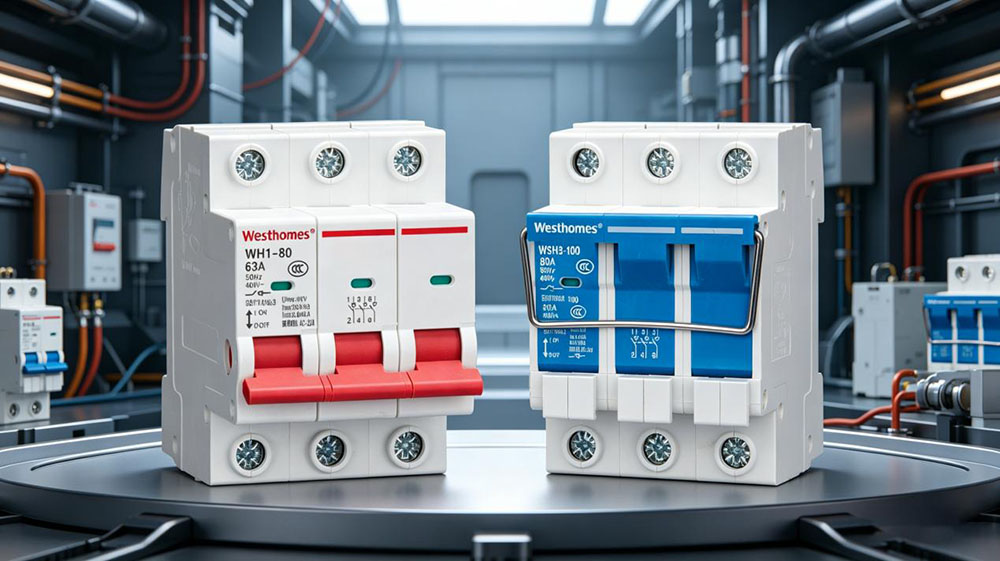
An electrical isolator switch is a manually operated mechanical device that completely isolates a specific section of a circuit from the main power supply.
When turned to the “OFF” position, it physically moves heavy conductive contacts apart. This action creates a highly visible, unambiguous physical air gap between the power source and the machinery.
The “No-Load” Operation Rule
- Strict Design: Isolators are structurally engineered to be operated strictly under “no-load”conditions.
- The Sequence: They must only be opened or closed after the electrical current flowing through the grid has already been brought to zero by an primary interrupting device, such as a circuit breaker.
Unlike solid-state relays, which can suffer from minor semiconductor leakage currents, this physical air separation guarantees that zero current can bypass the open gaps.
The Four Primary Purposes of an Isolator Switch
Absolute Personnel Safety During Maintenance
- Eliminating Ambiguity: When a technician works on a commercial HVAC unit or a high-voltage transformer, they cannot rely on software status screens.
- Visible Proof: The isolator switch provides undeniable, visible physical proof that the sub-grid is completely dead, eliminating the psychological fear of accidental shock.
Lockout-Tagout (LOTO) Compliance
- Built-in Security: Most professional industrial isolators feature integrated heavy-duty padlocking holes on their external handles.
- Preventing Unauthorized Re-start: Technicians insert their personal padlocks through the handle after opening the switch. This physically blocks anyone else from accidentally turning the power back on while maintenance is active.
Strategic Circuit Segmentation
- Targeted Isolation: In large manufacturing plants, shutting down an entire facility to repair a single minor component is financially damaging.
- Protecting Productivity: An isolator allows engineers to cut power to one specific branch line or single machine, leaving the broader distribution network fully live and productive.
Local Emergency Shutdown
- First Line of Defense: In specialized configurations, enclosed heavy-duty isolators are mounted directly adjacent to hazardous machinery.
- Overriding Control Failures: If a conveyor or robotic assembly experiences a massive mechanical fault and standard software controls fail to respond, field operators can use the heavy local handle to decisively cut off downstream power.
How Does an Isolator Switch Work? (The Mechanical Sequence)
An electrical isolator switch works through a simple mechanical action, but its safe operation depends on following a strict switching sequence. Because isolator switches are intended for no-load operation, they must always be used together with upstream protective devices such as circuit breakers to ensure safe electrical isolation.
The Golden Rule of Sequencing
An electrical isolator switch lacks any automated sensor relays or internal tripping components. It relies purely on the correct manual sequencing performed by the operator:
- Step 1 (De-energizing): The operator opens the upstream circuit breaker first to handle the high-energy burden of extinguishing the dynamic electrical arc.
- Step 2 (Isolating): Once the line current drops to zero, the operator manually throws the isolator handle to cleanly separate the physical blades.
- Step 3 (Re-energizing): When turning power back on, the reverse sequence must be kept: close the isolator first, then close the circuit breaker.
Why it Lacks Arc Quenching Mechanisms
Because the isolator is strictly operated when current is already zero, no intense electrical arc is generated across its opening contacts.
Therefore, it does not require complex arc-chute grids, heavy vacuum chambers, or dielectric oil suppression mediums. This makes its mechanical structure simpler, highly reliable, and optimized purely for structural gap clarity.
Key Classifications of Isolator Switches
Electrical isolator switches are available in a variety of designs to meet different electrical systems and installation requirements. They are most commonly classified by the number of poles they disconnect and by their operating mechanism. Understanding these classifications can help engineers and users select the most suitable isolator for a specific application.
By Number of Poles
The number of poles determines how many conductors the isolator switch can disconnect simultaneously. Different pole configurations are designed for single-phase and three-phase electrical systems with varying safety requirements.
| Type | Description | Typical Applications |
| Single-Pole (SP) | Disconnects one live conductor in a single-phase circuit. | Residential lighting and small electrical circuits. |
| Double-Pole (DP) | Disconnects both the live and neutral conductors simultaneously for enhanced safety. | Electric water heaters, air conditioners, and household appliances. |
| Triple-Pole (TP) | Disconnects all three phases in a three-phase electrical system. | Industrial motors and three-phase machinery. |
| Four-Pole (4P) | Disconnects three phases plus the neutral conductor at the same time. | Main distribution boards, generators, and industrial power systems. |
By Operating Mechanism
Isolator switches can also be classified according to their mechanical operating structure. Different mechanisms provide different levels of insulation distance and are selected based on system voltage and installation conditions.
| Type | Features | Typical Applications |
| Single-Break Isolator | Provides one disconnection point per phase with a simple structure. | Medium- and low-voltage distribution systems. |
| Double-Break Isolator | Creates two visible isolation gaps, offering greater insulation distance and reliability. | High-voltage substations and transmission systems. |
| Pantograph Isolator | Uses a pantograph mechanism for vertical opening and closing. | Extra-high-voltage substations where installation space is limited. |
Electrical Isolator vs. Circuit Breaker: The Core Differences
Although electrical isolator switches and circuit breakers are both used in electrical systems, they serve very different purposes. A circuit breaker is designed to protect circuits from overloads and short circuits by automatically interrupting the current, while an isolator switch is primarily used to provide a safe and visible point of electrical isolation for maintenance. Understanding the differences between these two devices is essential for selecting the right equipment and ensuring safe system operation.
| Technical Feature | Electrical Isolator Switch | Circuit Breaker |
| Operational State | Strictly “Off-Load” (No Current) | Can operate “On-Load” and under faults |
| Primary Function | Personnel safety isolation during maintenance | System overcurrent and short-circuit protection |
| Arc Quenching | None. Lacks mechanisms to suppress arcs | Equipped with complex arc chutes, vacuum, or SF6 gas |
| Action Mechanism | Manual operation via external physical handle | Automatic sensory tripping via internal relays |
| Breaking Capacity | Extremely low. Will sustain catastrophic damage if misoperated | Incredibly high fault-breaking capacity (kA ranges) |
In practice, circuit breakers and isolator switches are often used together rather than as substitutes, with each performing a distinct role in electrical protection and safety.
Real-World Applications Across Industries
Commercial HVAC Systems
- Line of Sight Requirement: Safety codes dictate that weatherproof rotary isolator switches must be mounted within clear line of sight of rooftop air conditioning condenser units.
- The Reason: This prevents an HVAC technician working outside from being endangered if an occupant inside the building unexpectedly modifies the indoor digital thermostat.
Solar Photovoltaic (PV) Distributed Energy
- Continuous DC Generation: Solar arrays generate direct current (DC) continuously as long as sunlight strikes them; this generation cannot be paused at the source.
- The Solution: Installing a heavy-duty, certified DC isolator switchbetween the panels and the inverter gives maintenance crews the immediate power to safely sever dangerous high-voltage lines before they enter the building.
Industrial Automated Machinery
- Harsh Environments: Automated assembly lines and heavy fluid pumps utilize metal-enclosed isolator switches with dual-interlocked mechanisms.
- Vibration Resistance: These units survive high levels of vibration, dust, and moisture while ensuring that factory floor workers can safely perform mechanical adjustments knowing the drive train is physically decoupled from the power source.
Engineering Checklist for Selection and Installation
Selecting the incorrect isolator switch can introduce catastrophic failure patterns into a distribution board. Engineers must verify the following metrics:
- Continuous Current Rating: Must equal or exceed the theoretical maximum current capacity of the downstream system to prevent continuous thermal build-up and insulation degradation.
- Nominal Voltage Rating: The rated insulation voltage must match the maximum grid operating threshold to prevent electrical tracking or sparkovers across contacts.
- Ingress Protection (IP Rating ): For outdoor or harsh industrial processing areas, enclosures with high Ingress Protection metrics (e.g., IP65 or IP66) are required to lock out heavy dust and moisture.
Frequently Asked Questions (FAQ)
Q What is the main purpose of an electrical isolator switch?
The primary purpose of an electrical isolator switch is to completely disconnect a section of an electrical system from its power source, creating a visible and safe isolation point for maintenance or repair work. Unlike a circuit breaker, it is not intended to interrupt load current or fault current.
Q What is the difference between an isolator switch and a circuit breaker?
A circuit breaker is designed to interrupt electrical current under normal and fault conditions, providing overload and short-circuit protection. An isolator switch, however, is designed for no-load operation and is used only to safely isolate equipment after the circuit has already been de-energized.
Q Can an isolator switch be operated under load?
No. Standard isolator switches are not designed to break load current. Operating an isolator under load may produce dangerous electrical arcs and can seriously damage the switch or create safety hazards. The upstream circuit breaker should always be opened first.
Q Where are electrical isolator switches commonly used?
Electrical isolator switches are widely used in industrial control panels, power distribution systems, HVAC equipment, solar photovoltaic (PV) systems, generators, and electrical machinery where safe maintenance isolation is required.
Q Is an isolator switch required for lockout-tagout (LOTO) procedures?
Yes. In many industrial applications, isolator switches provide the physical isolation point required for lockout-tagout (LOTO) procedures. Many models include padlock facilities that prevent accidental re-energization while maintenance is being performed.
Summary
Electrical isolator switches are essential for ensuring safe maintenance and servicing of electrical systems. By providing a visible and reliable disconnection point, they help protect both personnel and equipment while supporting safe operating procedures across industrial, commercial, and renewable energy applications.
Understanding how isolator switches work, where they are used, and how they differ from circuit breakers can help you select the right solution for your electrical system and improve overall safety and reliability.
Looking for a reliable electrical isolator switch for your project? Contact us to learn more about our electrical isolation solutions and technical support.

--- END ---
In this blog
Featured Articles
Get A Free Quote
