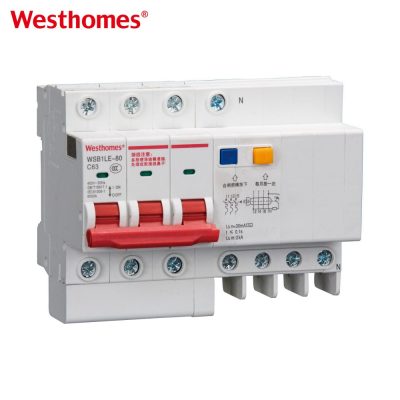
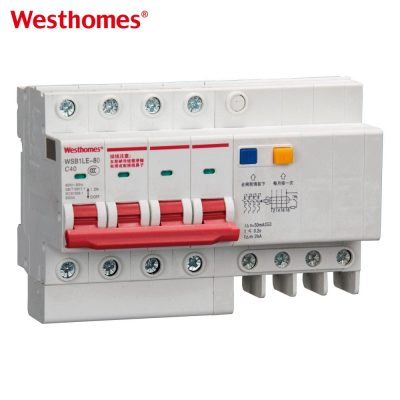
WSB1-63 Moulded case circuit breaker
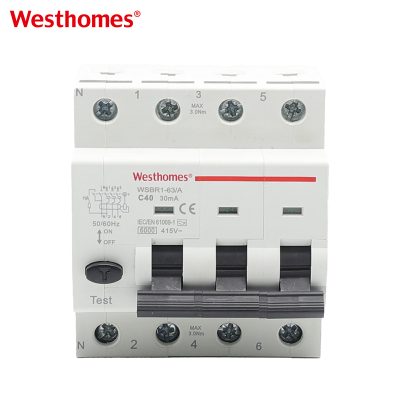
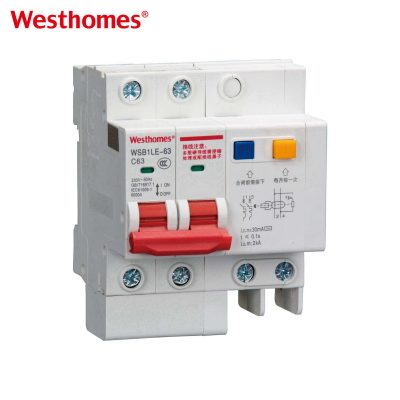
WSB1-63 series MCB is one of updated type MCCBs researched and developed by the company by using advanced design and manufacture technology internationally.
Get quick appointment for technical support!

WSB1-63 series MCB is one of updated type MCCBs researched and developed by the company by using advanced design and manufacture technology internationally.



WSB1-63 series MCB is one of updated type MCCBs researched and developed by the company by using advanced design and manufacture technology internationally.
WSB1-63 series MCBs are mainly applied at lines of AC 50Hz or 60Hz, rated operation voltage AC230/400V, rated current upto 63A, for overload and short circuit protection to the lines, also for changeover of infrequent operation to the lines. The MCBs are used at places of commercial office building, residential and similar building etc.
The product meets standards of GB 10963.1 and IEC 60898-1, at international advanced level.

| Frequency | 50Hz/60Hz |
| Pole | 1, 2, 3, 4 |
| Voltage | AC230V/400V |
| kA | 6kA, 10kA |
| Amps | 6, 10, 16, 20, 25, 32, 40, 50, 63 |
| Width | 18, 36, 54, 72mm |
| Mounting | Din rail |
| Standard | IEC/EN 60898 |
| Item No. | WSB1-63 |
| Rated current In(A) | 6, 10, 16, 20, 25, 32, 40, 50, 63 |
| Pole number | 1P, 2P, 3P, 4P |
| Trip characteristics | C type(5-10In); D type(10-20In) |
| Rated insulating voltage Ui(V) | 690 |
| Rated operating voltage Ue(V) | AC230V/AC400V |
| Rated impulse voltage Uimp(kV) | 4 |
| Breaking capacity Icu(kA) | 6 |
| Mechanical life(times) | 20000 |
| Electrical life(times) | 4000 |
| No. | Rated current | Initial state | Test current | Time limit | Expected result |
| 1 | In≤63 | Cold state | 1.13In | t≤1h | Not tripping |
| In>63 | t≤2h | ||||
| 2 | In≤63 | Just followed the last test item | 1.45In | t<1h | Tripping |
| In>63 | t<2h | ||||
| 3 | In≤32 | Cold state | 2.55In | 1s | Tripping |
| In>32 | 1s | ||||
| 4 | Type C | Cold state | 5In | t≤0.1s | Not tripping |
| 10In | t<0.1s | Tripping |

High performance here means the series offers both 6 kA and 10 kA breaking capacities, a wider current range (6–63 A) and consistent B/C/D tripping curves across 1P/2P/3P/4P configurations, while still complying with IEC 60898-1. It is intended for installations where fault levels are higher, inrush currents are larger, or the breaker may see repeated operations without losing coordination.
The series is offered in the IEC-standard MCB stepping: 6, 10, 16, 20, 25, 32, 40, 50 and 63 A. The lower ratings (6–16 A) suit lighting and small electronics, 20–32 A suit sockets and small appliances, 40–63 A suit showers, cookers, sub-mains and three-phase distribution boards. Always size In so that it sits between the design current Ib and the cable's current-carrying capacity Iz.
Choose 6 kA if the calculated prospective short-circuit current (PSCC) at the board is below 6 kA — typical for most homes and small offices fed by a distant transformer. Choose 10 kA when the board is close to a large transformer, on a high-urban-density supply, or when future supply upgrades are expected. As a rule, over-specifying breaking capacity is safer than under-specifying it; the extra cost is small compared with a fault incident.
Every MCB combines two protection elements. A thermal bimetallic strip gives inverse-time overload protection: the longer the overcurrent persists, the faster it trips. A magnetic solenoid gives instantaneous short-circuit protection, tripping in under a half-cycle when current crosses the curve threshold. The two elements share a common latch, contact set and arc chute that extinguishes the switching arc each time the breaker opens.
B-curve trips magnetically at 3–5 In and is for resistive, domestic and lighting loads. C-curve trips at 5–10 In and is the general-purpose choice for commercial, mixed and small-motor loads. D-curve trips at 10–20 In and is for highly inductive or high-inrush loads such as transformers, large motors, welders and bench tools. Selecting the wrong curve is the single most common cause of nuisance tripping.
The series is offered in 1P, 2P, 3P and 4P versions so it can cover everything from a single lighting branch to a three-phase four-wire main incomer. 1P covers single live branches, 2P switches L and N for double isolation, 3P switches L1–L3 for balanced three-phase loads, and 4P switches all three phases plus neutral where neutral isolation is required by code or by maintenance policy.
First calculate Ib, the design current of the load (sum of nameplate full-load currents, plus diversity if applicable). Pick an In that is equal to or just above Ib. Then look up Iz — the cable's current-carrying capacity under its actual installation method, ambient temperature and grouping with other cables — and confirm Iz ≥ In. If Iz is smaller than In, upsizing the cable is mandatory; upsizing the breaker instead defeats cable protection.
A compliant MCB should carry IEC 60898-1 (the product standard for household and similar overcurrent protection), CE marking for the EU market, and often additional national marks such as KEMA, VDE or UKAS for specific markets. The marking plate should also state Ue (rated operational voltage, here 230/400 V AC), In (current rating), Im (breaking capacity) and the tripping curve letter (B/C/D).
Typical uses include: final distribution in residential and commercial consumer units, branch protection for socket outlets and lighting, dedicated protection for showers, cookers, air-conditioners and heat pumps, three-phase feeds to workshops or office pods, and main incomer protection where a higher breaking capacity is needed. They are not substitutes for RCD/RCBO earth-leakage protection, which must be added separately where required by wiring regulations.
Step one: disconnect loads one at a time to find the faulty branch or appliance. Step two: confirm the load current does not exceed In (use a clamp meter). Step three: check whether a high-inrush device (motor, compressor, transformer) demands a C or D curve instead of B. Step four: look for loose terminals or damaged cable insulation causing local overheating. If none of these explain it, the breaker itself may have been weakened by a past short-circuit fault and should be replaced rather than reset.
* indicates a required field

 2 MB