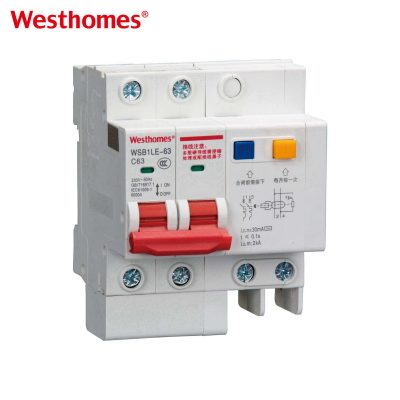
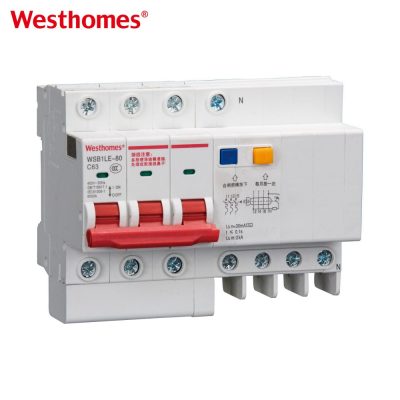
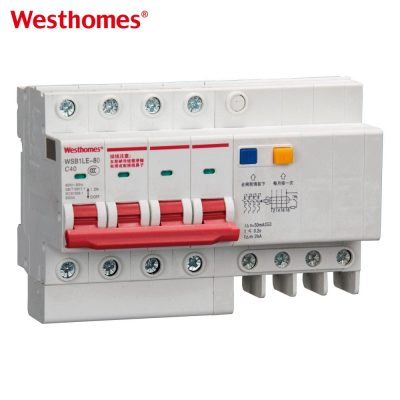
WSB1-80 Moulded case circuit breaker
WSB1-80 series MCB is one of updated type MCCBs researched and developed by the company by using advanced design and manufacture technology internationally.
Get quick appointment for technical support!

WSB1-80 series MCB is one of updated type MCCBs researched and developed by the company by using advanced design and manufacture technology internationally.



WSB1-80 series MCB is one of updated type MCCBs researched and developed by the company by using advanced design and manufacture technology internationally.
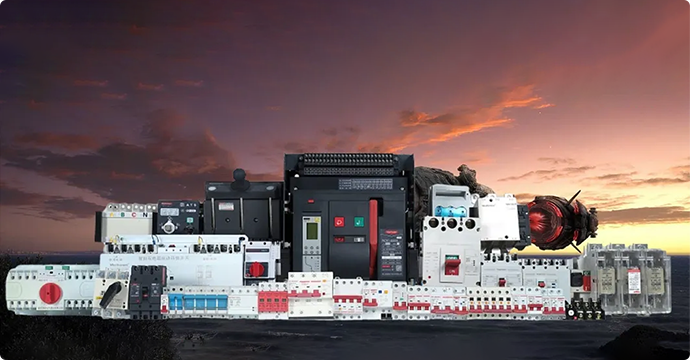
WSB1-80 series MCBs are mainly applied at lines of AC 50Hz or 60Hz, rated operation voltage AC230/400V, rated current upto 80A, for overload and short circuit protection to the lines, also for changeover of infrequent operation to the lines. The MCBs are used at places of commercial office building, residential and similar building etc.
The product meets standards of GB 10963.1 and IEC 60898-1, at international advanced level.

| Frequency | 50Hz/60Hz |
| Pole | 1, 2, 3, 4 |
| Voltage | AC230V/400V |
| kA | 6kA, 10kA |
| Amps | 6, 10, 16, 20, 25, 32, 40, 50, 63,80 |
| Width | 18, 36, 54, 72mm |
| Mounting | Din rail |
| Standard | IEC/EN 60898 |
| Item No. | WSB1-80 |
| Rated current In(A) | 6, 10, 16, 20, 25, 32, 40, 50, 63,80 |
| Pole number | 1P, 2P, 3P, 4P |
| Trip characteristics | C type(5-10In); D type(10-20In) |
| Rated insulating voltage Ui(V) | 690 |
| Rated operating voltage Ue(V) | AC230V/AC400V |
| Rated impulse voltage Uimp(kV) | 4 |
| Breaking capacity Icu(kA) | 6 |
| Mechanical life(times) | 20000 |
| Electrical life(times) | 4000 |
| No. | Rated current | Initial state | Test current | Time limit | Expected result |
| 1 | In≤63 | Cold state | 1.13In | t≤1h | Not tripping |
| In>63 | t≤2h | ||||
| 2 | In≤63 | Just followed the last test item | 1.45In | t<1h | Tripping |
| In>63 | t<2h | ||||
| 3 | In≤32 | Cold state | 2.55In | 1s | Tripping |
| In>32 | 1s | ||||
| 4 | Type C | Cold state | 5In | t≤0.1s | Not tripping |
| 10In | t<0.1s | Tripping |

A 3P MCB has three independent poles that simultaneously switch and protect L1, L2 and L3 in a three-phase circuit — it does not switch the neutral. By comparison, 1P breaks only one live conductor, 2P breaks line and neutral on a single-phase circuit, and 4P breaks all three phases plus neutral. For a balanced three-phase load with a separately grounded neutral, 3P is the standard and most cost-effective choice.
The two numbers reflect the two measurement points in a 230/400 V three-phase system: 230 V between any phase and neutral, and 400 V between any two phases. A 3P MCB is rated for 400 V between poles, so it works correctly on a standard three-phase supply; each pole also sees 230 V relative to neutral, which is within its rating. It is not suitable for 277/480 V or other nominal systems.
Inside each pole sits a bimetal strip that heats and bends under sustained overcurrent, producing a delayed (inverse-time) trip proportional to how far the current exceeds the rating. A separate magnetic coil trips the mechanism almost instantaneously (within milliseconds) when the current reaches the magnetic threshold of the chosen B/C/D curve. A common trip bar links all three poles so a fault on any phase opens the whole circuit.
Start from the load design current Ib (e.g. the sum of the FLA of all three-phase loads on the circuit). Pick In so that Ib ≤ In, and check that the cable can carry at least In continuously (Iz ≥ In) under its actual installation method (enclosed, clipped direct, etc.). Common stepping is 6, 10, 16, 20, 25, 32, 40, 50, 63 and 80 A; never select In purely by matching the cable size without accounting for grouping and ambient temperature derating.
It is the maximum prospective short-circuit current the breaker can safely clear at 400 V AC. For a 3P feeder, the fault current is the line-to-line (or line-to-neutral at the load end) value as seen from the board. If the upstream transformer impedance and cable length give a PSCC above the breaker rating, select the 10 kA version to avoid catastrophic failure during a fault.
As a rule of thumb under IEC 60364 reference conditions: up to 20 A uses 1.5 mm² copper, 25–32 A uses 4 mm², 40 A uses 6–10 mm², 50–63 A uses 10–16 mm², and 80 A uses 16–25 mm². These are starting points only — the actual Iz must be checked against the installation method, grouping with other cables and maximum ambient temperature, and the terminal temperature limits on the breaker itself.
Feed L1, L2 and L3 from the supply into the line-side terminals (top) marked on the front, and run the load-side conductors from the bottom terminals to the three-phase load. Neutral is not terminated on the breaker; it should go to a neutral bar and be grounded per the local TN/TT/TNS configuration. Keep phases in the same sequence left-to-right on both supply and load to make future troubleshooting obvious.
Use B-curve for purely resistive three-phase loads such as heaters and distributed lighting. Use C-curve (the most common) for general commercial three-phase loads with modest inrush, such as distribution boards, socket circuits and small motors starting direct-on-line. Use D-curve for high-inrush loads such as large motors, transformers, rectifiers and welding equipment, where the magnetic trip must tolerate 10–20 In without nuisance tripping.
No. The WSB1-80 3P uses a common internal trip bar: when the thermal or magnetic unit on any pole operates, the mechanism mechanically links all three poles so they open together. This is essential for safety — if only the overloaded pole opened, the motor or load would be fed from the other two phases and could burn out or present a shock hazard.
Frequent false trips usually stem from: (1) selecting a B or C curve where a D curve is needed for motor/transformer inrush; (2) undersizing the breaker below the actual running current; (3) a weak or damaged bimetal after repeated short-circuit operations; (4) loose terminals causing local overheating; or (5) a small earth fault or leakage current on one phase (in which case you should add an RCBO/RCD upstream rather than upsizing the MCB).
* indicates a required field


 2 MB