Get quick appointment for technical support!

Can You Use An MCB As A Main Switch?
Jul 25, 2025
If you’re curious whether a Miniature Circuit Breaker (MCB) can double as your main switch, you’re not the only one. Electricians, DIY enthusiasts, and homeowners always ask: “Can I rely on an MCB for total system isolation and safety?” In this post, we’ll dig into this question along with related topics. Let’s get started.
The Function of a Main Switch
A main switch is designed to control the entire electrical supply to a distribution board or building. Its function is to provide a way to turn off all power in one action. This is useful during installation, maintenance, or in case of an emergency.
Turning off the main switch ensures that no electricity is flowing into any circuit connected to the board, creating a safer condition for anyone working on the system. It gives users and electricians a simple way to control energy flow without relying on individual circuit breakers or pulling fuses.
Unlike other control devices, the main switch is typically rated to carry the full current load of the installation. It must be able to handle regular switching on and off under normal load conditions, and it must also offer reliable disconnection even after extended use. Its placement in the electrical system is at the point where the incoming power enters the board, meaning that its performance affects every downstream component.
In addition to controlling energy flow, the main switch serves as a defined point of isolation. This means that when it’s in the OFF position, no part of the system beyond that point should be live. It allows for clear, visible confirmation that the system is safe to work on. These features make the main switch a standard part of both residential and commercial electrical installations.
Differences Between MCB and Main Switch
| Feature | MCB (Miniature Circuit Breaker) | Main Switch |
| Primary Function | Protects individual circuits from overloads and short circuits | Manually disconnects power to the entire distribution board |
| Trip Mechanism | Automatic, based on fault detection | Manual only |
| Current Rating | Lower rating (typically 6A–32A for domestic use) | Higher rating (commonly 63A–100A or more) |
| Operation Type | Designed for occasional tripping, not frequent switching | Built for regular on/off operation under load |
| Isolation Capability | May not fully isolate all conductors (e.g., neutral) | Designed for complete system isolation |
| Usage Scope | Used on individual branch circuits | Controls entire panel or zone |
| Compliance | May not meet isolation standards required for main disconnection | Meets regulatory isolation requirements |
| Durability | Lower mechanical switching endurance | Higher mechanical switching rating |
While both MCBs and main switches may appear similar and be mounted side by side in an electrical panel, their functions and design specifications are fundamentally different. An MCB is built to detect fault conditions like overloads or short circuits and automatically disconnects a single circuit when needed.
It’s a protective device focused on individual branch safety. A main switch, by contrast, is manually operated and designed to shut off power to an entire system or zone. It doesn’t respond to current faults but provides a reliable way to isolate all connected circuits, making it more suitable for overall power control.
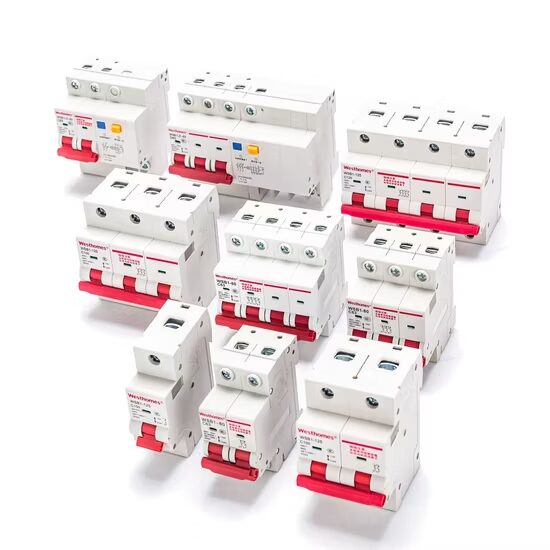
Another major difference is their ability to completely isolate systems. Main switches are rated to disconnect both live and neutral conductors, offering a clear break in power for maintenance or emergencies. MCBs typically don’t guarantee complete isolation, especially on the neutral line, which can present hidden risks.
Moreover, the main switches are mechanically rated for frequent switching and meet regulatory standards for system disconnection. MCBs, while durable in their protective role, are not designed for routine on-off use and may wear out prematurely if used as manual switches. For these reasons, using each device as intended ensures both reliability and safety over time.
When MCBs Act as the Main switch
In some cases, a miniature circuit breaker can replace the main switch, particularly in small-scale or temporary setups. This often occurs in compact distribution boards such as those found in detached garages, outdoor storage units, or secondary residential panels. In these cases, space and budget limitations might lead an installer to choose a high-amperage MCB as a simple means to control power to all circuits within that panel.
When the system’s total load is relatively low and the installation does not require full isolation features, an MCB might seem to serve both purposes adequately. However, this approach is more of a practical shortcut than a best practice.
When convenience is prioritized over long-term performance or regulatory compliance, an MCB may be selected to act as a combined protective and switching device. This tends to happen in installations where formal inspection is not required, or where electrical codes are applied more leniently.
Even in these cases, it is important to understand that using an MCB this way comes with compromises. It may not provide complete isolation, and it is not designed for repeated manual operation. These limitations should always be considered when deciding whether to use an MCB as a main switch, especially if the system is expected to be in use for the long term.
Safety Considerations in Using MCB as a Switch
While using an MCB as a main switch may seem like a practical solution in smaller setups, it often leads to limitations that affect both safety and performance. Switching off an MCB may stop current to certain parts of the system, but it does not always shut everything down completely. This can give the impression that the system is safe to work on when, in fact, some sections may still carry voltage. In maintenance situations, this becomes a serious concern.
Repeated manual use can also wear down the MCB’s internal components over time. These devices are primarily intended to respond automatically to faults, not to serve as daily switches. As wear increases, their ability to operate correctly during a real electrical issue may decline. On top of this, most building codes set specific requirements for what qualifies as a proper main switch.
These include full isolation, the ability to disconnect all conductors, and clear visual separation. MCBs are typically not rated to meet all of these standards. Even if the system continues to operate, it may no longer comply with regulations or offer the level of protection that was originally intended.
MCB in Residential and Commercial Applications
Residential Applications
- Lighting circuits
- Kitchen and general-purpose outlets
- Air conditioning units
- Water heaters
- Washing machines and dryers
- Small sub-panels in garages or sheds
Commercial and Industrial Applications
- Office lighting and power distribution
- HVAC systems
- Industrial machinery control panels
- Server rooms and IT infrastructure
- Motor protection in manufacturing setups
- Sub-distribution boards for segmented electrical zones
Summary
In a small system, can a single MCB act as both a circuit breaker and a main switch? Yes, it is possible in limited scenarios, but it’s rarely recommended. When it comes to safe isolation, meeting regulatory standards, and ensuring reliable maintenance access, using a dedicated main switch along with MCBs for circuit-level protection remains the best practice.
If you’re unsure about your setup, it’s always wise to consult a licensed electrician for guidance and proper component selection. Westhomes provides a full range of professional Miniature circuit breakers to help you build safer and smarter electrical systems.

--- END ---
In this blog
Featured Articles
Get A Free Quote
