Get quick appointment for technical support!

How to Read a Miniature Circuit Breaker (MCB) Nameplate
May 23, 2026
Introduction
At first glance, an MCB nameplate may seem like a collection of letters, numbers, and certification symbols. However, every marking on the front of a miniature circuit breaker serves a specific purpose. From the rated current and tripping curve to the breaking capacity and safety certifications, these details help determine whether a breaker is suitable for a particular electrical application.
For electricians, engineers, contractors, and distributors, understanding nameplate information is essential for selecting the right protection device, ensuring compliance with standards, and maintaining system reliability.
In this guide, we will explain the most important markings found on an MCB nameplate and show how to interpret them correctly.
Why Is the MCB Nameplate Important?
The nameplate of a Miniature Circuit Breaker (MCB) is often compared to the product’s identification card. Although the breaker itself may look simple, the information printed on its front contains critical details about its performance, protection capabilities, and intended application.
Quick Identification of Key Specifications
An MCB nameplate contains a large amount of technical information, but not every marking carries the same level of importance. For electricians, engineers, and buyers, being able to quickly identify a few key specifications can significantly improve product selection efficiency and reduce the risk of choosing an unsuitable breaker.
When evaluating an MCB, there is usually no need to read the entire technical datasheet first. Most of the essential information required for initial selection can be found directly on the front of the breaker. By understanding these core markings, users can quickly determine the breaker’s protection capability, operating characteristics, system compatibility, and compliance status.
The following markings are generally considered the most important information on an MCB nameplate and should be checked before installation or purchase.
Key Specifications to Check
- Rated Current (In)— Determines the maximum continuous operating current the breaker can carry under normal conditions.
- Trip Curve (B/C/D)— Defines how quickly the breaker responds to overloads and short-duration current surges.
- Breaking Capacity (Icn)— Indicates the maximum short-circuit current the breaker can safely interrupt.
- Rated Voltage (Ue)— Specifies the voltage level for which the breaker is designed and tested.
- Number of Poles— Shows how many conductors can be disconnected simultaneously.
- Safety Standards and Certifications— Verifies compliance with recognized safety and performance requirements.
- Manufacturer and Product Series— Identifies the product family and helps users locate technical documentation and spare parts.
These markings work together to provide a complete picture of the breaker’s capabilities. Rather than looking at only one parameter, users should evaluate all of them together to ensure the breaker matches the requirements of the electrical system.
As a general rule, if you can correctly identify the current rating, trip curve, breaking capacity, voltage rating, and certification marks, you will already understand most of the information that matters on an MCB nameplate.
Helps Ensure Correct Breaker Selection
Selecting an MCB is not simply about choosing the right current rating. The breaker must also match the system voltage, fault level, load characteristics, and installation requirements.
For example, two breakers may both be rated at 16A, but a B-curve breaker and a D-curve breaker can behave very differently during startup currents.
Understanding the nameplate helps users choose the right breaker for the application and avoid unnecessary operational problems.
Improves Electrical Safety
The nameplate also provides important safety information. Parameters such as breaking capacity and certification markings indicate whether the breaker has been tested to operate safely under fault conditions.
Using a breaker with an insufficient breaking capacity may create serious risks during a short circuit event.
Verifies Compliance and Certifications
Most quality MCBs display certification markings such as IEC 60898-1, CE, CCC, UL, or other regional approvals.
These markings help users verify that the product complies with recognized safety and performance standards.
For international projects, certification compliance is often just as important as the electrical specifications themselves.
A Small Label with Big Importance
Many installation mistakes occur because users only look at the current rating while ignoring other important markings.
Spending a few seconds reading the entire nameplate can help prevent incorrect breaker selection, improve protection performance, and ensure long-term system reliability.
Common Information Found on an MCB Nameplate
1. Manufacturer and Product Series
The upper section of an MCB nameplate usually displays the manufacturer’s name, logo, and product series. This information helps users identify the exact breaker model, locate technical datasheets, and verify compatibility with existing electrical systems.
Common examples include:
- WESTHOMES WSB1-63
- Schneider Acti9
- ABB S200
- CHINT NXB-63
Although this marking may appear simple, it is often the starting point for selecting spare parts, checking certifications, and obtaining installation instructions.
2. Rated Current (In)
The rated current is one of the most important parameters on an MCB nameplate. It indicates the maximum current the breaker can continuously carry under normal operating conditions without tripping.
Typical ratings include:
- 6A
- 10A
- 16A
- 20A
- 32A
- 63A
It is important to understand that the rated current does not represent the maximum fault current the breaker can interrupt. Instead, it represents the current level the breaker is designed to carry continuously.
Choosing the correct current rating helps prevent nuisance tripping while still providing adequate protection against overload conditions.
Typical Applications
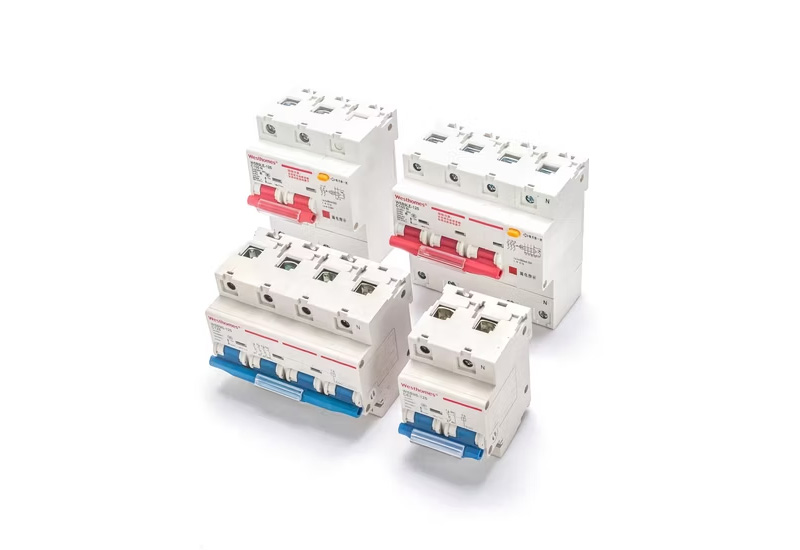
Although current rating is one of the most visible markings on an MCB nameplate, selecting the right rating requires understanding the actual load characteristics of the circuit. Lighting circuits, socket outlets, air conditioners, water heaters, and distribution feeders all have different current demands. Using the appropriate MCB rating helps ensure reliable operation while maintaining effective overload protection. The following table provides a general reference for common MCB current ratings and their typical applications.
| Current Rating | Typical Application |
| 6A | Lighting circuits |
| 10A | Residential lighting |
| 16A | Socket outlets |
| 20A | Dedicated appliance circuits |
| 32A | High-power appliances |
| 63A | Main distribution circuits |
3. Tripping Curve (B, C, or D)
Another important marking found on an MCB nameplate is the tripping curve. Many users immediately notice markings such as B16, C16, or D32, but may not fully understand what these codes mean.
The tripping curve describes how quickly the breaker responds to sudden overcurrents and short-duration current surges. While all MCBs are designed to protect circuits from overloads and short circuits, different types of electrical loads produce different levels of inrush current when they start up. For this reason, MCBs are manufactured with different tripping characteristics to match various applications.
For example, lighting circuits typically require fast protection because they generate very little startup current, while motors and transformers may draw several times their normal operating current for a short period during startup. Selecting the wrong tripping curve can lead to nuisance tripping or inadequate protection.
Many MCBs display markings such as:
- B16
- C16
- D32
The letter indicates the tripping characteristic, while the number represents the rated current.
For example:
C16 = C Curve + 16A Rated Current
Choosing the correct trip curve is just as important as selecting the correct current rating because it directly affects system reliability and protection performance.
4. Breaking Capacity (Icn)
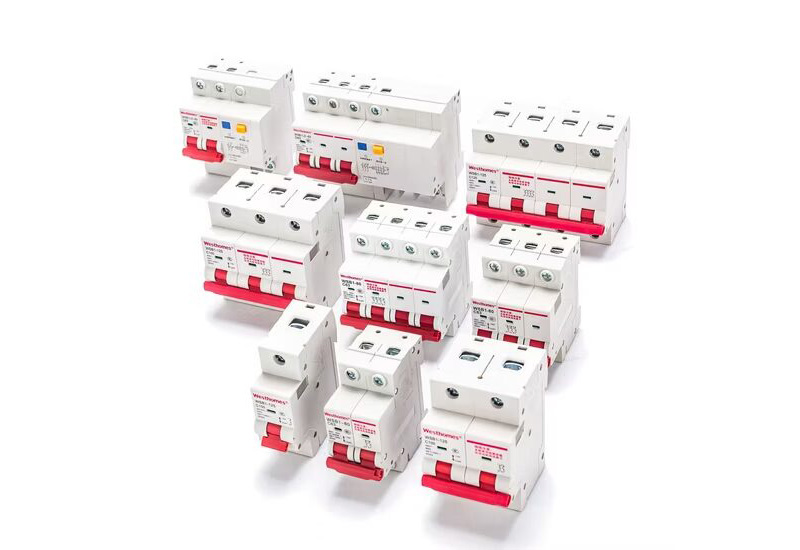
Breaking capacity is one of the most critical safety parameters shown on an MCB nameplate. While the rated current tells us how much current the breaker can carry continuously, the breaking capacity tells us how much fault current it can safely interrupt during a short circuit.
During a short-circuit event, the fault current can rise to hundreds or even thousands of amperes within milliseconds. If the breaker is unable to interrupt this current safely, severe equipment damage, fire hazards, or personal injury may occur. This is why breaking capacity is considered one of the most important specifications when selecting a circuit breaker.
Common markings include:
- 5kA
- 6kA
- 10kA
Breaking capacity refers to the maximum short-circuit current that the breaker can interrupt safely without being damaged.
For example:
6kA = Maximum interrupting capacity of 6,000 amperes
In residential installations, fault levels are usually relatively low. However, in commercial buildings, industrial plants, and power distribution systems located close to transformers, available fault currents can be significantly higher. Therefore, selecting an appropriate breaking capacity is essential for maintaining electrical safety.
5. Rated Voltage (Ue)
The rated voltage indicates the voltage level for which the breaker has been designed, tested, and certified. It is an important parameter because the breaker must be capable of interrupting fault currents safely at the specified voltage level.
Many users focus primarily on current rating while overlooking voltage rating. However, even if the current rating is correct, using a breaker in a system with a higher voltage than its rated value may reduce its performance and compromise safety.
Common markings include:
- 230V
- 240V
- 400V
- 415V
Using an MCB within its rated voltage range ensures proper insulation performance, reliable fault interruption, and compliance with safety standards.
6. Number of Poles
The pole marking indicates how many conductors the breaker can disconnect simultaneously. Although this specification is often overlooked, it plays an important role in electrical safety, maintenance procedures, and system isolation requirements.
Different electrical systems require different pole configurations. Selecting the correct number of poles ensures proper circuit isolation and helps prevent dangerous situations during maintenance or fault conditions.
Typical configurations include:
- 1P
- 2P
- 3P
- 4P
The choice depends on the electrical system structure, wiring method, and protection requirements.
7. Standard Certification Markings
Besides electrical ratings, certification markings are among the most important indicators of product quality and safety. These markings show that the breaker has undergone testing and evaluation according to recognized national or international standards.
For engineers, contractors, and buyers, certification marks provide confidence that the product meets minimum requirements for safety, reliability, mechanical endurance, insulation performance, and fault interruption capability.
Common markings include:
- IEC 60898-1
- CE
- CCC
Certification information is especially important in export projects and international markets where compliance requirements may vary significantly between regions.
Common Mistakes When Reading MCB Nameplates
Although MCB nameplates provide a wealth of technical information, many users only focus on one or two familiar markings and overlook the rest. In practice, incorrect interpretation of nameplate data is one of the most common causes of improper breaker selection.
A breaker that appears suitable based on current rating alone may actually have insufficient breaking capacity, an inappropriate trip curve, or certifications that do not meet project requirements. These mistakes can lead to nuisance tripping, inadequate protection, equipment damage, project compliance issues, and even electrical safety hazards.
To avoid these problems, it is important to understand the most common mistakes people make when reading MCB nameplates.
Confusing Rated Current with Breaking Capacity
Among all nameplate markings, rated current and breaking capacity are probably the two parameters most frequently misunderstood. Many users can easily identify the current rating printed on the breaker but fail to understand that it serves a completely different purpose from the breaking capacity.
Understanding the distinction between these two parameters is essential because one relates to normal operation, while the other relates to fault protection.
Many people assume that a breaker marked “16A” can only interrupt a maximum fault current of 16 amperes. In reality, the 16A marking refers to the breaker’s rated current, which indicates the maximum current it can continuously carry under normal operating conditions.
The actual short-circuit interruption capability is determined by the breaking capacity, which may be marked as 4.5kA, 6kA, 10kA, or higher.
For example:
- A 16A breaker with a 6kA rating can continuously carry 16A during normal operation.
- The same breaker can safely interrupt a fault current of up to 6,000A during a short circuit.
Ignoring breaking capacity during product selection may result in catastrophic failure when a severe fault occurs. Therefore, both parameters should always be evaluated together.
Ignoring the Trip Curve
Another common mistake is focusing only on the current rating while completely ignoring the trip curve. Since the trip curve is represented by a single letter, many users mistakenly assume it is a minor detail. In reality, it directly determines how the breaker reacts to short-duration current surges.
The wrong trip curve can significantly affect both system reliability and protection performance.
For example:
- B16
- C16
- D16
Although all three breakers are rated at 16A, they respond very differently to inrush currents.
Choosing the wrong trip curve may lead to:
- Frequent nuisance tripping during motor startup
- Unexpected shutdowns of equipment
- Reduced protection for sensitive circuits
- Poor coordination with other protective devices
For this reason, the trip curve should always be selected according to the load type rather than current rating alone.
Overlooking Certification and Compliance Marks
Many buyers pay close attention to technical specifications but pay little attention to certification markings. This is particularly common when comparing products from different manufacturers.
However, certifications often provide valuable information about product quality, safety testing, and market compliance.
Most high-quality MCBs display markings such as:
Safety Standards
- IEC 60898-1
- UL 489
Certifications
- CE
- CCC
- VDE
These markings indicate that the breaker has undergone recognized testing procedures and meets defined safety and performance requirements.
Ignoring certifications may lead to:
- Project approval difficulties
- Compliance problems
- Reduced customer confidence
- Uncertain protection performance
Misunderstanding Voltage Ratings
Voltage rating is another specification that is often overlooked during product selection. Some users assume that if the current rating is correct, the breaker can be installed in any electrical system.
This assumption is incorrect because breaker performance is closely linked to its rated operating voltage.
Using a breaker beyond its rated voltage may affect:
- Arc extinguishing performance
- Short-circuit interruption capability
- Electrical insulation safety
- Long-term reliability
Therefore, voltage ratings should always be checked alongside current ratings when selecting an MCB.
Choosing the Wrong Number of Poles
The number of poles is sometimes treated as a secondary consideration, but it directly affects circuit isolation and maintenance safety.
Many users choose pole configurations based solely on cost or availability without considering the actual wiring structure of the electrical system.
An incorrect pole configuration may result in:
- Incomplete circuit isolation
- Unsafe maintenance conditions
- Reduced fault protection effectiveness
- Non-compliance with local regulations
Assuming All MCBs with the Same Rating Are Identical
Perhaps the most overlooked mistake is assuming that two breakers with the same current rating and trip curve are equivalent.
In reality, breakers that appear identical on the surface can differ significantly in quality, testing standards, and overall performance.
Important differences may include:
- Breaking capacity
- Certification standards
- Mechanical lifespan
- Electrical lifespan
- Terminal design
- Temperature performance
- Environmental resistance
For this reason, professionals should always review the complete nameplate rather than relying on only one or two familiar markings.
Example: How to Read a Real MCB Nameplate
After understanding the individual markings found on an MCB nameplate, the next step is learning how to interpret all the information together. In real-world applications, electricians and engineers rarely analyze one parameter in isolation. Instead, they read the complete nameplate to quickly determine the breaker’s current rating, tripping characteristic, breaking capacity, voltage suitability, and compliance standards.
The ability to interpret a nameplate at a glance is an important skill when selecting products, performing maintenance, troubleshooting electrical systems, or verifying compliance during project inspections.
To illustrate how this works, let’s examine a typical MCB marking and break down each element step by step.
Example
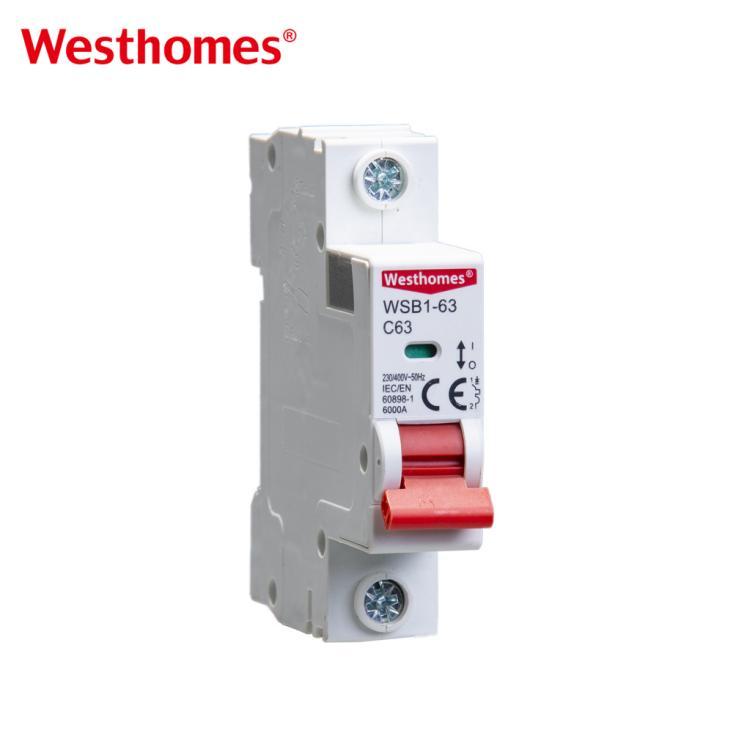
WESTHOMES WSB1-63 C63 6kA 230/400V IEC 60898-1
At first glance, this combination of letters and numbers may seem complicated. However, each marking provides specific technical information about the breaker. By reading them from left to right, users can quickly understand the product’s key specifications and intended application.
This marking can be interpreted as:
- WSB1-63→ Product series
- C63→ C-curve breaker with a rated current of 63A
- 6kA→ Maximum short-circuit breaking capacity of 6000A
- 230/400V→ Rated operating voltage for single-phase and three-phase systems
- IEC 60898-1→ Complies with the international standard for residential and commercial MCBs
What Does This Tell Us?
From this nameplate, we can quickly determine that the breaker is designed for general-purpose power distribution applications. The C-curve characteristic makes it suitable for most residential and commercial circuits, while the 6kA breaking capacity provides adequate protection for typical low-voltage distribution systems.
Compliance with IEC 60898-1 further confirms that the breaker has been tested according to internationally recognized safety and performance requirements.
Quick Tip: When reading any MCB nameplate, start by identifying the current rating, trip curve, and breaking capacity first. These three parameters usually provide the fastest indication of whether the breaker is suitable for your application.
Frequently Asked Questions (FAQ)
Q1: What does C16 mean on an MCB?
C indicates the tripping curve and 16 indicates a rated current of 16A.
Q2: What is the difference between 6kA and 10kA?
They represent different short-circuit breaking capacities.
Q3: Is a higher kA rating always better?
Not necessarily. The breaker should match the fault level of the installation.
Q4: Can I replace a B-curve breaker with a D-curve breaker?
Only after confirming that the application requires it and complies with local regulations.
Q5: What does IEC 60898-1 mean?
IEC 60898-1 is the most widely used international standard for miniature circuit breakers used in residential and commercial installations.
Q6: Where can I find the breaking capacity on an MCB?
The breaking capacity is usually printed near the rated current marking and appears as 4.5kA, 6kA, or 10kA.
Q7: Can two C16 breakers have different performance?
Yes. Even if the rated current and trip curve are the same, breaking capacity, certifications, lifespan, and construction quality may differ.
Conclusion
Reading an MCB nameplate is an essential skill for anyone working with electrical systems. By understanding markings such as rated current, trip curve, breaking capacity, voltage rating, pole configuration, and certification standards, users can select the right breaker for their application and improve overall system safety.
A few seconds spent reading the nameplate can help prevent costly installation mistakes and ensure reliable protection throughout the life of the electrical system.

--- END ---
In this blog
Featured Articles
Get A Free Quote
