Get quick appointment for technical support!

What Are the Common Safety Standards for Electrical Protection Devices?
May 21, 2026
Introduction
When choosing electrical protection devices like circuit breakers, RCCBs, MCCBs, or fuses, most people focus on current ratings or price. But there is another factor that is just as important: safety standards.
A protection device may look reliable from the outside, but without proper certification and testing, there is no guarantee it will operate safely during a fault. In real electrical systems, certified and non-certified products can make a huge difference in equipment protection, fire prevention, and personal safety.
That is why electrical safety standards matter. They define how products should be designed, tested, and operated to ensure reliable performance under real working conditions. Whether in homes, commercial buildings, or industrial systems, understanding these standards helps users make safer and more reliable choices.
Why Electrical Safety Standards Matter
Electrical systems operate under constantly changing conditions. Overloads, short circuits, insulation failure, voltage fluctuations, and environmental factors can all create potential hazards. Safety standards help ensure protection devices are capable of handling these situations safely and consistently.
Without standardized testing, different manufacturers might use completely different testing methods, making product performance unpredictable. International standards create a common benchmark for quality, reliability, and safety.
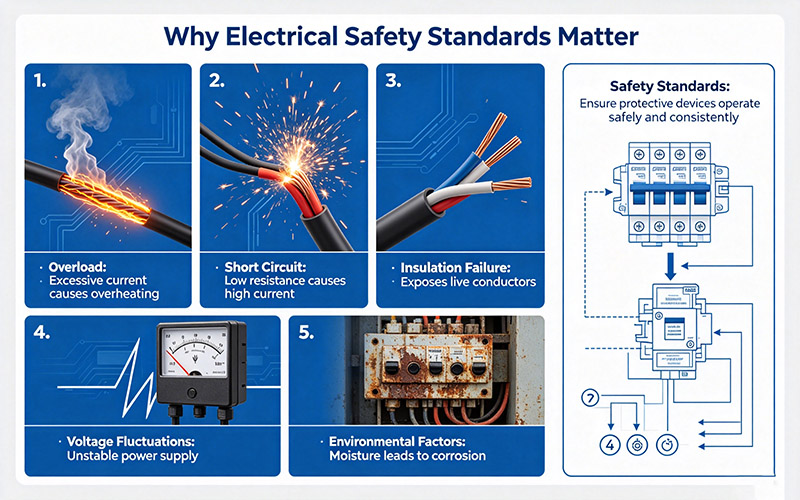
Key Benefits of Safety Standards
Protection of People and Property
The most important purpose of electrical safety standards is protecting people and equipment from danger. Electrical faults can lead to electric shock, overheating, arc flashes, equipment failure, and even large-scale fires. Safety standards help reduce these risks by ensuring that protection devices are designed, tested, and manufactured to operate safely under real working conditions.
For example, circuit breakers must trip within specific time limits during overloads or short circuits, while insulation materials must withstand certain temperature and voltage levels. Without these requirements, even small electrical faults could quickly become serious safety accidents.
Reliable Fault Protection
Safety standards verify whether protection devices can actually perform correctly during abnormal conditions. Products such as MCBs, MCCBs, RCCBs, and fuses all need to pass strict overload, short-circuit, insulation, and endurance testing before certification.
This helps ensure that protection devices can still react quickly and safely when real faults occur in factories, commercial buildings, or residential systems.
Product Consistency and Quality Control
International standards help ensure that certified products from different manufacturers meet minimum safety and performance requirements. This makes system design easier and improves compatibility between devices within the same distribution system.
Easier Access to Global Markets
Certifications such as IEC, UL, CE, and CCC are often mandatory for entering certain countries or regions. Products with recognized certifications are generally easier to export and more trusted by international customers.
Compliance With Local Regulations
Many countries legally require certified electrical products in construction and industrial projects. Using uncertified products may create inspection failures, insurance disputes, or legal liabilities after accidents.
IEC Standards: The Most Widely Used International Standards
The IEC (International Electrotechnical Commission) is one of the most recognized organizations in the electrical industry. IEC standards are widely used across Europe, Asia, the Middle East, Africa, and many international markets.
Common IEC Standards for Protection Devices
- IEC 60898— Household and residential MCBs
- IEC 60947-2— Industrial MCCBs and power breakers
- IEC 61008 / IEC 61009— RCCBs and RCBOs
- IEC 60269— Low-voltage fuses
Surge protection selection follows a different route from overcurrent selection, and the comparison of Type 1, Type 2 and Type 3 devices sets out which one a given installation needs.
UL Standards in North America
UL stands for Underwriters Laboratories, one of the most recognized safety certification organizations in North America. UL-certified products are widely trusted because they undergo strict safety and performance testing.
Common UL Standards
- UL 489— Molded case circuit breakers and branch protection
- UL 1077— Supplementary protectors
- UL 943— GFCI leakage protection devices
CE Marking in Europe
Unlike IEC or UL, CE is not a testing standard itself. It is a conformity marking required for products sold within the European Economic Area.
Why CE Matters
- Required for entering many European markets
- Indicates compliance with safety and EMC regulations
Other Common International Certifications
Besides IEC, UL, and CE standards, many countries also have their own local certification systems for electrical protection devices. These certifications help ensure products comply with regional regulations, installation requirements, and market access rules.
CCC Certification (China)
CCC stands for China Compulsory Certification. Many electrical products cannot legally enter the Chinese market without CCC approval. The certification process includes product testing, factory inspections, and ongoing quality supervision.
CSA Certification (Canada)
CSA is one of the most recognized electrical safety certifications in Canada. It is commonly required for electrical products used in residential, commercial, and industrial projects.
VDE Certification (Germany)
VDE certification is highly respected because of Germany’s strict engineering standards. Products carrying VDE approval are often associated with high quality, strong reliability, and excellent safety performance.
RoHS Compliance
RoHS focuses on environmental protection by restricting hazardous substances such as lead, mercury, and cadmium in electrical products. Today, RoHS compliance is widely required in many international markets.
How Safety Standards Affect Real Applications
In Industrial Systems
Industrial systems often operate under high fault currents, voltage fluctuations, vibration, dust, humidity, and continuous heavy loads. Certified protection devices help ensure stable operation even under harsh conditions.
In factories, electrical failures may stop production lines, damage expensive machinery, and create significant financial losses. That is why industrial projects usually place strong emphasis on internationally certified electrical protection devices.
In Commercial Buildings
Commercial buildings rely heavily on stable power distribution for lighting, HVAC systems, elevators, office equipment, security systems, and data networks.
Certified breakers and RCCBs help isolate faults quickly, preventing local problems from affecting the entire building. Standards also improve maintenance safety and inspection efficiency.
In Residential Installations
Certified breakers and RCCBs help reduce risks such as electric shock, overloaded wiring, overheating, and electrical fires. As household power demand continues increasing, properly certified protection devices have become an important part of everyday electrical safety.
Pole configuration is settled in the same pass, and the difference between SP, TP, TPN and 4P arrangements shows how the standard defines each.
Common Mistakes When Choosing Protection Devices
Focusing Only on Price
Extremely low-cost products may look similar to certified products, but their internal materials, testing quality, and protection performance can be completely different. In some cases, low-quality devices may fail to trip during overloads or short circuits, creating serious safety hazards.
Ignoring Certification Marks
Some users only focus on current ratings while ignoring certification marks such as IEC, UL, CE, CCC, or CSA. Without proper certification, actual product safety and reliability may not be guaranteed.
Mixing Different Standards Incorrectly
Products designed for IEC systems may not always match UL-based installations. Mixing standards incorrectly may lead to compatibility problems or incorrect protection performance.
Using Non-Certified Products in Critical Systems
Using non-certified breakers in hospitals, data centers, factories, or commercial buildings creates major safety and liability risks.
Frequently Asked Questions (FAQ)
Q1: Is IEC better than UL?
Neither is universally “better.” IEC is more common internationally, while UL is dominant in North America. The correct choice depends on the target market and local regulations.
Q2: Can one product have multiple certifications?
Yes. Many manufacturers obtain IEC, CE, UL, and other certifications for different markets.
Q3: Why are certified breakers more expensive?
Because certification requires testing, factory audits, quality control, and compliance management.
Q4: Are counterfeit certifications common?
Unfortunately, yes. Always verify certification marks and purchase from trusted suppliers.
Q5: Do residential systems also need certified protection devices?
Absolutely. Residential electrical faults can still cause fires and safety hazards.
Our Certifications
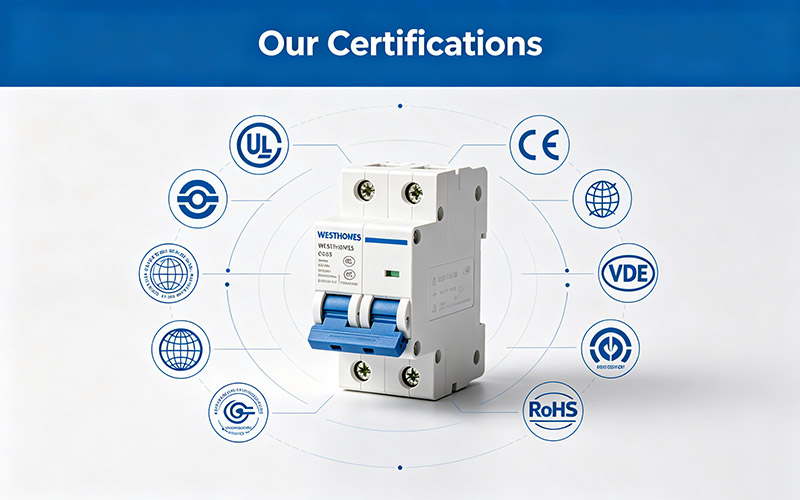
WESTHOMES products comply with multiple international safety standards to ensure reliable electrical protection performance in global markets.
Conclusion
Electrical protection devices are only as reliable as the standards behind them. Certifications such as IEC, UL, CE, and other international standards are not just labels on a product. They represent testing, safety verification, and long-term reliability under real operating conditions.
For engineers, contractors, distributors, and end users, understanding these standards helps ensure safer installations, more stable systems, and better long-term protection performance.
In modern electrical systems, choosing certified protection devices is not simply about compliance. It is about protecting people, equipment, and entire power systems with confidence.
Device selection across MCB, MCCB, RCCB and RCBO follows the same clause logic, and the guide to circuit breaker choices sets out how each type meets a different requirement.

--- END ---
In this blog
Featured Articles
Get A Free Quote
