Get quick appointment for technical support!

What Is the Red Wire in Electrical? Understanding Its Purpose and Use
Jun 05, 2026
Introduction
Electrical wiring can often feel like a maze, especially when you pull off a switch plate and encounter a cluster of different colored insulation. Among these, the red wire is arguably one of the most common—yet most frequently misunderstood. Many homeowners assume that all live wires are black, leading to confusion, or worse, dangerous mistakes when a red wire suddenly appears in a circuit.
In reality, the red wire is a versatile and critical component of modern residential and wiring. Depending on how your home was wired, it can act as a switch-controlled hot wire, a secondary live conductor delivering high voltage, or a vital communication link in life-safety systems.
Understanding exactly what a red wire does is not just about getting your DIY projects right; it is a fundamental requirement for safe troubleshooting, routine maintenance, and accident prevention. This comprehensive guide will break down the true purpose of the red wire, its common applications, and the vital safety protocols you must follow.
What Does the Red Wire Mean?
In standard alternating current (AC) electrical systems, wire colors serve as a visual code to protect installers and ensure consistent circuit design. Under these conventions, the red wire is classified as a live or “hot” conductor.
This means it is designed to carry a continuous or controlled electrical current directly from your main breaker panel. Unlike white neutral wires, which return current to the panel, or green ground wires, which safely divert fault currents, a red wire is energized and inherently carries a risk of severe shock if handled improperly.
In residential setups, you will rarely see a red wire running by itself. It almost always works in tandem with a black wire (the primary hot conductor) to provide expanded functionality. Together, they allow a single cable run to manage complex tasks like controlling a ceiling fan and its light kit independently, or powering heavy-duty appliances that require higher voltage.
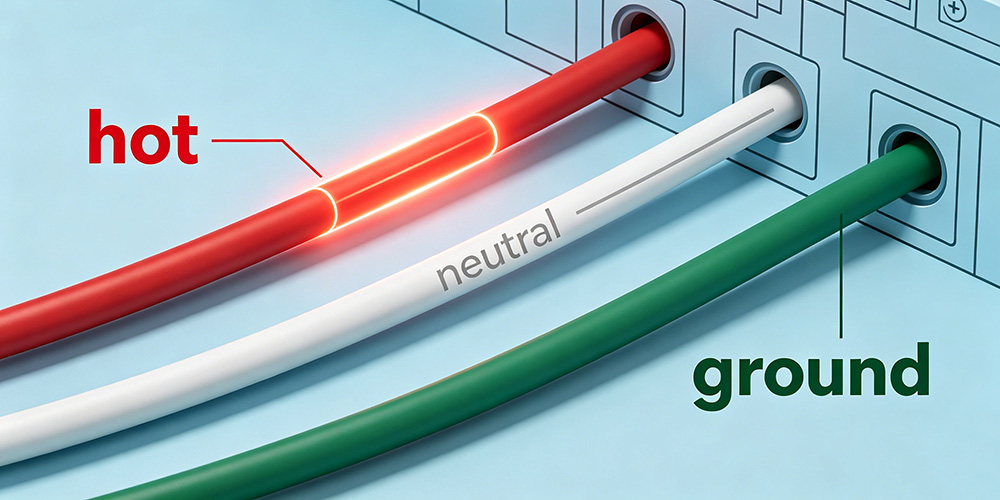
The Golden Rule of Electrical Safety: Wire colors act as an incredibly helpful guide, but they are not an absolute guarantee. Factors like outdated regional standards, DIY mistakes by previous homeowners, or unauthorized modifications can completely flip standard conventions. Never rely on color alone to assume a wire is safe.
Visual Reference for Electrical Wiring
To help you visualize how these components interact, let’s look at the standard structural layout of modern residential wiring.
Electrical Wire Color Identification Chart
| Wire Color | Electrical Classification | Primary Function & Behavior |
| Black | Primary Hot | Carries constant, unswitched 120V power directly from the breaker panel. Always assume it is energized. |
| Red | Secondary / Switched Hot | Used as a secondary live wire for 240V, a traveler for multi-way switches, or a controlled load line. |
| White | Neutral Wire | Completes the circuit by returning current back to the source. Can still carry current under load. |
| Green / Bare | Equipment Ground | Provides a safe, low-resistance path into the earth to trip the breaker during a short circuit. |
| Blue / Yellow | Specialty Traveler / Conduit Line | Frequently utilized in commercial conduit runs as switch legs or complex multi-location controls. |
Major Applications of Red Wires
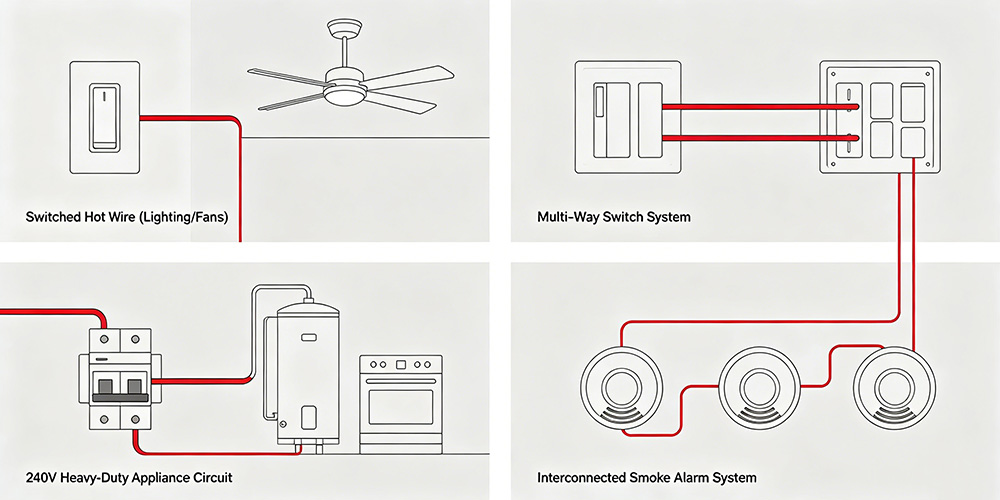
To understand where you might encounter a red wire, it helps to look at the specific electrical challenges this color was introduced to solve. Here are the four most common applications in modern infrastructure:
Switched Hot Wires in Lighting and Fans
One of the most practical everyday uses for a red wire is splitting power within a single electrical box. For instance, when you install a ceiling fan with a built-in light kit, you want to be able to turn the light on and off using a wall switch while keeping the fan blades rotating continuously via its pull chain.
To achieve this, electricians run a standard three-conductor cable ($14/3$ or $12/3$ WG). The black wire supplies constant power directly to the fan motor, while the red wire acts as the switched hot line, connecting the wall switch directly to the light fixture. When the switch is flipped down, the red wire loses its voltage, but the fan motor remains powered.
Common Locations: Dining room chandeliers, master bedroom ceiling fans, and half-hot split outlets (where the top plug is always on, but the bottom plug is controlled by a wall switch).
Multi-Way Switch Systems (Three-Way & Four-Way)
Have you ever wondered how you can turn on a staircase light from the bottom of the stairs and then turn it off once you reach the top? This convenience relies entirely on three-way switch circuits, and the red wire plays the starring role.
In a multi-way switch configuration, a pair of wires called traveler wires must constantly pass signals back and forth between the two switches. Electricians utilize the red wire alongside the black wire as these dual travelers.
Depending on the physical positions of both toggles, the live current shifts paths between the red and black wires to complete or break the circuit. Because the red wire alternates between being energized and de-energized every time someone flips either switch, treating it with caution is paramount.
Dedicated 240V Heavy-Duty Appliance Circuits
While standard household outlets run on a single 120V hot wire, massive, energy-hungry residential appliances require double that power to operate efficiently. This is accomplished using a 240V circuit, which draws power from both phases of your electrical panel.
In a standard 240V installation (such as a 4-wire configuration):
- Black Wire: Connects to Phase A (120V to ground)
- Red Wire: Connects to Phase B (120V to ground)
- White Wire: Acts as the shared neutral completion path
- Green Wire: Serves as the chassis safety ground
Because Phase A and Phase B are perfectly out of sync, combining them yields a powerful 120V – (-120V) = 240V potential difference across the appliance load. In this specific scenario, the red wire is a full-time, primary live conductor that is permanently energized with high-amperage current whenever the main dual-pole breaker is turned on.
Typical Equipment: Central air conditioning compressors, electric clothes dryers, residential water heaters, and built-in kitchen ovens.
Interconnected Smoke Alarm Systems
Modern building codes mandate that if a smoke detector in a remote basement senses a fire, every single alarm throughout the entire multi-story residence must sound simultaneously to give occupants maximum evacuation time.
To establish this critical life-safety web, manufacturers design residential alarms with three wire hookups: black for constant 120V power, white for neutral, and a red terminal strictly for interconnection. In this context, the red wire does not supply operational power. Instead, it acts as a dedicated low-voltage signal communication line running from room to room.
When an individual detector triggers, it sends a localized voltage pulse down the red wire, which instantly forces every other linked unit into full alarm mode.
Pitfalls & Misconceptions to Avoid
When dealing with a red wire, making unverified assumptions can lead to catastrophic hardware damage, total system short circuits, or fatal injuries. Let’s look at the most dangerous mistakes encountered during residential renovations:
Mistaking Red for a Neutral Conductor
Because many untrained individuals assume that only black wires are dangerous, they mistakenly look at a red wire and assume it is safe to group with white neutral lines. Connecting a live red wire directly to a neutral line creates a dead short circuit.
This instantly unleashes a massive, unrestricted current surge that will intensely arc, vaporize metal contacts, and violently trip your circuit breaker—posing an extreme risk of electrical fires inside the walls.
Falling Victim to the Ghost Power of Shared Neutrals
In older homes, electricians frequently used an installation practice known as a Multi-Wire Branch Circuit (MWBC). In this system, a red hot wire and a black hot wire share a single, common white neutral wire to clear current.
If you only open the breaker box and shut down the single breaker controlling the black wire, you might naturally assume the entire physical junction box you are about to open is dead.
However, the red wire inside that same junction box may still be pulling heavy current from a completely separate breaker phase. Always verify the complete isolation of the enclosure using an approved safety device before touching anything.
Safety Standards & Identification Protocols
Before undertaking any structural wiring changes, following a disciplined safety checklist will guarantee that your project remains completely incident-free.
De-Energize the Main Distribution Point
Do not simply flip the local wall switch down. Go directly to your building’s main breaker panel. Locate the correct sub-circuit switch and firmly move it to the OFF position. If the labeling is ambiguous, shut down the main master isolator to kill power to the whole building.
Conduct a Live-Dead-Live Instrument Test
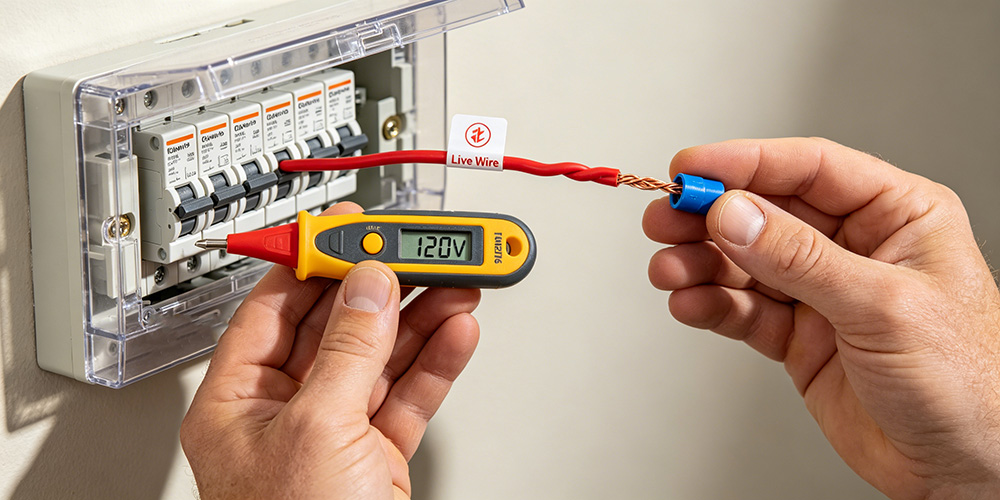
Grab a reliable Non-Contact Voltage Tester (NCVT) or a digital multimeter. First, test your tool on a known live outlet to confirm it works perfectly. Next, press the tester tip directly against the bare end or outer sleeve of the red wire under evaluation. Finally, re-test your tool on the live outlet once more to guarantee the tester didn’t fail during the process.
Trace Physical Circuit Geometry
Carefully pull back the wires out of the junction box enclosure. Examine where the red wire originates. Is it bundled inside a non-metallic cable sleeve alongside a black and white wire? If it travels straight into a toggle switch terminal, it is behaving as a switched load leg or local traveler line.
Isolate & Cap Every Abandoned Node
If you are permanently removing a lighting fixture or deleting a wall switch, never leave an unused red wire dangling loosely inside the void. Even if it reads zero volts right now, someone could flip a switch elsewhere later and re-energize it. Snugly twist an approved, flame-retardant wire nut over the exposed metal tip, and secure it firmly with professional electrical tape.
Summary FAQ
Q Is a red wire positive or negative?
In residential AC alternating current systems, those terms do not apply. “Positive” and “negative” are strictly concepts for Direct Current (DC) systems (like car batteries or USB electronics). In household electrical systems, the red wire is classified as a live hot conductor.
Q Can I connect a red wire directly to a black wire?
Generally, no. While both are hot wires, connecting them directly without a specific load or control device in place can short-circuit different phases of your panel, causing severe damage, explosive arcing, or an immediate breaker blowout. Only tie them together if you are following a certified layout (e.g., bypassing a switch loop to make an outlet permanently hot).
Q Why does my non-contact voltage tester light up on a red wire even when the switch is turned OFF?
This is a common and dangerous trap known as phantom voltage (or induced voltage). Because the red wire often runs inside the same plastic sheath right next to a black wire that is constantly energized, electricity can creates a small electromagnetic field that bleeds a “ghost” reading into your tester. However, it could also mean the switch was wired incorrectly on the neutral side (a dangerous mistake called a switched neutral). Always verify with a digital multimeter to see if there is actual actual voltage under load.
Q I’m installing a smart switch, and it requires a neutral wire. Can I use the red wire as a neutral?
Absolutely not. Using a red wire as a neutral violates almost every electrical code standard and creates a massive shock hazard for anyone working on the system later. Neutral wires must be white (or light gray). If your switch box does not have a white neutral wire bundled in the back, you cannot use a smart switch that requires a neutral unless you rewire the circuit or purchase a “no-neutral” specific smart switch model.
Conclusion
The red wire is a vital, multi-functional component of modern electrical engineering. It provides the exact structural flexibility required to safely route power through multi-way switches, separate lighting from fan motors, synchronize fire defense grids, and run power-hungry appliances.
However, because its actual role shifts completely depending on the specific circuit design, it demands total respect and precision.
Never make assumptions based on color alone, always maintain a rigorous testing routine, and remember: if you ever feel out of your depth with a wiring layout, stop working immediately and call a licensed professional electrician. Keeping your home and family safe is always worth the call.

--- END ---
In this blog
Featured Articles
Get A Free Quote
