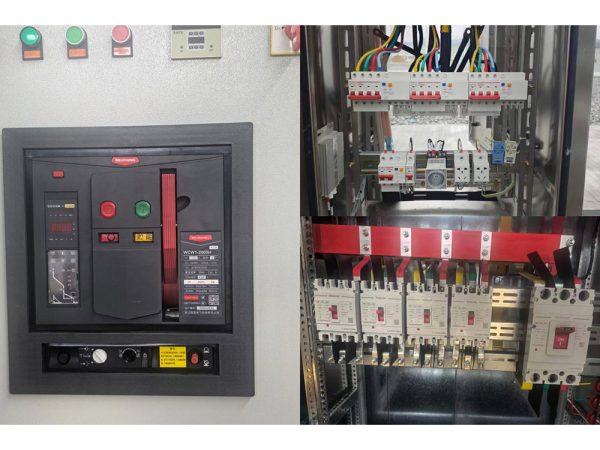
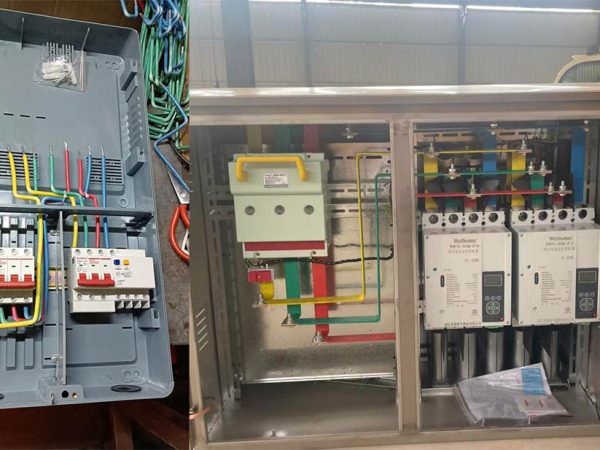
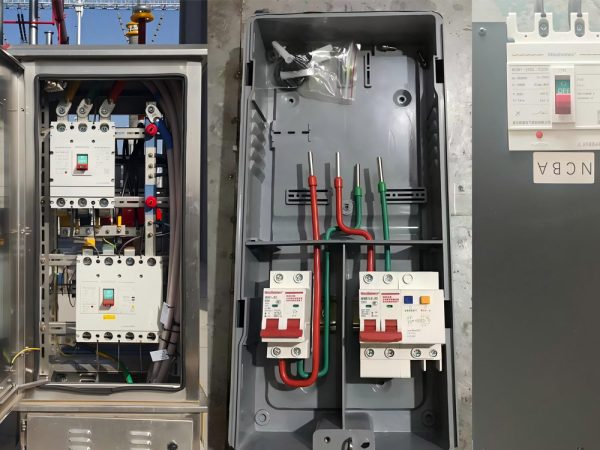
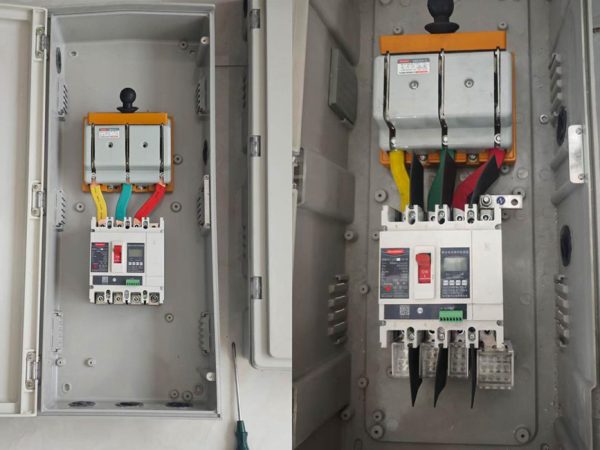
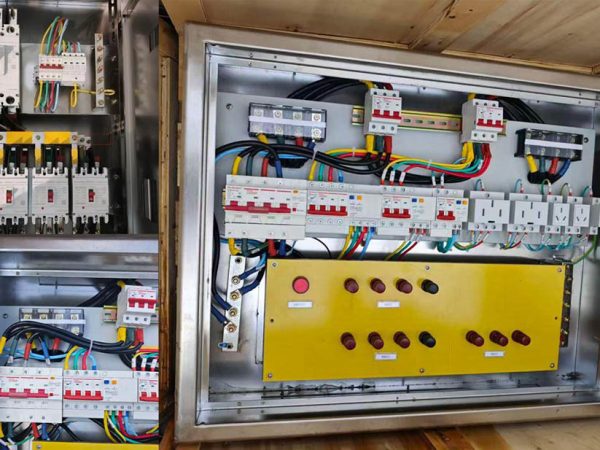
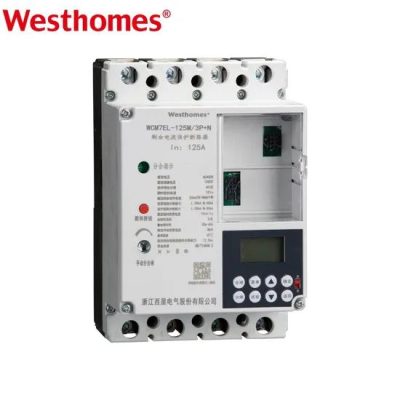
WCM7EL Moulded case circuit breaker
WCM7EL is one of updated type MCCBs researched and developed by the company by using advanced design and manufacture technology internationally.
Get quick appointment for technical support!

WCM7EL series MCB is one of updated type MCCBs researched and developed by the company by using advanced design and manufacture technology internationally.



WCM7EL is one of updated type MCCBs researched and developed by the company by using advanced design and manufacture technology internationally.
| Pole | 3P+N |
| Voltage | AC400V |
| kA | 35KA-85KA |
| Inm(A) | 160,250, 400 |
| In(A) | 100-400 |
| Main technical parameters | WCM7ES/WCM7ELS | |
| Rated current of frame level Inm(A) | 160/250 | 400 |
| Breaking capacity Grade | H | L,M |
| Rated current of instantaneous releaser | 100,125,140,160,180,200,225,250 | 200,225,250,315,350,400 |
| pole | 3P+N | |
| Rate service voltage | AC400V | |


"High-Speed" in the WCM7EL context refers to a fast-actuating operating mechanism and optimized arc interruption that minimizes total clearing time under short-circuit conditions. While still a standard MCCB class device, the high-speed variant uses refined mechanism kinematics and arc-splitting geometry to reduce both opening time and arcing time compared to a standard WCM7EL, reducing let-through energy (I²t) and protecting downstream equipment.
The high-speed variant uses a more powerful spring-charged mechanism, optimized toggle linkage geometry, and a refined arc-chute stack to accelerate contact separation and rapidly extinguish the fault arc. The result is shorter total clearing time — typically a few milliseconds faster on short-circuit — which lowers the peak let-through current and the thermal energy delivered to cables, switchgear, and connected equipment.
The high-speed WCM7EL maintains the same 35kA, 50kA, 65kA, and 85kA breaking capacity ratings at 400/415V AC as the standard WCM7EL range. The high-speed designation improves speed and let-through performance rather than increasing the nominal breaking capacity. It is intended for installations where fault currents are already high and the speed of clearing adds meaningful protection to sensitive downstream equipment.
The high-speed WCM7EL is offered in 1P, 2P, 3P, and 4P pole configurations and is a fixed-mounted breaker. It can be bolted to a mounting plate or — on compatible frame sizes — snapped onto a DIN rail. Its compact fixed form factor makes it suitable for retrofitting into existing MCCB cubicles where faster fault clearing is needed without replacing the entire switchboard lineup.
Every millisecond a short-circuit current flows, it imposes magnetic forces and thermal heating on busbars, cables, transformers, and motor windings. Faster clearing reduces the peak current the system sees (current-limiting effect), lowers the I²t energy, reduces mechanical stress on switchgear, and decreases the risk of conductor melting or busbar distortion. It also reduces voltage dip duration, which helps prevent process-control dropouts and motor contactor dropout during faults.
It is available with both thermal-magnetic and electronic trip units, matching the standard WCM7EL range. The high-speed mechanism acts independently of the trip unit — it determines how fast the contacts open once the trip decision is made. Electronic trip units add microprocessor-based sensing and adjustable protection curves on top of the fast mechanical opening.
Yes, Westhomes provides ODM/OEM customization for the high-speed WCM7EL, including private labeling, auxiliary contact arrangements, terminal lug options, and tailored trip-curve variants. This allows panel builders and industrial OEMs to offer a high-performance, fast-clearing MCCB under their own brand and optimized for their specific equipment protection requirements.
Installation follows the same procedure as a standard fixed MCCB: mount on a DIN rail or bolt to a panel, connect line and load conductors to the rated terminals using correct torque, and verify correct phase orientation. Because the breaker interrupts very high fault currents quickly, ensure upstream and downstream short-circuit coordination has been studied, and confirm that busbars and cables have adequate short-time withstand (Icw) for the available fault level.
Yes, the high-speed WCM7EL is tested and certified to IEC 60947-2, which covers breaking capacity, short-time withstand, endurance, and temperature rise requirements. Its high-speed performance is an enhancement within the standard's framework — the standard sets minimum requirements, and manufacturers may exceed them to improve let-through energy and system protection.
Typical uses include: downstream protection of sensitive electronics and PLCs in process plants, motor circuits where fast fault clearing reduces motor damage, data center and IT power distribution where voltage sags must be minimized, and any high-fault-current industrial feeder where the cost of equipment damage or downtime justifies premium fast-clearing performance. It is also used where selective coordination studies demand a lower let-through energy than standard MCCBs can provide.
* indicates a required field

 2 MB