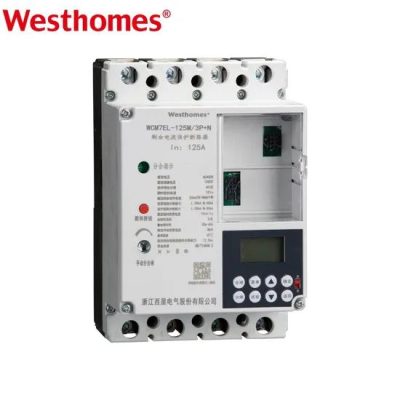
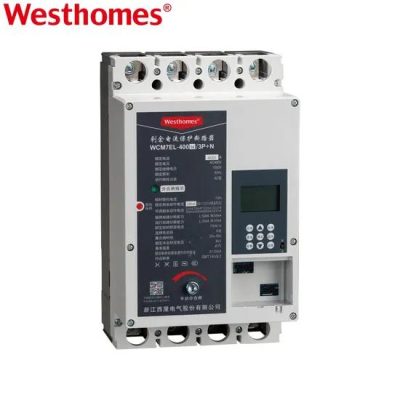
WCM7EL Moulded case circuit breaker
WCM7EL is one of updated type MCCBs researched and developed by the company by using advanced design and manufacture technology internationally.
Get quick appointment for technical support!

WCM7EL series MCB is one of updated type MCCBs researched and developed by the company by using advanced design and manufacture technology internationally.



WCM7EL is one of updated type MCCBs researched and developed by the company by using advanced design and manufacture technology internationally.
| Pole | 3P+N |
| Voltage | AC400V |
| kA | 35KA-85KA |
| Inm(A) | 160,250, 400 |
| In(A) | 100-400 |
| Main technical parameters | WCM7ES/WCM7ELS | |
| Rated current of frame level Inm(A) | 160/250 | 400 |
| Breaking capacity Grade | H | L,M |
| Rated current of instantaneous releaser | 100,125,140,160,180,200,225,250 | 200,225,250,315,350,400 |
| pole | 3P+N | |
| Rate service voltage | AC400V | |


A high-breaking-capacity MCCB is a molded-case circuit breaker designed to safely interrupt very high short-circuit fault currents — in this case, from 35kA up to 85kA — within a compact, sealed molded plastic housing. It combines the familiar MCCB form factor with enhanced arc-chute and contact engineering to handle fault levels that would exceed the capacity of standard MCCBs. The WCM7EL series targets industrial environments with large transformers and high available fault current.
The breaking capacity (Icu/Ics) is the maximum prospective short-circuit current the breaker can clear safely at its rated voltage. A 35kA–85kA range means different frame sizes within the WCM7EL family are rated from 35kA up to 85kA. Engineers select a breaker whose breaking capacity exceeds the calculated available short-circuit current at its point of installation. Higher fault-level installations — such as those fed by large transformers or multiple parallel generators — require the 65kA or 85kA versions.
A fixed MCCB is bolted or snapped directly onto the busbar or DIN rail within the distribution enclosure and cannot be withdrawn without physical disconnection. It is simpler, lower cost, and takes less cubicle space compared to drawout types, which slide on a chassis for live withdrawal. The trade-off is that replacing or servicing a fixed breaker requires de-energizing the circuit first. WCM7EL fixed types are ideal for standard feeders where maintenance windows can be planned.
Poles indicate how many independent current-carrying contacts the breaker switches simultaneously. 1P is used for single-phase circuits; 2P switches both line and neutral on single-phase split systems; 3P is the standard for three-phase motor and power circuits; 4P additionally switches the neutral conductor, used where neutral isolation is required (e.g., IT systems, switch-mode neutral switching, or separation of derived supplies). The WCM7EL is available across all pole configurations to match wiring system requirements.
Yes, the WCM7EL series supports DIN-rail mounting as an option on selected frame sizes, alongside traditional busbar plug-in or screw-fixed mounting. DIN-rail mounting speeds up panel assembly and allows breakers to be snapped onto a standard 35mm DIN rail without custom busbar fabrication. This is particularly useful for OEM panel builders who need fast, repeatable assembly for control panels, machinery, and modular distribution boards.
A thermal-magnetic trip uses a bimetallic strip for inverse-time overload protection and an electromagnetic solenoid for instantaneous short-circuit trips — simple, robust, and affordable. An electronic (microprocessor) trip unit uses current sensors and digital processing to offer fully adjustable long-time, short-time, instantaneous, and ground-fault thresholds with precise curves. The WCM7EL family offers both options: thermal-magnetic for straightforward protection, electronic where selectivity and adjustability are required.
Electronic trip units on the WCM7EL feature front-mounted rotary dials or push-button displays to set the long-time pickup (Ir), long-time delay (tr), short-time pickup (Isd), short-time delay (tsd), and instantaneous pickup (Ii). Each parameter is adjustable within a defined range per the breaker's rating plate. Proper setting requires coordination studies to ensure the upstream breaker trips after downstream devices, maintaining selectivity and limiting outage scope.
The WCM7EL is mounted on a DIN rail or bolted to a panel, with line-side conductors connected to the top terminals and load-side conductors to the bottom terminals using torque settings specified in the installation manual. Lug types range from plain screw terminals to bolt-type connections for higher-current frames. Minimum and maximum wire cross-sections are listed per frame size. Installation must follow IEC 60364 and local wiring regulations, and clearances for arc fault venting must be observed.
Yes, the WCM7EL series is designed and type-tested in accordance with IEC 60947-2, the governing international standard for low-voltage circuit-breakers. This covers thermal withstand, short-time delay, short-circuit breaking capacity (Icu/Ics), operation cycles, dielectric testing, and marking requirements. Compliance with IEC 60947-2 ensures the breaker can be specified for global industrial projects and accepted by utility and insurance inspectors.
These high-breaking MCCBs are used on feeders downstream of large transformers (e.g., 1000kVA–2500kVA and above), main distribution boards in industrial plants, data center power feeds, mining installations, and large commercial buildings where available fault current exceeds the 10kA–25kA range of standard MCCBs. They protect busways, motor control centers, and critical machinery where a standard MCCB would be unable to safely interrupt the prospective fault level.
* indicates a required field

 2 MB