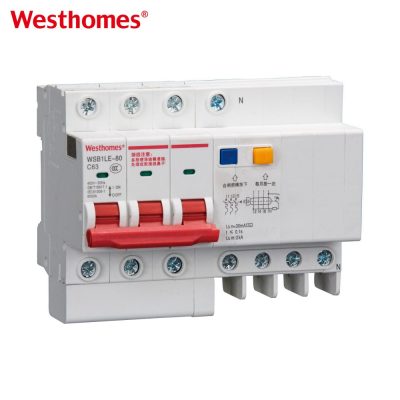
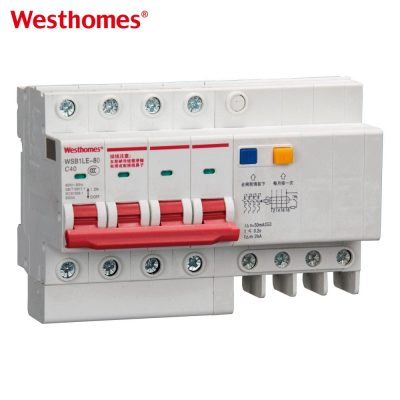
WSB1-80 Moulded case circuit breaker
WSB1-80 series MCB is one of updated type MCCBs researched and developed by the company by using advanced design and manufacture technology internationally.
Get quick appointment for technical support!

WSB1-80 series MCB is one of updated type MCCBs researched and developed by the company by using advanced design and manufacture technology internationally.



WSB1-80 series MCB is one of updated type MCCBs researched and developed by the company by using advanced design and manufacture technology internationally.
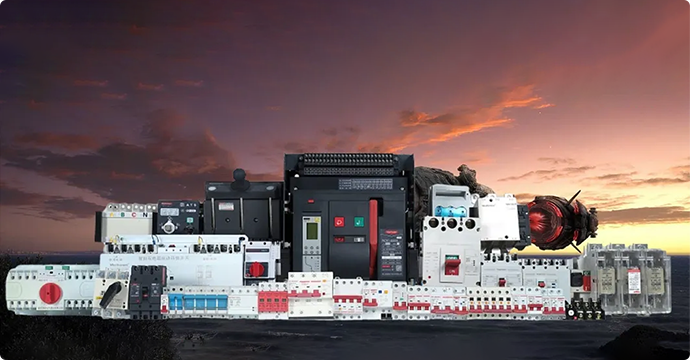
WSB1-80 series MCBs are mainly applied at lines of AC 50Hz or 60Hz, rated operation voltage AC230/400V, rated current upto 80A, for overload and short circuit protection to the lines, also for changeover of infrequent operation to the lines. The MCBs are used at places of commercial office building, residential and similar building etc.
The product meets standards of GB 10963.1 and IEC 60898-1, at international advanced level.

| Frequency | 50Hz/60Hz |
| Pole | 1, 2, 3, 4 |
| Voltage | AC230V/400V |
| kA | 6kA, 10kA |
| Amps | 6, 10, 16, 20, 25, 32, 40, 50, 63,80 |
| Width | 18, 36, 54, 72mm |
| Mounting | Din rail |
| Standard | IEC/EN 60898 |
| Item No. | WSB1-80 |
| Rated current In(A) | 6, 10, 16, 20, 25, 32, 40, 50, 63,80 |
| Pole number | 1P, 2P, 3P, 4P |
| Trip characteristics | C type(5-10In); D type(10-20In) |
| Rated insulating voltage Ui(V) | 690 |
| Rated operating voltage Ue(V) | AC230V/AC400V |
| Rated impulse voltage Uimp(kV) | 4 |
| Breaking capacity Icu(kA) | 6 |
| Mechanical life(times) | 20000 |
| Electrical life(times) | 4000 |
| No. | Rated current | Initial state | Test current | Time limit | Expected result |
| 1 | In≤63 | Cold state | 1.13In | t≤1h | Not tripping |
| In>63 | t≤2h | ||||
| 2 | In≤63 | Just followed the last test item | 1.45In | t<1h | Tripping |
| In>63 | t<2h | ||||
| 3 | In≤32 | Cold state | 2.55In | 1s | Tripping |
| In>32 | 1s | ||||
| 4 | Type C | Cold state | 5In | t≤0.1s | Not tripping |
| 10In | t<0.1s | Tripping |

A 1P (single-pole) MCB breaks only the live (phase) conductor of a single-phase branch circuit, leaving the neutral permanently connected. It is the standard protection device for individual lighting, socket-outlet, appliance and small-load branches in a consumer unit, and is the most space- and cost-effective way to protect individual circuits on a DIN rail.
The WSB1-80 series is offered in discrete standardized ratings (6, 10, 16, 20, 25, 32, 40, 50, 63, 80 A) and this SKU is factory-set to 40 A. The 40 A rating is a popular mid-size choice for 16 mm² or 10 mm² radial circuits, domestic electric showers up to about 9.2 kW, immersion heaters and commercial socket circuits on 6 mm² cable.
It means the breaker can safely clear a prospective short-circuit current of up to 6,000 A RMS at 230 V AC. This is sufficient for the vast majority of domestic and light-commercial final circuits in urban and suburban supply areas. If the board is fed directly from a very large transformer or very short, thick cables, calculate the PSCC — if it exceeds 6 kA, choose a 10 kA version instead.
A low-level overload (say 1.3 × 40 A) heats a bimetal strip inside the breaker, which bends over seconds or minutes and releases the mechanical latch — this is inverse-time thermal protection. A short circuit (e.g. 300 A) energizes a solenoid coil, whose armature snaps the mechanism open in milliseconds. The same contact set and arc chute extinguish both types of interruption.
The 230 V is the working voltage across the single pole to neutral; the 400 V figure is the rated insulation and arc-withstand voltage between the poles and to earth, which lets the breaker be mounted in a 400 V three-phase board alongside 2P/3P/4P breakers without compromising clearances. Practically, you connect it between one phase and neutral on a 230 V supply.
For a purely resistive 40 A load (shower, immersion, heater), a B-curve breaker (3–5 In magnetic trip) is typical. For a 40 A mixed socket-outlet or small motor circuit, C-curve (5–10 In) is preferred to avoid nuisance tripping from motor start-up or capacitor inrush. D-curve is rarely needed on a 1P 40 A domestic branch unless the load is a dedicated transformer or high-inrush device.
Feed the phase conductor from the busbar or supply into the top (line) terminal marked "L" or "IN". Run the phase going to the branch circuit from the bottom (load) terminal. Neutral is not connected to the breaker — it must land on the neutral bar. Tighten the terminal screw to the torque value printed on the side of the breaker (typically 1.8–2.5 N·m) to avoid overheating.
Under typical IEC 60364 conditions, a 6 mm² copper cable clipped direct can carry about 40 A, so 6 mm² is the minimum for a 40 A circuit; if the cable is enclosed in insulation, runs long distances or is grouped with other cables, step up to 10 mm². Always verify the cable's Iz (current-carrying capacity under actual installation conditions) is at least 40 A, and check voltage drop over the run.
Start with the usual causes before replacing it: (1) the load genuinely exceeds 40 A — check the combined current of everything on the circuit; (2) a motor, compressor or transformer on the circuit has high inrush that trips a B-curve breaker — switch to C or D; (3) a developing insulation fault or appliance fault causes intermittent overcurrent; (4) loose terminals are heating the bimetal; (5) repeated short-circuit trips have weakened the mechanism. A properly rated MCB should never trip on normal running current.
Yes. It snaps onto a standard 35 mm DIN rail (EN 60715) inside a consumer unit or distribution enclosure, and the WSB1-80 series is designed, type-tested and CE-marked in accordance with IEC 60898-1. That guarantees consistent thermal and magnetic trip times, correct contact gap and short-circuit endurance so it can be substituted directly for other compliant 40 A 6 kA 1P MCBs on the market.
* indicates a required field

 2 MB