WNB1-63 MCB 6kA Miniature Circuit Breaker | B/C/D Curve
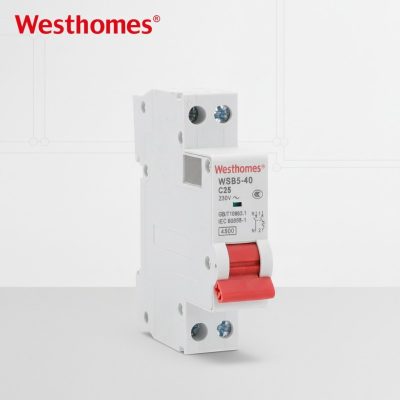
Westhomes WNB1-63 1P Miniature Circuit Breaker – Reliable Overload & Short Circuit Protection for Single-Phase Circuits.
Get quick appointment for technical support!

Shop the Westhomes WNB1-63 1P MCB. 230V single-pole protection with 6kA breaking capacity. Available in B/C/D curves. DIN rail mount. Ideal for home lighting.


Westhomes WNB1-63 1P Miniature Circuit Breaker – Reliable Overload & Short Circuit Protection for Single-Phase Circuits.

The Westhomes WNB1-63 Series 1P MCB is designed to protect single-phase lighting and socket circuits against overloads and short circuits. Engineered for residential and commercial distribution boards, this single-module (18mm) breaker maximizes space efficiency while delivering high-performance protection.
Key Features:
Single Pole Protection: Switches and protects the phase (live) conductor only, ideal for final sub-circuits.
High Breaking Capacity: Features a 6kA rated short-circuit capacity, ensuring rapid fault clearance to safeguard downstream equipment.
Multiple Tripping Curves: Available in B, C, and D curves. The C-curve characteristic is perfectly suited for standard lighting and receptacle loads.
Wide Application: Rated for 230V AC at 50/60Hz, compatible with global residential power standards.
Easy Installation: Complies with standard 35mm DIN rail mounting for quick and secure snap-on installation with lift terminals for firm wiring.
Applications
Residential lighting circuits, general-purpose socket outlets, small appliances, and control transformers.


| Type | MCB |
| BCD Curve | B, C, D |
| Rated Frequency (Hz) | 50hz/60hz |
| Material | Copper |
| Application | Circuit-Breaking |
| Model Number | WNB1-63 Series |
| Rated Voltage | 220V/230V, 400 V |
| Breaking Capacity | 6 kA |
| Mounting Type | Rail Mounting |
| Protection | Li |
| Place of Origin | Zhejiang, China |
| Brand Name | Westhomes |
| Standard | IEC/EN 60898-1 |
| Protection | Overcurrent and short circuit |
| Type of trip | Thermo-magnetic |
| No.of poles | 1P,1P+N,2P,3P,3P+N,4P |
| Rated currents(In) | 1,2,3,4,5,6,8,10,16,20,25,32,40,50,63A |
| Rated voltage(Ue) | 240/415V~ |
| Rated frequency | 50/60Hz |
| Rated breaking capacity | 3KA,4.5KA,6KA. |
| Rated impulse withstandard voltage(1,5/50)Uimp | 4,000V |
| Dielectric test voltage at Ind.Freq.for 1 min | 2kV |
| Thermal release characteristic | (1.13-1.45)x In |
| Magnetic release characteristic | B:(3-5)x In,C:(5-10)x In,D:(10-20)x In |
| Electrical life | 4,000 Cycles |
| Mechanical life | 10,000 Cycles |
| Contact position indicator | Yes |
| Protection degree | IP20 |
| Ambient temperature | -5℃ to+40℃,Max.95%humidity |
| Terminal connection type | Cable/Pin-type busbar |
| Installation | Mounting on 35mm DIN rail |
| Connection | From top and bottom |
| Selling Units | Single item |
| Quantity (pieces) | 1 – 1,000 | > 1,000 |
| Lead time (days) | 15 | To be negotiated |
For a closer look at miniature circuit, read 32 Amp miniature circuit breaker Applications.
An MCB is an electromechanical device that automatically protects an electrical circuit from damage caused by overload or short circuit. Housed in a compact DIN-rail module, it combines a thermal bimetal strip (slow trip on sustained overcurrent) and an electromagnetic solenoid (instant trip on high fault current). Unlike a fuse, it can be reset manually after the fault is cleared and is reusable indefinitely under normal service conditions.
On a mild overload, current heats a bimetallic strip that bends over seconds or minutes, releasing the mechanical latch to open the contacts. On a short circuit, the very high current energizes a solenoid that plunges an armature into the trip mechanism in 2–3 milliseconds, opening the contacts before damage occurs. An internal arc chute splits and cools the arc between opening contacts, extinguishing it safely.
6 kA is the rated ultimate short-circuit breaking capacity (Icn) — the maximum prospective fault current the MCB can interrupt at its rated voltage without failing. It is a measure of how strong the upstream supply can be while still expecting safe disconnection. Domestic installations typically see 3–6 kA fault levels, so a 6 kA MCB is adequate for most homes and small commercial panels.
Add up the load current on the circuit (e.g., total watts ÷ 230 V), multiply by 1.25 for margin, and choose the next standard MCB rating at or above that figure. Then verify that the downstream cable's current-carrying capacity (after derating for grouping, ambient temperature, and insulation) is at least equal to In. For example, a 2.5 mm² cable typically requires a 20 A or smaller breaker.
Choose Type B (3–5× In) for domestic lighting, heaters, and short cable runs where sensitive fault disconnection is needed. Choose Type C (5–10× In) for sockets, general commercial loads, and small motors. Choose Type D (10–20× In) only for loads with very high inrush, such as transformers, welders, and large direct-on-line motors. Never select D solely to stop nuisance tripping — it reduces protection sensitivity.
The WNB1-63 clips onto a standard 35 mm DIN rail. Connect the supply to the upper terminals marked "LINE" (or 1, 3, 5) and the load to the lower terminals marked "LOAD" (or 2, 4, 6). Strip conductors to the depth marked in the manual, insert fully under the screw clamps, and tighten to the specified torque. Polarity and phase sequence must match the marking on the device.
Common causes are overload (too many appliances on one circuit), a faulty appliance or cable with intermittent short circuit, loose terminals overheating the bimetal, or a wrong trip curve for the load. A short-circuit trip feels almost instantaneous, while an overload trip may take seconds to minutes. Unplug loads one at a time to isolate the faulty appliance, and inspect terminals for heat or discoloration.
IEC 60898-1 is the IEC product standard for AC miniature circuit breakers used in household and similar overcurrent protection. It defines rated voltages up to 440 V, rated currents up to 125 A, and breaking capacities from 1.5 kA upward, and specifies type tests for tripping characteristics, short-circuit performance, mechanical endurance, and temperature rise. A product marked "IEC 60898-1" has been third-party type-tested to these requirements.
No. An MCB only interrupts overcurrents and short-circuit currents; it cannot detect the small residual current (30 mA) that flows through a person to earth during an electric shock. For shock protection you need an RCD/RCBO, or an RCBO that combines both functions in one module. An MCB protects the installation and cables, not the person touching live parts.
They are widely used as branch-circuit protection in residential consumer units, commercial distribution boards, small industrial panels, HVAC control circuits, lighting and socket outlets, solar PV combiner boxes, and OEM equipment. The 6 kA rating is well suited to most low-voltage supplies where the upstream short-circuit level does not exceed 6 kA.
* indicates a required field


 155 MB