WNB1-63 2P MCB 6kA Double Pole Circuit Breaker | 400V AC
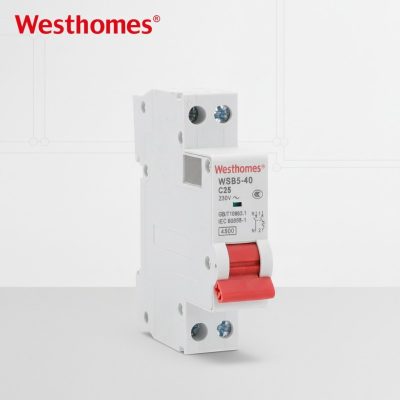
Westhomes WNB1-63 2P Miniature Circuit Breaker – Simultaneous Phase & Neutral Switching for Enhanced Safety.
Get quick appointment for technical support!

Buy Westhomes WNB1-63 2P MCB. True double-pole protection for 400V circuits. 6kA breaking capacity. B/C/D trip curves. Ideal for AC units and motors.


Westhomes WNB1-63 2P Miniature Circuit Breaker – Simultaneous Phase & Neutral Switching for Enhanced Safety.
The Westhomes WNB1-63 2P MCB provides comprehensive protection by controlling and safeguarding both the phase and neutral conductors. Unlike 1P+N designs, this true double-pole breaker ensures that both poles are protected against overcurrent and are positively isolated when switched off, making it the safest choice for critical circuits.
Key Features:
Dual Conductor Protection: Offers thermal-magnetic protection on both poles, ensuring complete safety for the connected circuit.
High Interruption Rating: Confident 6kA breaking capacity handles high fault currents effectively.
Versatile Trip Curves: Choose between B, C, or D curves to match specific load types, such as motor starting (D curve) or general power (C curve).
Wide Voltage Compatibility: Suitable for both 230V (split-phase) and 400V applications.
Robust Build: Housed in a durable flame-retardant casing with IP20 finger-safe terminals, designed for standard DIN rail mounting.
Applications
Dedicated appliance circuits (A/C, water heaters), heat pumps, small motors, and applications requiring complete circuit isolation.
| Type | MCB |
| BCD Curve | B, C, D |
| Rated Frequency (Hz) | 50hz/60hz |
| Material | Copper |
| Application | Circuit-Breaking |
| Model Number | WNB1-63 Series |
| Rated Voltage | 220V/230V, 400 V |
| Breaking Capacity | 6 kA |
| Mounting Type | Rail Mounting |
| Protection | Li |
| Place of Origin | Zhejiang, China |
| Brand Name | Westhomes |
| Standard | IEC/EN 60898-1 |
| Protection | Overcurrent and short circuit |
| Type of trip | Thermo-magnetic |
| No.of poles | 1P,1P+N,2P,3P,3P+N,4P |
| Rated currents(In) | 1,2,3,4,5,6,8,10,16,20,25,32,40,50,63A |
| Rated voltage(Ue) | 240/415V~ |
| Rated frequency | 50/60Hz |
| Rated breaking capacity | 3KA,4.5KA,6KA. |
| Rated impulse withstandard voltage(1,5/50)Uimp | 4,000V |
| Dielectric test voltage at Ind.Freq.for 1 min | 2kV |
| Thermal release characteristic | (1.13-1.45)x In |
| Magnetic release characteristic | B:(3-5)x In,C:(5-10)x In,D:(10-20)x In |
| Electrical life | 4,000 Cycles |
| Mechanical life | 10,000 Cycles |
| Contact position indicator | Yes |
| Protection degree | IP20 |
| Ambient temperature | -5℃ to+40℃,Max.95%humidity |
| Terminal connection type | Cable/Pin-type busbar |
| Installation | Mounting on 35mm DIN rail |
| Connection | From top and bottom |
| Selling Units | Single item |
| Quantity (pieces) | 1 – 1,000 | > 1,000 |
| Lead time (days) | 15 | To be negotiated |
Related: AC Mini Circuit Breakers and C Curve Circuit Breakers, which covers circuit breaker step by step.
A 2P miniature circuit breaker is a DIN-rail mounted protection device that simultaneously switches and protects two conductors (typically phase and neutral, or two phases). Internally it combines a thermal bimetallic strip for overload protection and an electromagnetic solenoid for instant short-circuit tripping, with both poles mechanically linked so they open together. When a fault occurs, the mechanism separates the contacts and an arc chute quenches the resulting arc within milliseconds.
The 6kA (kiloampere) breaking capacity, also called Icn, is the maximum prospective short-circuit current the MCB can safely interrupt at its rated voltage. If a fault produces up to 6,000 A, the breaker will open without destroying itself or causing an arc flash. If the upstream fault level exceeds 6 kA, you must select a higher-rated breaker (e.g., 10 kA) or add current-limiting upstream protection.
A 1P MCB switches and protects only one conductor (usually the phase), leaving the neutral connected to the neutral bar. A 2P MCB opens both phase and neutral (or two phases) at the same time, providing true double-pole isolation and using two DIN modules (~36 mm). A 2P device is preferred for main incomers, dedicated appliance circuits, EV chargers, and any installation where simultaneous disconnection of live and neutral is required for safety.
First calculate the total load current (watts ÷ voltage), then apply a ~1.25× margin for inrush and continuous duty. Round up to the nearest standard rating (6, 10, 16, 20, 25, 32, 40, 50, 63 A). Most importantly, the MCB rating must not exceed the current-carrying capacity of the cable it protects — always size the breaker to the cable, not only to the load. For continuous loads, keep the running current below ~80% of In.
The curve defines the instantaneous magnetic trip threshold. Type B trips at 3–5× In and is used for domestic lighting and resistive loads. Type C trips at 5–10× In for general commercial loads, sockets, and small motors with moderate inrush. Type D trips at 10–20× In for heavy inductive loads such as transformers, welders, and large direct-on-line motors. Choosing the wrong curve is the most common cause of nuisance tripping.
The WNB1-63 2P clicks onto a standard 35 mm (TH35-7.5) DIN rail by hooking the top edge and pushing the lower latch until it snaps. Connect the supply (line) conductors to the marked top terminals and the load conductors to the bottom terminals, observing the terminal numbers and phase sequence. Tighten screw terminals to the manufacturer's torque value (typically 1.2–1.5 N·m) and leave adequate clearance for heat dissipation.
Nuisance tripping usually comes from one of four causes: an undersized or wrong-curve breaker for the load (e.g., a Type B on a motor circuit), a genuine overload from too many appliances on one circuit, loose or corroded terminals causing heat, or a developing short circuit in an appliance. Do not simply fit a larger breaker — identify the root cause first, because upsizing without checking cable ampacity can create a fire risk.
IEC 60898-1 is the international standard for miniature circuit breakers for overcurrent protection in household and similar installations, covering rated currents up to 125 A and breaking capacities up to 25 kA. Compliance means the device has passed type tests for overload tripping characteristics, short-circuit endurance, temperature rise, and dielectric strength. The CE mark indicates conformity with EU Low Voltage and EMC directives, allowing free sale within the European Economic Area.
Typical uses include single-phase main incomers in consumer units, double-pole isolation for air-conditioner and water-heater circuits, EV charging points, inverter and solar DC-coupled AC outputs, generator changeover circuits, and dedicated appliance circuits where both live and neutral must be disconnected together for maintenance safety.
A 2P MCB can serve as a functional switch and provides visible contact separation, but it is not primarily designed as an isolating device in the IEC 60947-3 sense. For formal lockout/tagout isolation, use a dedicated switch-disconnector rated for isolation (such as the WH5-125 series), or verify that the MCB carries an isolation symbol and a positive indication of contact position. Always pair any isolator with upstream overcurrent protection.
* indicates a required field


 155 MB