WSB9L‑125 4‑Pole 100/125 A RCCB for EV Charger
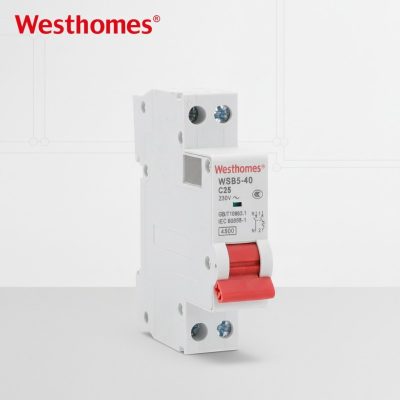
Westhomes WSB9L‑125 Series 4‑Pole (3P+N) Earth Leakage Circuit Breaker / RCCB for EV Charger Applications.
Get quick appointment for technical support!

Rated for 230 V AC, 100 or 125 A with 30 mA residual current trip. Provides earth leakage, overload & short‑circuit protection. Compliant with IEC 61009‑1 and GB/T 16917 standards. Ideal for residential and commercial EV charging.


Westhomes WSB9L‑125 Series 4‑Pole (3P+N) Earth Leakage Circuit Breaker / RCCB for EV Charger Applications.

The WSB9L‑125 series is engineered for electric vehicle charging systems, delivering reliable protection at AC 230 V, with rated currents of 100 A or 125 A and a fixed 30 mA residual operating current (IΔn). It provides safety against electric shock via earth leakage detection, along with overcurrent and short‑circuit protection—while also supporting infrequent manual switching of power lines. Its robust design is ideal for residential, commercial, and industrial EV charger installations.
Key Features:
Precision leakage detection minimizes risk of shock—meets safety codes for EV platforms
Comprehensive protection in one device: earth leakage (ELCB / RCCB), overcurrent, and short-circuit
High-rated current options (100/125 A) support powerful charging stations
Modular DIN‑rail design allows straightforward integration and maintenance
Global compliance with IEC & GB standards ensures reliability across markets
Applications
Designed specifically for electric vehicle charging stations, the WSB9L‑125 delivers vital safety features in EV infrastructure. Its robust performance and international certifications make it ideal for use in residential EV chargers, commercial charge points, hotels, and light industrial sites.
| Model | WSB9L-125 |
| Current rating(A) | 63,80,100,125 |
| Pole | 1P+N,3P+N |
| Type of instantaneous releaser | C |
| Rated voltage(V) | AC 230V |
| Electrical life(times) | 4000 |
| Mechanical life(times) | 20000 |
| Model NO. | WSB9L-125 |
| Arc-extinguishing Medium | Air |
| Structure | MCB |
| Type | Circuit Breaker |
| Certification | ISO9001-2000, CE, CB, CCC |
| Production Line | 100% Automatic |
| AMP | 63A, 80A, 100A, 125A |
| Specification | 6, 10, 16, 20, 25, 32, 40, 50, 63, 80 |
| Origin | Chine |
| Production Capacity | 10000PCS/Week |
| Speed | Normal Type Circuit Breaker |
| Installation | DIN Rail |
| Poles Number | 1p+N, 3p+N |
| Function | Conventional Circuit Breaker, Circuit-Breaker Failure Protection, Overcurrent Protection, OVP(Overvoltage Protection) |
| Cooperation Type | ODM OEM |
| Company | Factory |
| Transport Package | Paper Box |
| Trademark | Westhomes |
| HS Code | 8536200000 |
EV chargers contain rectifiers and power electronics that can produce smooth DC residual (earth-leakage) current in addition to AC. A standard Type AC or even Type A RCCB may become "blinded" by DC component and fail to detect an earth fault, so EV charging circuits require devices that detect DC residual current—typically a Type B RCD or a Type A RCD combined with an internal 6 mA DC monitor (RDC-DD). IEC 61851-1 requires every EV charging point to detect smooth DC residual current above 6 mA.
Type AC detects sinusoidal AC leakage only; Type A adds pulsating DC detection; Type F handles certain mixed-frequency AC; Type B (per IEC 62423) detects AC, pulsating DC, and smooth/constant DC residual current. For EV charging where the wallbox has no internal DC fault protection, a Type B RCD is the safest and most complete option. If the charger includes an integrated RDC-DD (6 mA DC monitor), a 30 mA Type A or Type F RCD upstream is normally acceptable.
IEC 61851-1 and IEC 62423 require detection of smooth DC residual current at or above 6 mA, because above this level DC can magnetically saturate upstream AC-sensitive RCDs and make them insensitive. A Type B RCCB (or the charger's internal RDC-DD) trips or signals when DC leakage reaches this threshold, preventing blinding of downstream protection and reducing shock and fire risk. This is a defining feature of EV-specific protection.
The 30 mA rated residual operating current (IΔn) is the threshold at which the device trips for AC earth faults, providing supplementary protection against direct-contact electric shock. For EV charging circuits, the RCD upstream of the charger must not exceed 30 mA to meet personal-safety requirements. Note that the 6 mA DC detection is a separate function—it monitors smooth DC leakage while the 30 mA setting governs AC tripping.
The 125A is the rated current (In) the WSB9L-125 can carry continuously, sized for higher-power EV supply equipment (typically 11 kW–22 kW three-phase chargers and associated cabling). It is not a trip value—the device trips on residual current, not on load current. Ensure upstream overcurrent protection (MCB/MCCB/fuses) is correctly coordinated and that cables are rated for the load and the 125A device.
Mount the WSB9L-125 on the DIN rail of the distribution board that feeds the EV charger, on the supply side of the charger, with a separate dedicated circuit for the EVSE. Connect supply to line terminals and the charger to load terminals, observing correct phase/neutral/earth arrangement. Confirm whether the charger has internal RDC-DD so you can select the correct RCD type, and commission with an RCD tester. Local codes (e.g., BS 7671, NEC, or equivalent) may mandate specific RCD types for EV circuits.
A standard (Type AC/Type A) RCCB detects AC and possibly pulsating DC leakage but is blind to smooth DC residual current, which EV chargers can generate. The EV-specific WSB9L-125 adds smooth DC detection (per IEC 62423) so it remains sensitive in charging circuits. Using a standard RCCB on an EV circuit risks nuisance-proofing failure and loss of protection, so it should not be substituted without verifying the charger's internal DC monitoring.
Trips can be caused by genuine earth faults, leakage through long cable runs, damp conditions, the charger's own power electronics generating residual current, or DC component accumulation. First isolate the charger from the circuit and test the installation's own earth leakage; if the RCD holds with the charger disconnected, the fault lies in the EVSE or vehicle. Use an RCD tester to confirm it trips at 30 mA AC and check the DC detection function; do not disable or up-rate the device to stop nuisance trips.
An EV RCCB should comply with IEC 61008 (RCCB), IEC 62423 (Type B / Type F requirements), and the EV charging provisions of IEC 61851-1. Look for relevant safety certifications (e.g., CE and national approvals) and confirm the rated residual current, type, and In match the charger and local wiring rules. Certification to these standards is what validates both the AC shock protection and the DC detection function.
No. An RCCB (without overcurrent protection) provides residual current protection only; it will not trip on overload or short-circuit current. You must add an upstream MCB or MCCB rated for the circuit, cables, and charger to provide overload and short-circuit protection. If you want both functions in one device, use an EV-specific RCBO instead, but verify its RCD type and DC detection suitability.
* indicates a required field


 155 MB