Get quick appointment for technical support!

What Is The Difference Between RCD and RCBO?
Feb 28, 2026
While both are fundamental to modern electrical installations, understanding their distinct roles, operational principles, and ideal applications is crucial for ensuring optimal protection for people, property, and equipment.
At its core, the difference is one of scope: an RCD is a specialist in a single, vital safety function, while an RCBO is an integrated unit that combines that specialty with additional, equally critical protections.
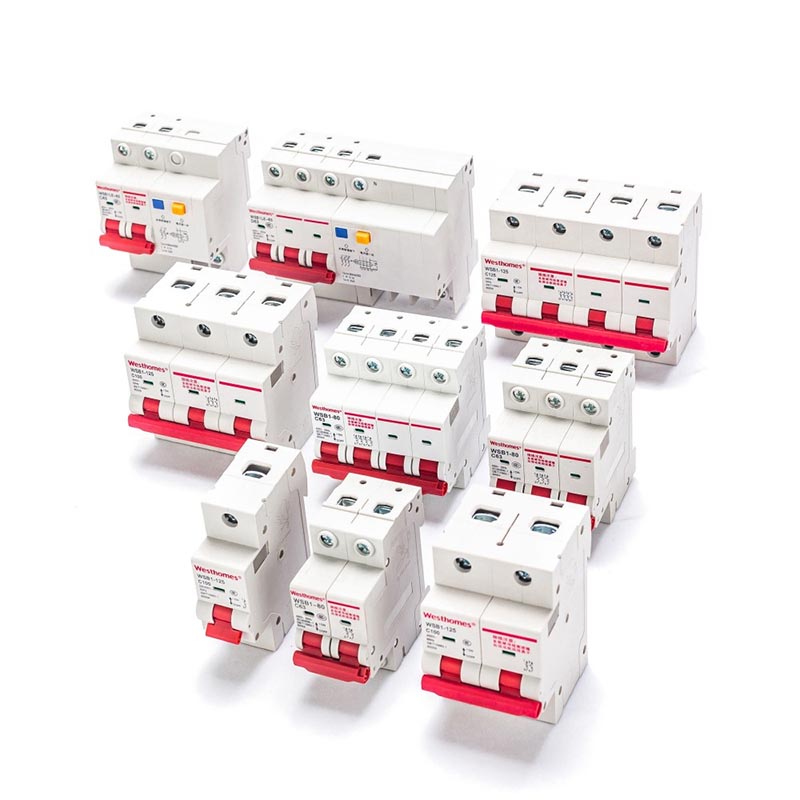
The Residual Current Device (RCD): The Life-Saver
An RCD, also known as a Ground Fault Circuit Interrupter (GFCI) in some regions, is a life-saving device engineered with one paramount objective: to prevent fatal electric shocks. It provides no protection against overcurrents from overloads or short circuits. Its operation is elegantly precise, based on the principle of current balance.
How an RCD Works: The Core Principle of Current Balance
An RCD continuously monitors the current flowing in the live (phase) and neutral conductors of the circuit it protects. In a healthy, fault-free circuit, the current entering a circuit via the live wire must exactly equal the current returning via the neutral wire. The RCD’s internal sensing toroid (a doughnut-shaped coil) measures this balance.
If a fault causes current to leak from the live conductor to earth—for instance, through damaged cable insulation, a faulty appliance, or, critically, through a person’s body—the balance is disrupted.
The current returning via the neutral wire becomes less than the current sent in the live wire. This difference is known as residual current. The RCD is calibrated to detect incredibly small imbalances, typically as low as 30 milliamperes (mA) or even 10 mA for highly sensitive areas like bathrooms.
Upon detecting a residual current exceeding its rated sensitivity, the RCD acts with remarkable speed, disconnecting the circuit within 20-40 milliseconds—faster than the time it takes for a dangerous cardiac arrhythmia to be induced.
Key Characteristics and Limitations of an RCD:
Single-Function Protection: It protects only against earth leakage currents that could cause shock or fire from persistent leakage.
Dependency on a Separate Overcurrent Device: An RCD must always be used in conjunction with a fuse or a circuit breaker (MCB). The MCB provides the necessary overload and short-circuit protection for the cables, while the RCD provides the shock protection. They are often installed as an RCD module protecting multiple downstream MCBs in a distribution board.
Nuisance Tripping: Its high sensitivity can sometimes lead to “nuisance tripping” when used with older appliances that have inherent, minor but acceptable, leakage currents, or in damp environments.
The Residual Current Circuit Breaker with Overload (RCBO): The Integrated Protector
An RCBO is a more advanced, multi-functional device. It effectively integrates the functions of an RCD and a Miniature Circuit Breaker (MCB) into a single, compact unit. Therefore, one RCBO provides three layers of protection for its circuit.
How an RCBO Works: A Triad of Protections
An RCBO contains two independent but coordinated detection mechanisms within one housing:
Residual Current Protection (RCD Function): Identical to a standalone RCD, it uses a sensing toroid to monitor the live-neutral current balance and trip on detection of a dangerous earth leakage.
Overload Protection (MCB Thermal Function): It incorporates a bi-metallic strip. If the circuit draws a sustained current above the RCBO’s rated amperage (e.g., 16A, 20A) for too long—such as from plugging in too many devices—the strip heats up, bends, and triggers a trip to prevent the cables from overheating and catching fire.
Short-Circuit Protection (MCB Magnetic Function): It includes an electromagnetic solenoid. In the event of a sudden, massive current surge from a short circuit (e.g., live-to-neutral contact), the resulting magnetic field instantly trips the mechanism to cut power, preventing catastrophic damage and arcing faults.
Key Characteristics and Advantages of an RCBO:
Comprehensive, All-in-One Protection: A single device offers protection against electric shock, cable overload, and short-circuit faults.
Circuit Selectivity: If a fault occurs on one circuit protected by an RCBO, only that specific RCBO will trip, isolating the problem. Other circuits in the installation remain energized. This is a significant advantage over a single RCD protecting multiple MCBs, where a fault on one circuit can plunge several unrelated circuits into darkness—a scenario known as “discrimination failure.”
Space-Efficient: It provides combined protection in the space of a single module in a consumer unit, simplifying panel design.
Simplified Compliance: It easily meets modern wiring regulations that often require both RCD and overcurrent protection on most final circuits.
Detailed Comparative Analysis: RCD vs. RCBO
| Feature | Residual Current Device (RCD) | Residual Current Breaker with Overload (RCBO) |
| Primary Protection | Electric shock / Earth leakage only. | Electric shock, Overload, and Short Circuit. |
| Functional Scope | Single-function device. | Multi-function integrated device (RCD + MCB). |
| Required Companions | Must be paired with a separate fuse or MCB for overcurrent protection. | Self-contained; no additional overcurrent device needed for its circuit. |
| Trip Selectivity | Poor. One RCD tripping will cut power to all MCBs downstream of it. | Excellent. Only the faulty circuit is disconnected. |
| Typical Installation | As a main switch or a bank protecting several circuits (e.g., all sockets). | Dedicated to individual circuits (e.g., one for kitchen sockets, one for lighting). |
| Cost Consideration | Lower unit cost, but requires additional MCBs. | Higher unit cost per device, but eliminates need for separate MCB on that circuit. |
| Complexity & Wiring | Simpler device, but system wiring can be more complex. | More complex internal device, but final installation wiring is neater and more logical. |
| Ideal Application | Providing broad, cost-effective shock protection across multiple similar circuits. | Providing precise, fault-tolerant protection for critical, high-risk, or individual circuits. |
Choosing Between RCD and RCBO: Application Guidelines
The choice is not merely technical but also economic and practical, depending on the specific requirements of the installation.
When to Opt for an RCD Configuration:
Budget-Conscious Projects: For new builds or upgrades where initial cost is a major constraint, using a couple of RCDs to protect multiple circuits is economically efficient.
Retrofit in Older Consumer Units: Adding an RCD module at the origin of an existing fusebox or distribution board can significantly improve overall shock protection without a complete rewiring.
Temporary or Portable Protection: Plug-in RCD adaptors or RCD-protected extension leads are invaluable for providing shock safety for power tools or outdoor equipment.
Protecting Stable, Low-Risk Circuit Groups: For example, a dedicated RCD protecting all lighting circuits (which are generally fixed-load and less prone to faults) can be a sensible and cost-effective approach.
When an RCBO is the Superior Choice:
Critical and High-Risk Circuits: Circuits supplying kitchens, workshops, outdoor outlets, bathrooms, and medical facilities should ideally have RCBO protection. The selectivity ensures a fault with a freezer or medical device doesn’t inadvertently disable lighting or other critical circuits.
Home Offices and IT Equipment: To prevent disruptive power loss to computers and network equipment from a fault elsewhere, RCBOs on these circuits are highly recommended.
Meeting Modern Wiring Standards: Regulations like the IEC 60364 and national codes (e.g., BS 7671 in the UK) increasingly demand both RCD and individual circuit protection, making RCBOs the most straightforward compliance solution for new installations.
Troubleshooting and Convenience: The selective tripping of an RCBO makes identifying the source of a fault instantaneous, saving time and frustration.
Future-Proofing an Installation: Installing a consumer unit populated with RCBOs offers the highest level of safety, convenience, and flexibility for future circuit additions.
Conclusion
In summary, while both RCDs and RCBOs are indispensable for electrical safety, they serve different levels of a protection strategy. An RCD is a crucial component for shock protection but represents only one part of a complete system, requiring the support of overcurrent devices.
An RCBO, conversely, is a complete, self-contained protection system for an individual circuit. The evolution towards RCBOs in residential, commercial, and industrial settings reflects a demand for higher safety standards, greater reliability, and improved operational convenience.
Ultimately, the investment in RCBOs translates to a more resilient, fault-tolerant, and safer electrical installation, where protection is precisely targeted and the risk of widespread power loss from a single fault is eliminated.

--- END ---
In this blog
Featured Articles
Get A Free Quote
