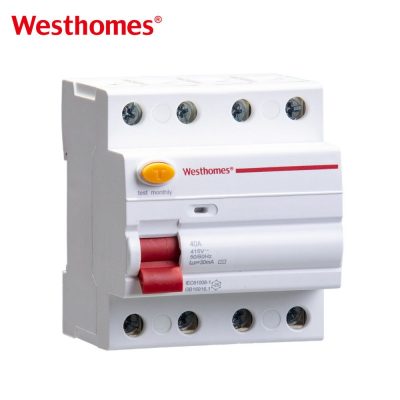
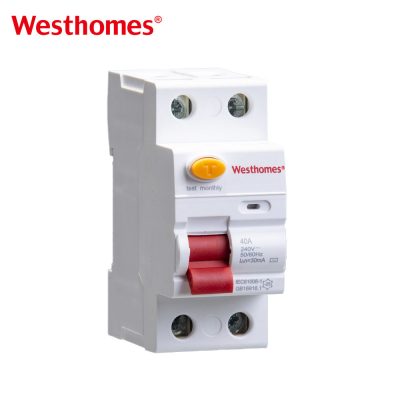
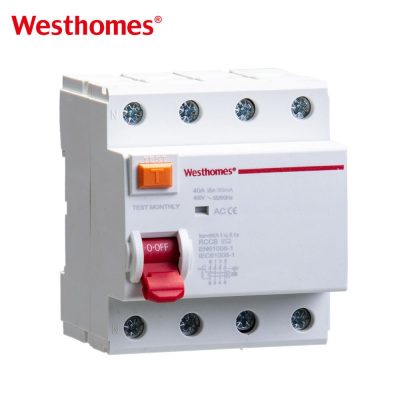
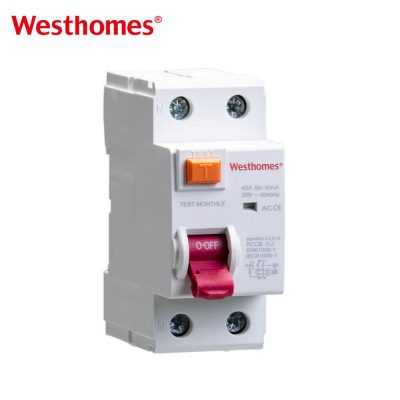
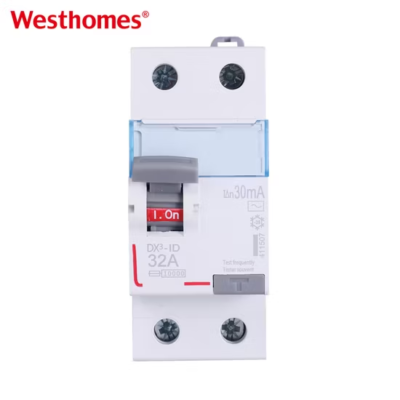
230V/400V RCCB | WSB3L Series Electronic Residual Current Circuit Breaker
This AC 230V/400V RCCB is a crucial component for modern distribution systems where personal safety and equipment protection are paramount.
Get quick appointment for technical support!

The Westhomes WSB3L Series RCCB is an advanced electronic type residual current operated circuit breaker designed for AC 230V/400V, 50Hz power distribution systems.


This AC 230V/400V RCCB is a crucial component for modern distribution systems where personal safety and equipment protection are paramount.

Engineered to detect and eliminate electrical faults in real-time, this RCCB provides highly effective protection against electric shocks, earth leakage currents, short circuits, and overloads in both residential and commercial environments.
With a rated current up to 63A, the WSB3L RCCB ensures that circuits are disconnected immediately upon detection of leakage or overload, safeguarding human life and electrical equipment. This model is particularly optimized for use in low-voltage distribution systems operating at 230V single-phase or 400V three-phase, making it a reliable choice for office buildings, residential homes, industrial units, and commercial installations.
Constructed with a high-impact resistant and flame-retardant housing, the WSB3L series is compact yet robust, supporting long-term safety and performance. Its advanced internal structure offers precise tripping characteristics and consistent operational reliability, ensuring enhanced protection in a wide range of applications.
| Rated Current | 16, 20, 25, 32, 40, 50, 63A |
| Rated Voltage Ue | AC240V (1P+N, 2P); AC400V (3P+N, 4P) |
| Rated Insulation Voltage Ui | AC415 |
| Rated Impulse Withstand Voltage Uimp | 4kV |
| Rated Frequency | 50/60Hz |
| Number of Poles | 1P+N, 3P+N |
| Module Size | 36mm, 72mm |
| Circuit Type | AC type, A type, B type |
| Breaking Capacity | 6000A, 10000A |
| Rated Residual Current I△n | 10mA, 30mA, 100mA, 300mA |
| Rated Residual Operation Current | 10, 30, 100, 300mA |
| Optimum Operation Temperature | -5ºC to 40ºC |
| Terminal Tightening Torque | 2.5-4N/m |
| Terminal Capacity (top) | 25mm² |
| Terminal Capacity (bottom) | 25mm² |
| Electro-mechanical Endurance | 4000 cycles |
| Mounting | 35mm DIN rail |
| The very new tripping structure makes more in safety | |
| Suitable Busbar | PIN busbar |
| Standard | IEC61008-1 |
| Model NO. | WSB3L |
| Arc-extinguishing Medium | Air |
| Structure | MCB |
| Type | Circuit Breaker |
| Certification | ISO9001-2000, CE, CB, CCC |
| Ka | 6ka, 10ka |
| Voltage | AC240V/AC400V |
| Specification | 10A-63A |
| Origin | China |
| Production Capacity | 365000 |
| Speed | Normal Type Circuit Breaker |
| Installation | Fixed |
| Poles Number | 1p+N, 3p+N |
| Function | Conventional Circuit Breaker, Circuit-Breaker Failure Protection, Overcurrent Protection, OVP(Overvoltage Protection) |
| Production Line | 100% Automic |
| Cooperation Type | OEM ODM |
| Transport Package | Standard |
| Trademark | Westhomes |
| HS Code | 8536300000 |
This topic is covered in more detail in Westhomes WSB1L Series 125A 2P RCCB.
This topic is covered in more detail in Westhomes WSB1L Series 63A 3P+N RCCB.
Unlike a traditional electromagnetic RCCB that uses the residual current itself to drive a sensitive solenoid, the WSB3L uses an electronic amplifier circuit powered from the line supply to evaluate the zero-sequence CT signal and a relay to trip the mechanism. This design allows finer control over sensitivity and timing in a smaller package. It is classified as an electronic type under IEC 61008.
When a residual current appears, the toroidal CT produces a small signal voltage. An electronic amplifier compares this signal to a threshold; when it exceeds the rated residual operating current, the amplifier energizes a small polarized relay, which releases the main contact mechanism and opens the circuit. The main contacts are held closed by a mechanical latch and are spring-loaded for fast opening.
Because the amplifier needs a stable supply, an electronic RCCB may fail to trip in a true earth-fault situation when the supply voltage is absent or very low—for example, if the neutral conductor is broken while the person remains touching a live part. Electromagnetic RCCBs trip independently of supply voltage, which is why safety-critical installations sometimes prefer them. Confirm the local code accepts electronic RCCBs for the intended application.
The WSB3L series is typically offered at 30mA (personal protection) and other sensitivity ratings, in Type AC or Type A variants. Type A is recommended wherever electronic loads—such as EV chargers, LED drivers, or variable-speed motors—may generate pulsating DC residual current. Higher sensitivity (10mA) and higher values (100mA/300mA) are used for special locations or upstream fire/selective protection.
Electromagnetic RCCBs require a highly precise, expensive sensitive relay and a large toroidal CT to generate enough energy to trip directly. An electronic design uses a smaller CT and a low-cost amplifier/relay, freeing internal space and lowering manufacturing cost. This is why electronic RCCBs dominate the residential market where space and budget are constrained.
Mount it on a standard DIN rail, connect the phase and neutral incoming supplies to the line terminals and the protected load to the load terminals, ensuring both conductors pass through the CT. Because the electronics need a supply, observe the required phase/neutral orientation and do not disconnect the device's internal supply path. Pair it with an upstream or series MCB for over-current and short-circuit protection within the conditional rating.
Press the test button monthly to confirm the trip chain works; this also verifies the auxiliary supply is present. Perform an installation test with a proper RCD tester where required by the local code to confirm the tripping current and disconnection time. If the device fails the test, replace it rather than relying on it.
It is type-tested to IEC 61008-1, which explicitly defines requirements for residual current devices with electronic components, including behavior under abnormal supply conditions. CE marking and other regional approvals (e.g., KEMA, INMETRO) are available per model and market. Always confirm the certification is valid for the target country before installation.
First press the test button to confirm basic function. Then disconnect outgoing loads one at a time to locate the leaking circuit, and check whether the device is correctly powered (voltage present at its supply terminals). If the nuisance trips persist, look for damp cables, surge devices, or electronic loads, and consider Type A or an upstream S-type (delayed) RCCB for discrimination. If the device will not reset at all, it may be faulty and should be replaced.
The WSB3L is widely used in residential distribution boards, office sub-boards, and light-commercial installations where compact size, good sensitivity, and cost-effectiveness are priorities. It protects socket outlets, lighting circuits, bathrooms, and outdoor supplies. It is not the first choice where absolute fail-safe, supply-voltage-independent protection is mandated; in those cases an electromagnetic RCCB should be selected.
* indicates a required field


 155 MB