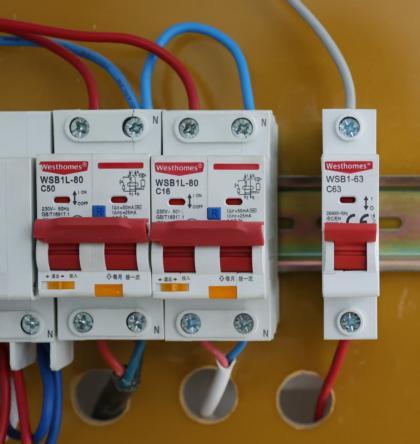
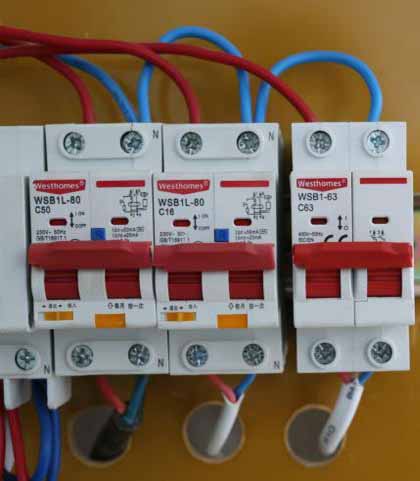
3P / 4P Wiring for Three-Phase Systems
- 3P breakers: Protect and switch L1, L2, and L3.
- 4P breakers: Additionally switch the neutral conductor for full isolation.
These configurations are widely used for industrial loads, motor control, and larger distribution systems where phase coordination and system stability are critical. Proper wiring prevents overloads, reduces voltage imbalance, and supports efficient energy distribution.
| Configuration |
Description |
Typical Applications |
Notes |
| 1P (Single-Pole) |
Interrupts only the live conductor; neutral connects directly to the neutral bar. |
Standard lighting circuits, general single-phase branch loads |
Phase-only protection |
| 2P (Double-Pole) |
Disconnects both line and neutral simultaneously for better isolation. |
Sockets, water heaters, main incoming protection in smaller distribution boards |
Higher safety during maintenance or fault conditions |
| 3P (Three-Pole) |
Protects and switches L1, L2, L3. |
Industrial loads, motor control, larger three-phase distribution systems |
Requires phase balancing |
| 4P (Four-Pole) |
Protects and switches L1, L2, L3, and neutral. |
Sensitive three-phase loads requiring neutral isolation |
Full three-phase + neutral isolation |
Circuit Breaker Installation in Distribution Boxes
Installing breakers should follow a logical, standardized sequence: Incoming Power → Main Breaker → Branch Breakers → Load Devices. Standard installation ensures safe operation, easy maintenance, and compliance with electrical codes.
Step-by-Step Installation:
1. Incoming Power: Connect the line (L) and neutral (N) from the utility or generator to the main breaker input.
2. Main Breaker: Use a 2P breaker when possible to disconnect both line and neutral simultaneously for higher safety.
3. Branch Breakers: Connect individual circuits (1P breakers) for lighting, sockets, or appliances below the main breaker.
4. Neutral Bus: All neutral conductors terminate on the neutral bar.
5. Ground Bus: All grounding conductors connect to the PE bar.
6. Temporary Construction Circuits: Use proper segregation and follow standard safety procedures.
Correct installation not only ensures circuit protection but also simplifies future troubleshooting and expansion.
Key Wiring Principles
- Line vs Load Identification: Supply conductors must connect to LINE terminals; outgoing circuits connect to LOAD terminals.
- Neutral & Ground Separation: Neutral and PE bars should remain separate to avoid fault currents and ensure compliance.
- Phase Load Balancing: For three-phase systems, distribute loads evenly to minimize overheating and voltage imbalance.
WESTHOMES Distribution Box Solution
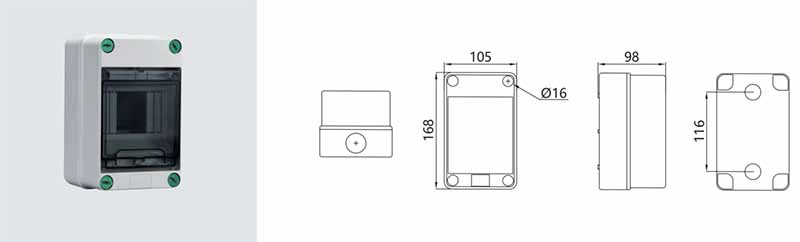
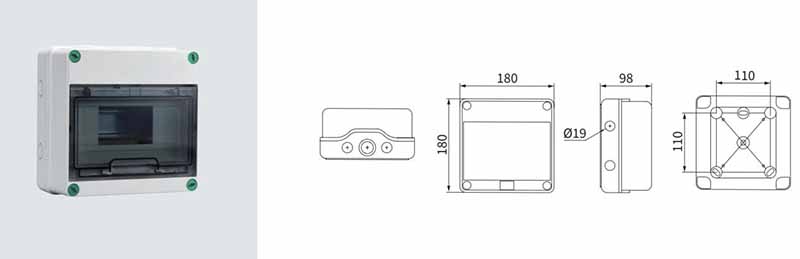
The WESTHOMES SHT Distribution Box provides a reliable foundation for wiring breakers in residential and commercial applications:
- IP66 protection: Excellent waterproof and dustproof performance.
- UV-resistant housing: Suitable for both indoor and outdoor installations.
- 650°C glow-wire resistance: Enhances fire safety.
- Customizable cable entries: Flexible layout options.
- Easy installation: Simplifies assembly and maintenance.
With robust protection and flexible design, the SHT series supports safe, durable wiring for various breaker configurations.
Common Wiring Mistakes to Avoid
- Loose terminal connections leading to heat buildup.
- Incorrect neutral-ground connections.
- Using the wrong pole configuration for the load.
- Overloading branch circuits.
- Using jumper wires instead of properly rated busbars.
Avoiding these mistakes improves both safety and system reliability.
Safety and Installation Best Practices
- Use properly sized conductors.
- Follow torque specifications for all terminals.
- Utilize comb busbars where possible.
- Verify grounding continuity before energizing.
- Follow IEC and NEC standards.
Good wiring practice ensures not just code compliance but long-term operational reliability.
Frequently Asked Questions (FAQ)