Get quick appointment for technical support!

What is TMA in MCCB?
May 05, 2026
Introduction
If you’ve ever compared different MCCBs side by side, you’ve probably noticed small markings like TM, TMA, or electronic trip units on the nameplate. They don’t look like much, but they actually tell you a lot about how the breaker will behave in real situations.
Among these options, TMA is one you’ll come across quite often, especially in everyday distribution systems. It isn’t just a technical detail. It plays a direct role in how the breaker responds when something goes wrong, whether it’s a gradual overload or a sudden short circuit.
Understanding what TMA means can make the difference between simply choosing a breaker and choosing one that actually fits your system.
Understanding TMA in MCCB
What Does TMA Mean?
TMA stands for Thermal Magnetic Adjustable. It refers to a type of trip unit inside the MCCB that combines two protection mechanisms: thermal protection for overload conditions and magnetic protection for short circuits.
The “adjustable” part means that the thermal trip setting can be tuned according to the actual load requirements, making it more flexible than fixed trip units.
How Does a TMA Trip Unit Work?
In practice, a TMA unit works by combining these two responses in one device. The thermal part reacts more slowly and handles overload conditions, tripping the breaker when current exceeds the set value over time.
The magnetic part reacts almost instantly, cutting off the circuit immediately when a short circuit occurs.
Why TMA is Still So Widely Used
Simplicity and Reliability
Today, electronic trip units are becoming more common, especially in advanced power systems with digital monitoring and communication requirements. However, TMA trip units still hold a very important position in the market.
One major reason is simplicity. TMA units are straightforward, reliable, and easy to maintain. Many engineers prefer them because they provide the protection functions needed for most applications without introducing unnecessary complexity into the system.
Cost Efficiency in Standard Systems
Another reason is cost efficiency. Not every project requires advanced communication, energy monitoring, or remote configuration. In standard distribution systems, a TMA trip unit often delivers all the protection needed at a much lower cost compared to electronic solutions.
Stable Performance in Industrial Environments
TMA units are also known for stable performance. Since the mechanism is relatively simple, they are less sensitive to environmental conditions and can operate reliably for long periods in industrial environments.
For factories, commercial buildings, workshops, and standard distribution panels, this combination of reliability, flexibility, and affordability makes TMA a practical and trusted solution.
Where You’ll Typically See TMA
TMA MCCBs are commonly found in industrial distribution panels, commercial buildings, equipment protection circuits, and as backup protection in motor systems.
Industrial Distribution Panels
In industrial plants, TMA MCCBs are often used to protect feeders, machinery, and production equipment where stable overload and short-circuit protection are required. Their reliability makes them suitable for continuous operation environments.
Commercial Buildings
In commercial buildings, they help ensure safe and reliable power distribution across lighting systems, HVAC equipment, elevators, and other electrical loads.
Equipment Protection Circuits
TMA trip units are also widely used in general-purpose distribution systems where advanced digital functions are unnecessary. In these situations, engineers usually prefer dependable protection and easy maintenance over highly sophisticated features.
Motor System Backup Protection
Another common application is upstream protection in motor systems. Although motors often require dedicated motor protection devices, TMA MCCBs are still frequently used as upstream breakers to provide system-level short-circuit and overload protection.
TMA in Practice: A Real-World Example
Why Adjustable Protection Matters
In real projects, selecting a TMA-based MCCB is less about theory and more about how well it fits actual working conditions.
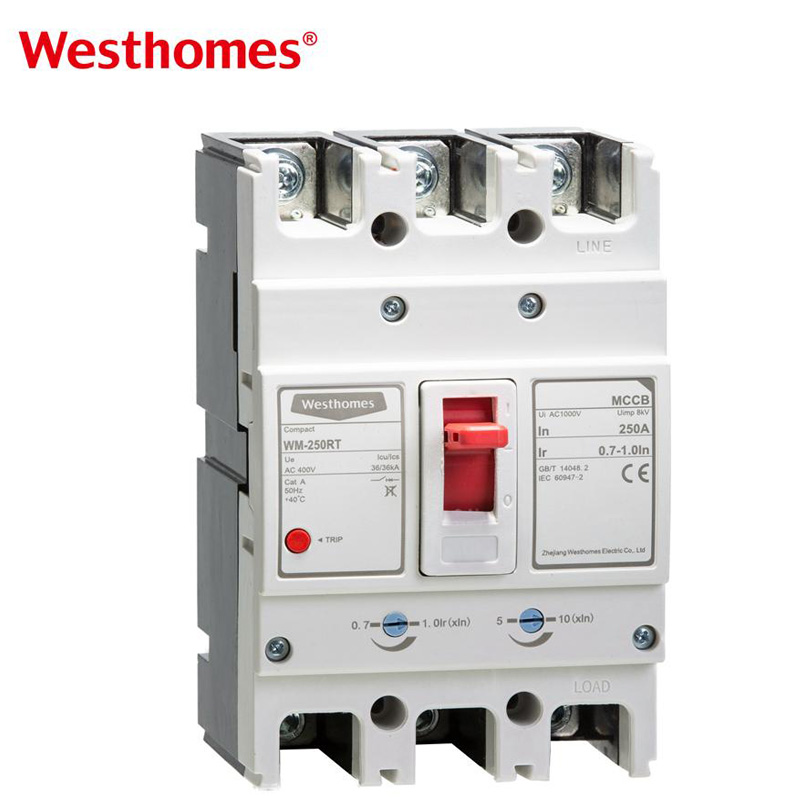
WESTHOMES WM-RT Series MCCB
A good example is the WESTHOMES WM-RT series thermomagnetic dual adjustable MCCB, designed for low-voltage distribution where flexibility and reliability are important. It supports adjustable thermal protection from 0.8 to 1.0In and magnetic protection from 5 to 10In, making it easier to match different load requirements on site.
Practical Advantages in Real Applications
This level of adjustment gives engineers more control during commissioning and helps reduce unnecessary tripping while maintaining solid protection. With its multi-contact structure, stable breaking performance, and compact design, it also fits well in space-limited panels.
As a result, it is widely used in industrial plants, commercial buildings, and general distribution systems where consistent and reliable protection is required.
TMA vs Other Trip Units: A Quick Comparison
Compared with electronic trip units, TMA is simpler and more cost-effective, though it does not include advanced features such as precise monitoring or communication. Compared with fixed thermal-magnetic units, TMA offers more flexibility thanks to its adjustable settings.
| Aspect | TMA Trip Unit | Electronic Trip Unit | Fixed Thermal-Magnetic |
| Complexity | Simple and reliable | More complex, feature-rich | Very simple |
| Cost | Cost-effective | Higher cost | Low cost |
| Adjustability | Thermal adjustable | Highly adjustable | Not adjustable |
| Protection Accuracy | Standard protection | High precision protection | Basic protection |
| Extra Features | None | Monitoring, communication, data | None |
| Typical Use | General distribution systems | Advanced or critical systems | Basic applications |
Frequently Asked Questions (FAQ)
Q1: Is TMA better than an electronic trip unit?
Not necessarily. It really depends on the application. TMA trip units are popular because they are simple, reliable, and cost-effective. For standard distribution systems, they often provide more than enough protection.
Electronic trip units, however, offer more advanced features such as precise current monitoring, communication functions, and programmable settings. These are usually preferred in critical power systems or projects that require energy management and remote monitoring.
Q2: What does the “adjustable” part in TMA actually mean?
The adjustable feature mainly refers to the thermal overload setting. It allows engineers to fine-tune the protection range according to the actual load requirements of the system.
This flexibility helps avoid unnecessary tripping while still maintaining proper overload protection. It is especially useful in applications where load conditions may vary slightly during operation.
Q3: Can TMA MCCBs be used for motor protection?
Yes, but usually as upstream protection rather than dedicated motor protection. TMA MCCBs can provide overload and short-circuit protection for motor circuits, but they may not detect motor-specific faults such as phase loss or phase imbalance.
In many industrial systems, TMA MCCBs are combined with dedicated motor protection devices to achieve more complete protection.
Q4: Why is TMA still widely used if electronic trip units are more advanced?
Because many systems simply do not need advanced digital features. For standard power distribution applications, engineers often prioritize reliability, simplicity, and cost control.
TMA trip units provide dependable protection with a straightforward design, making them easier to maintain and more economical for many projects.
Q5: How do I choose the right TMA MCCB?
The selection usually depends on factors such as rated current, fault level, load type, and installation environment. Engineers also need to consider whether adjustable protection ranges are required for the application.
Choosing the correct MCCB is important because an undersized breaker may trip frequently, while an oversized breaker may not provide adequate protection.
Q6: Does a TMA trip unit require regular maintenance?
Like all protection devices, TMA MCCBs should be inspected regularly to ensure reliable operation. Typical maintenance includes checking terminal connections, cleaning dust, and verifying that the breaker trips properly under test conditions.
Compared with more complex electronic systems, TMA trip units are generally easier to maintain because of their simpler mechanical structure.
Conclusion
TMA is one of the most practical and widely used trip unit types in MCCBs. It combines thermal and magnetic protection in a simple and reliable way, making it suitable for a wide range of applications.

Understanding how TMA works helps in selecting the right MCCB for your system, ensuring both safety and efficiency without unnecessary complexity.

--- END ---
In this blog
Featured Articles
Get A Free Quote
