Get quick appointment for technical support!

How to Fix Power Went Out in One Room But Breaker Not Tripped?
Jun 08, 2026
Introduction
Few electrical problems are more confusing than losing power in just one room while the rest of the house continues to work normally.
You check the electrical panel and find that none of the circuit breakers have tripped. The lights won’t turn on, outlets have no power, and yet the breaker appears to be in the ON position.
While this situation may seem alarming, it is actually a fairly common household electrical issue. In many cases, the problem is not the circuit breaker itself but another component somewhere along the circuit.
This guide explains the most common causes, troubleshooting steps, and solutions when power goes out in one room but the breaker is not tripped.
Why Can a Room Lose Power Without a Tripped Breaker?
Many people assume that any electrical fault will immediately trip a breaker. In reality, circuit breakers are designed primarily to protect against overloads and short circuits.
Problems such as loose wiring, failed outlets, tripped GFCI devices, or damaged connections may interrupt power flow without creating enough current to trip the breaker. As a result, part of a circuit can lose power while the breaker remains in the ON position.
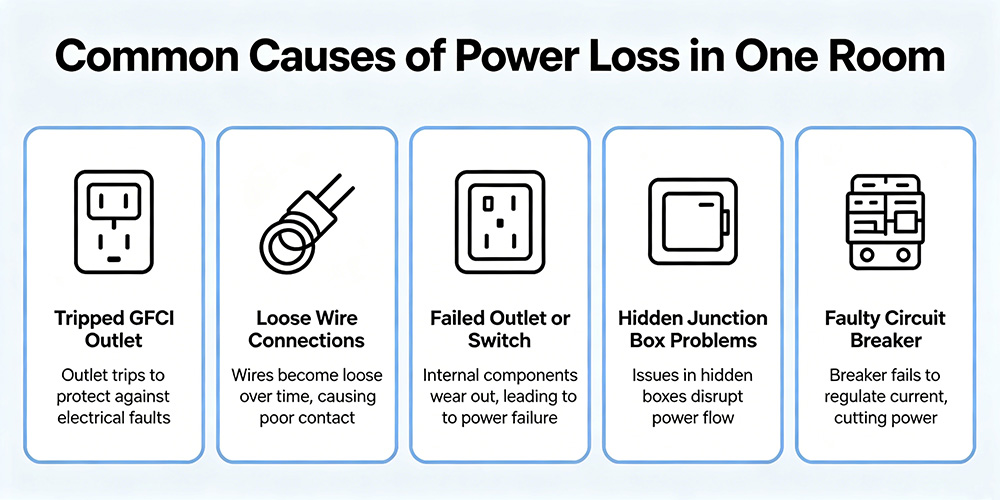
Common Causes of Power Loss in One Room
1. A Tripped GFCI Outlet
One of the most common causes is a tripped GFCI (Ground Fault Circuit Interrupter) outlet.
Many homeowners don’t realize that a single GFCI outlet can protect multiple outlets located downstream on the same circuit. When it trips, every protected outlet may lose power, even if they are located in a different room.
What to Check
- Bathroom outlets
- Kitchen outlets
- Garage outlets
- Basement outlets
- Outdoor outlets
Press the RESET button on every GFCI outlet you can find.
2. Loose Wire Connections
Electrical connections can loosen over time due to vibration, thermal expansion, aging, or improper installation.
A loose connection may interrupt power to an entire section of a circuit without causing the breaker to trip. This is especially common in older homes where backstab wiring methods were used.
Warning Signs
- Flickering lights
- Intermittent power loss
- Warm outlets
- Buzzing sounds
- Burning smell
3. A Failed Outlet or Switch
Sometimes the problem is not the breaker at all but a damaged outlet or wall switch.
Because outlets are often wired in sequence, one failed device can interrupt power to everything connected downstream.
4. Hidden Junction Box Problems
Loose wire nuts, corroded connections, or damaged conductors inside a junction box can disconnect power from part of the circuit.
These issues are often hidden behind walls or ceilings and require inspection by a qualified electrician.
5. Faulty Circuit Breaker
Although less common, a breaker can fail mechanically and remain in the ON position even when it is no longer supplying power.
Before assuming the breaker is working properly, try turning it fully OFF and then firmly back ON.
Step-by-Step Troubleshooting Guide
Before calling an electrician, there are several basic checks you can perform to identify the source of the problem. In many cases, a room losing power while the breaker remains ON is caused by a simple issue such as a tripped GFCI outlet, a loose connection, or a partially failed device. Following a systematic troubleshooting process can help narrow down the cause and may even resolve the issue without professional assistance.
Step 1: Reset the Breaker
Even if the breaker handle appears to be in the ON position, do not immediately assume that it is functioning properly. Some breakers can partially trip internally without the handle moving completely to the OFF position. This condition is sometimes referred to as a “hidden trip.”
To ensure the breaker is fully reset, move the handle firmly to the OFF position first and then switch it back to ON. If power returns after resetting, the breaker may have experienced a temporary fault condition.
If the breaker immediately trips again after being reset, there may be a more serious issue such as an overload, short circuit, or wiring fault that requires further investigation.
Step 2: Check Every GFCI Outlet
A tripped GFCI outlet is one of the most common reasons for losing power in a single room while the breaker remains on. Many homeowners are surprised to learn that one GFCI outlet can protect several standard outlets located elsewhere on the same circuit.
For example, a GFCI outlet installed in a bathroom may also protect outlets in nearby bedrooms, garages, basements, or outdoor areas. If the GFCI trips, all downstream outlets may lose power even though the breaker has not tripped.
Carefully inspect every GFCI outlet in your home and press the RESET button. If the outlet immediately trips again, there may be a ground fault somewhere in the circuit.
Step 3: Test Nearby Outlets
The next step is determining the extent of the power outage. Understanding exactly which devices have lost power can provide valuable clues about where the fault is located.
Try plugging a lamp, phone charger, or outlet tester into nearby receptacles and determine whether the problem affects:
- One outlet only
- Several outlets on the same wall
- Multiple outlets throughout the room
- The entire room
If only a single outlet is affected, the outlet itself may be damaged. If multiple outlets are dead, the problem is more likely located at an upstream connection, junction box, or GFCI device.
Step 4: Check Wall Switches
Not all outlets receive constant power. In many homes, certain receptacles are controlled by wall switches, especially in bedrooms and living rooms where switched outlets are used instead of ceiling lighting fixtures.
Before assuming there is an electrical fault, check nearby wall switches and confirm that none have been accidentally turned off. It is also worth testing all switches in the room, as some may control only part of a receptacle or a hidden lighting circuit.
Although this may seem obvious, accidentally switched-off outlets are responsible for many unnecessary service calls every year.
Step 5: Look for Signs of Damage
If power has not been restored after the previous steps, carefully inspect outlets, switches, and visible wiring for signs of electrical damage.
Pay close attention to:
- Burn marks
- Discoloration
- Melted plastic
- Warm or hot outlets
- Buzzing sounds
- Burning odors
- Loose faceplates
These symptoms often indicate loose wiring, overloaded connections, arcing, or deteriorated electrical components. Such conditions can become serious fire hazards if left unaddressed.
If any of these warning signs are present, stop troubleshooting and contact a qualified electrician immediately.
When Should You Call an Electrician?
While some power-loss issues can be resolved by resetting a breaker or a GFCI outlet, not every electrical problem is safe to troubleshoot on your own. If the outage is caused by damaged wiring, loose connections, overloaded circuits, or hidden electrical faults, attempting DIY repairs may increase the risk of electric shock, fire, or further equipment damage.
As a general rule, if the problem cannot be identified after basic troubleshooting, or if there are any signs of overheating or electrical damage, it is best to stop using the affected circuit and contact a qualified electrician.
Warning Signs That Require Professional Attention
Contact a licensed electrician immediately if you notice any of the following symptoms:
Burning Smells
A burning odor coming from an outlet, switch, breaker panel, or electrical appliance often indicates overheating, insulation failure, or damaged wiring. This should never be ignored, as it may be an early sign of an electrical fire.
Visible Sparks
Occasional tiny sparks may occur when plugging in certain appliances, but frequent or large sparks from outlets or switches are not normal. They may indicate loose connections, damaged contacts, or electrical arcing.
Hot Outlets or Switches
Electrical outlets and switches should remain relatively cool during normal operation. If they feel noticeably warm or hot to the touch, excessive current flow or poor electrical connections may be present.
Repeated Power Loss
If power repeatedly goes out in the same room or circuit, even after resetting breakers and checking GFCI outlets, there may be a deeper wiring issue that requires professional diagnosis.
Buzzing or Crackling Sounds
Electrical systems should operate quietly. Buzzing, crackling, or humming sounds from outlets, switches, or breaker panels can indicate loose wiring, damaged breakers, or electrical arcing.
Evidence of Damaged Wiring
Exposed conductors, melted insulation, scorched outlets, or visibly damaged cables should always be inspected and repaired by a professional electrician as soon as possible.
Safety Reminder
Never continue using a circuit that shows signs of overheating, sparking, or physical damage. Turning off power to the affected circuit and seeking professional assistance is often the safest and most cost-effective solution.
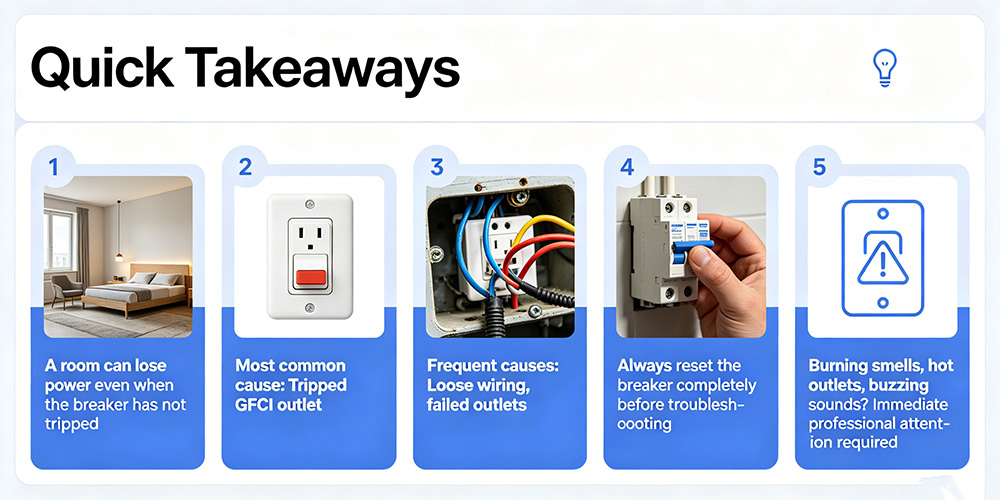
Quick Takeaways
- A room can lose power even when the breaker has not tripped.
- The most common cause is a tripped GFCI outlet.
- Loose wiring and failed outlets are also frequent causes.
- Always reset the breaker completely before further troubleshooting.
- Burning smells, hot outlets, and buzzing sounds require immediate professional attention.
FAQ
Q1 Can a breaker fail without tripping?
Yes. Although uncommon, internal mechanical failure can prevent proper operation.
Q2 Why did only one room lose power?
Most rooms are supplied by separate branch circuits. A fault on one circuit may affect only one room.
Q3 Can a GFCI in another room cause this problem?
Yes. One GFCI outlet may protect several downstream outlets on the same circuit.
Q4 Is it safe to keep using outlets that intermittently lose power?
No. Intermittent power loss often indicates a loose connection that may generate heat and become a fire hazard.
Conclusion
Losing power in one room while the circuit breaker remains in the ON position can be frustrating, but it does not always indicate a serious electrical failure. In many cases, the problem can be traced to a tripped GFCI outlet, a loose wire connection, a faulty receptacle, or another issue somewhere along the branch circuit.
The key is to approach the problem systematically. Start by checking the breaker, resetting any GFCI outlets, and inspecting nearby switches and receptacles. Many minor issues can be identified through basic troubleshooting. However, if you notice signs such as overheating, burning smells, buzzing sounds, sparks, or repeated power loss, professional electrical inspection is strongly recommended.
Understanding the common causes of power loss can help homeowners and facility managers respond more quickly, reduce downtime, and maintain a safer electrical system. A properly installed and well-maintained circuit protection system—including high-quality circuit breakers—plays an important role in ensuring reliable power distribution and long-term electrical safety.

--- END ---
In this blog
Featured Articles
Get A Free Quote
