Get quick appointment for technical support!

How to Choose the Right RCBO for My Electrical Panel
Jul 01, 2026
Introduction
Every electrical panel needs reliable protection against more than just overloads and short circuits. Earth leakage faults can also pose serious risks, including electric shock, equipment damage, and even fire.
This is why RCBOs have become a common choice in modern residential, commercial, and industrial distribution systems. An RCBO combines overcurrent protection and residual current protection in a single device, reducing panel space while improving electrical safety. However, selecting the right RCBO involves more than choosing the correct current rating.
Factors such as leakage sensitivity, load type, breaking capacity, and system configuration all influence how well the device performs. This guide explains the key considerations for choosing an RCBO that matches your electrical panel and application.
What is an RCBO?
An RCBO is a protective electrical device that integrates the functions of an MCB (Miniature Circuit Breaker) and an RCCB (Residual Current Circuit Breaker). It protects against both overcurrent conditions and earth leakage faults within a single unit.
This combination reduces panel space, simplifies wiring, and improves overall system safety.
Why Proper RCBO Selection Matters
Correct RCBO selection ensures:
- Protection of human life from electric shock
- Prevention of electrical fires caused by leakage or overload
- Stable operation of sensitive electrical equipment
- Coordination with upstream protection devices
- Reduced nuisance tripping in real applications
Incorrect selection often leads to either over-sensitive tripping or insufficient fault protection.
Key Parameters for RCBO Selection
Rated Current (In)
The rated current determines the maximum continuous load the RCBO can carry.
Basic calculation:
I=P/V
A safety margin of around 125% is commonly applied in engineering design to avoid nuisance tripping under peak load conditions.
Residual Current Sensitivity (IΔn)
Residual current sensitivity (IΔn) determines the leakage current level at which an RCBO will automatically disconnect the circuit. Choosing the correct sensitivity is essential for balancing personnel safety, equipment protection, and system reliability. A sensitivity that is too low may lead to nuisance tripping, while one that is too high may not provide adequate protection for the intended application.
| Sensitivity | Typical Application | Description |
| 30mA | Personal protection | Provides additional protection against electric shock and is the standard choice for socket outlets, residential circuits, and most final distribution circuits. |
| 100mA | Equipment protection & selective protection | Commonly used for equipment protection or as an upstream protective device where higher leakage currents are expected, helping reduce nuisance tripping while maintaining system safety. |
| 300mA | Fire protection & upstream coordination | Primarily used to reduce the risk of electrical fires caused by insulation faults and to achieve selective coordination in larger distribution systems. |
Breaking Capacity
This defines the maximum short-circuit current the RCBO can safely interrupt.
It must always be higher than the prospective fault current of the system.
Pole Configuration
| System Type | RCBO Type |
| Single-phase | 1P+N |
| Three-phase | 3P / 3P+N |
Trip Curve
The trip curve determines how quickly an RCBO responds to overcurrent conditions. The most commonly used trip curves include:
| Trip Curve | Typical Application |
| Type B | Resistive loads such as lighting and heating circuits |
| Type C | General-purpose circuits, including commercial and light industrial applications |
| Type D | Circuits with high inrush current, such as motors, transformers, and compressors |
Residual Current Type
Different electrical loads produce different leakage current waveforms. Selecting the correct residual current type improves protection performance and minimizes nuisance tripping.
| Leakage Type | Typical Application |
| Type AC | Standard AC loads with sinusoidal residual currents |
| Type A | Electronic equipment, LED lighting, inverters, and switching power supplies |
| Type F | Variable-speed drives and single-phase inverter equipment |
| Type B | Three-phase inverters, EV charging systems, and industrial DC applications |
Load Type Consideration
One of the most important but often overlooked factors in RCBO selection is the type of electrical load. Different load types behave differently under operation, especially in terms of inrush current, leakage characteristics, and waveform distortion. These factors directly affect whether an RCBO will operate stably or cause nuisance tripping.
Understanding load behavior is essential to ensure proper coordination between protection devices and the actual electrical system.
Resistive Loads (Stable Current Behavior)
Resistive loads such as lighting systems, heaters, and simple household appliances draw a relatively stable current without significant inrush at startup.
For these applications, standard RCBO settings are usually sufficient, and nuisance tripping is rare.
Inductive Loads (High Inrush Current)
Inductive loads such as motors, pumps, compressors, and HVAC systems generate high inrush current during startup. This current can be several times higher than the rated operating current.
If not properly considered during RCBO selection, it may lead to unwanted tripping during normal operation.
Electronic Loads (Non-linear Behavior)
Modern electronic devices such as computers, LED drivers, and switching power supplies introduce harmonic distortion and leakage currents caused by internal filters and capacitive components.
These loads may cause cumulative leakage current in the system, requiring careful selection of RCBO sensitivity type (Type A or Type B in advanced systems).
Engineering Selection Insight
In real-world applications, most electrical panels contain a mixture of resistive, inductive, and electronic loads. This means RCBO selection should never be based on a single load type, but rather on the dominant or combined load characteristics.
A correct understanding of load behavior helps improve system stability, reduce nuisance tripping, and extend equipment lifespan.
WESTHOMES RCBO SOLUTION
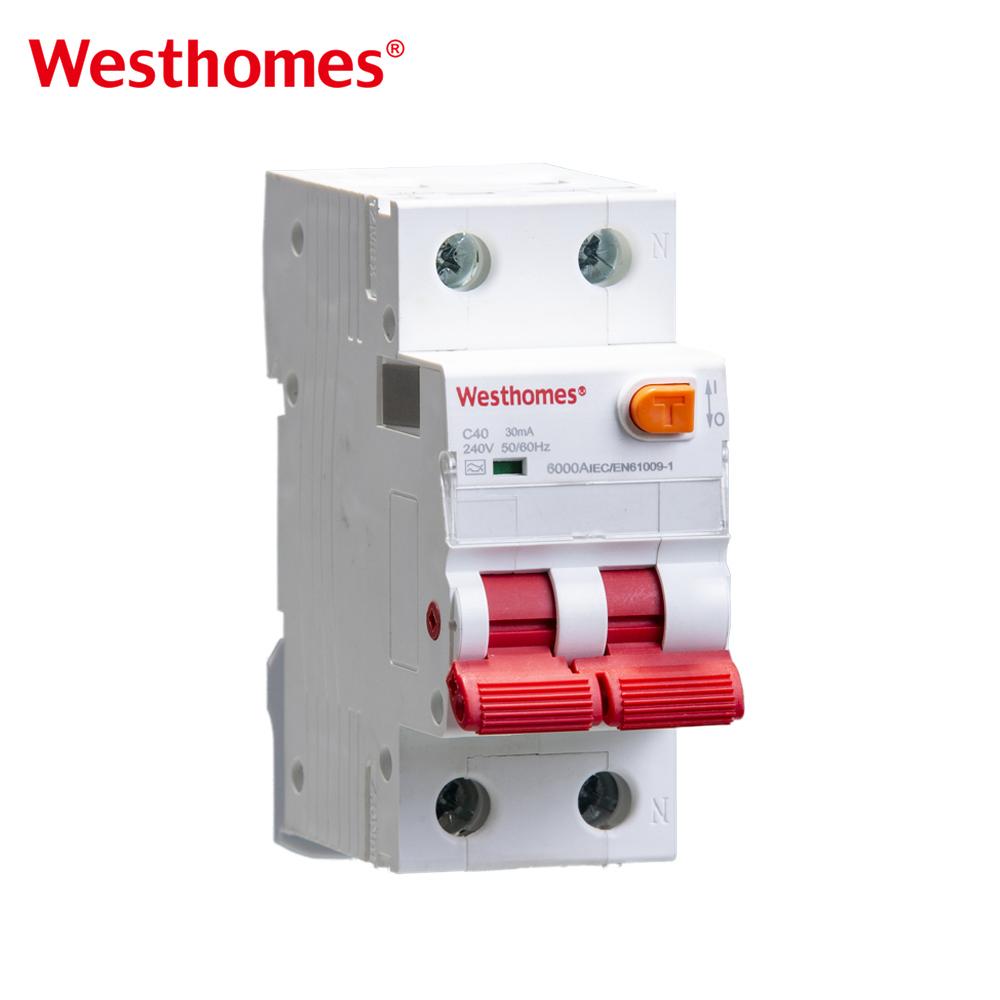
Selecting the right RCBO is not only about choosing the correct electrical ratings but also about ensuring long-term reliability and compliance with international standards. The WESTHOMES WRO1-63 RCBO combines overload, short-circuit, and residual current protection in one compact device, making it suitable for residential, commercial, and light industrial distribution systems.
Key Features
- Compliant with IEC 61009-1
- Rated current: 6A–40A
- Residual current options: 10mA, 30mA, 100mA, 300mA
- Available in Type AC and Type A
- Breaking capacity up to 6kA
- 1P+Nand 3P+N configurations
- Rated voltage: AC 240V/415V, 50/60Hz
- Fast tripping time of ≤0.1 s for enhanced protection
Typical Applications
The WRO1-63 RCBO is widely used in residential distribution boards, commercial buildings, office facilities, HVAC systems, and light industrial control panels, providing reliable protection for both people and electrical equipment.
System Design Considerations
When selecting an RCBO, the device itself is only one part of the overall protection strategy. In real electrical systems, correct performance depends heavily on system-level coordination, installation design, and environmental conditions. Ignoring these factors can lead to nuisance tripping, reduced protection effectiveness, or even equipment damage.
Coordination with upstream MCB/MCCB
RCBOs must be properly coordinated with upstream protective devices such as MCBs or MCCBs. This ensures selectivity, meaning that only the faulted circuit is disconnected while the rest of the system remains operational.
Without proper coordination, a minor fault may cause upstream breakers to trip unnecessarily, leading to larger system outages.
Selectivity and discrimination
Selectivity ensures that only the nearest protective device responds to a fault condition. Proper discrimination between devices improves system reliability and reduces downtime.
This is particularly important in multi-level distribution systems where multiple protection devices are installed in series.
Panel space limitations
Modern electrical panels often have limited installation space. RCBOs are compact devices, but improper planning may still result in overcrowding, poor airflow, or difficult maintenance access.
Good panel layout design improves heat dissipation and long-term reliability.
Ambient temperature derating
RCBO performance is affected by ambient temperature. Higher temperatures reduce the effective current-carrying capacity of the device, requiring derating in system design.
If temperature conditions are ignored, premature tripping or overheating may occur.
Wiring and installation constraints
Correct wiring practices are essential for safe operation. Loose connections, incorrect conductor sizing, or improper routing can lead to overheating, leakage issues, or false tripping.
Installation should always follow manufacturer torque specifications and electrical standards.
Common Mistakes in RCBO Selection
In real electrical installations, many RCBO selection problems are not caused by product quality, but by incorrect design assumptions or incomplete system analysis. These mistakes can lead to nuisance tripping, reduced protection performance, or even system safety risks.
Selecting RCBO only based on current rating
Many users choose RCBOs solely based on rated current without considering load type or system conditions. This can result in improper protection behavior, especially in systems with inductive or electronic loads.
Ignoring leakage sensitivity type
Different applications require different residual current sensitivity levels (e.g., 30mA, 100mA, 300mA). Using an incorrect sensitivity level may either cause nuisance tripping or fail to provide adequate protection.
Oversizing without proper calculation
Oversizing RCBOs “for safety margin” without load calculation reduces protection sensitivity. In some cases, it may allow unsafe overcurrent conditions to persist.
Not considering inrush current
Inductive and motor loads generate high inrush current during startup. If not considered during selection, RCBOs may trip even under normal operating conditions.
Mismatching cable size
Incorrect coordination between RCBO rating and cable size can lead to overheating, insulation damage, or insufficient protection for conductors.
Ignoring breaking capacity
Breaking capacity is critical for short-circuit safety. Selecting an RCBO with insufficient breaking capacity may result in device failure under fault conditions.
Step-by-Step Selection Method
Selecting the correct RCBO requires a structured engineering approach rather than a simple rating comparison. Each step ensures that the device is properly matched to real electrical conditions, including load behavior, fault levels, and installation environment.
Calculate total load current
The first step is to determine the total load current of the circuit. This can be calculated based on connected power loads using:
I=P/V
For three-phase systems:
I=P/√3×V×cosφ
This value represents the base for all subsequent RCBO selection decisions.
Identify load type
Different load types behave differently under operation. It is important to classify whether the load is resistive, inductive, or electronic, as this directly affects inrush current and leakage characteristics.
Select rated current (In)
The RCBO rated current should always be higher than the calculated load current, typically with a safety margin of 125%:
In≥1.25×Iload
However, oversizing should be avoided to maintain proper protection sensitivity.
Choose leakage sensitivity (IΔn)
Leakage sensitivity determines how sensitive the RCBO is to earth leakage faults:
- 30mA → personal protection
- 100mA → equipment protection
- 300mA → fire protection / upstream coordination
Selection depends on application environment and safety requirements.
Determine breaking capacity
Breaking capacity must be higher than the expected short-circuit current at the installation point:
Icu≥Isc
Failure to meet this requirement may result in device damage during fault conditions.
Select pole configuration
Pole selection depends on system type:
| System Type | RCBO Configuration |
| Single-phase | 1P+N |
| Three-phase | 3P / 3P+N |
Correct pole selection ensures proper disconnection of all active conductors.
Check installation conditions
Environmental factors such as temperature, humidity, and ventilation must be considered. High ambient temperature may require current derating.
Poor installation conditions can significantly reduce RCBO performance and lifespan.
Verify system coordination
Finally, ensure proper coordination with upstream and downstream protection devices. This guarantees selectivity so that only the faulted circuit is disconnected.
Without coordination, system-wide outages may occur even for local faults.
Application Scenarios
RCBOs are used across a wide range of electrical systems, from residential installations to complex industrial networks. Their ability to combine overload protection and earth leakage protection makes them suitable wherever both equipment safety and human protection are required.
In practical applications, different environments place different demands on RCBO performance, including load stability, leakage sensitivity, and system coordination.
Residential distribution boards
In residential buildings, RCBOs are commonly installed in final distribution boards to protect individual circuits such as lighting, sockets, and kitchen appliances. They provide personal protection against electric shock while also preventing overload-related hazards in household wiring systems.
Commercial buildings
In commercial environments such as offices, shopping centers, and hotels, electrical loads are more diverse and continuously changing. RCBOs help maintain stable operation by isolating faulted circuits without affecting the entire distribution system.
Industrial control panels
Industrial systems often include motors, control equipment, and automation devices. RCBOs are used to protect individual control circuits from overloads and leakage currents caused by harsh operating conditions.
HVAC systems
Heating, ventilation, and air conditioning systems typically involve inductive loads such as compressors and fans. RCBOs help ensure safe operation while handling inrush current during startup conditions.
Renewable energy systems
In solar PV and other renewable energy installations, RCBOs are used to protect inverter output circuits and AC distribution sides. They help ensure safe disconnection during maintenance and fault conditions.
Smart building infrastructure
Modern smart buildings integrate multiple electrical systems including lighting control, automation, and IoT-based devices. RCBOs provide reliable protection while maintaining system continuity and reducing unnecessary shutdowns.
Quick Selection Checklist
In practical engineering work, RCBO selection often needs to be completed quickly while still ensuring key electrical parameters are correctly evaluated. The checklist below summarizes the most important factors that should be verified before final selection.
This table can be used as a quick engineering reference to reduce selection errors and ensure system compatibility.
Quick RCBO Selection Checklist
| Item | Requirement |
| Load Current | Calculated based on actual system load |
| Safety Margin | Typically 1.25 × rated load current |
| Load Type | Resistive / Inductive / Electronic |
| Leakage Sensitivity | 30mA / 100mA / 300mA depending on application |
| Breaking Capacity | Must exceed system fault current |
| Pole Configuration | 1P+N / 3P / 3P+N according to system type |
| Cable Size | Must be compatible with rated current |
| Ambient Temperature | Derating considered in high-temperature environments |
| System Coordination | Must coordinate with upstream protection devices |
Engineering Notes
Each parameter in the checklist corresponds to a specific aspect of electrical safety and system performance. For example, selecting the correct leakage sensitivity directly affects personnel protection, while breaking capacity determines the device’s ability to withstand short-circuit conditions.
Ignoring any single item in the checklist may lead to improper protection behavior or system instability.
Practical Use Scenario
This checklist is typically used during:
- Electrical panel design stage
- Product selection before procurement
- On-site troubleshooting and replacement decisions
- Engineering review and system audit
FAQ
Q1 What is the difference between RCBO and MCB?
MCB protects against overcurrent only, while RCBO also provides earth leakage protection.
Q2 Can RCBO replace MCB + RCCB?
Yes, in most modern installations RCBO can replace both devices.
Q3 What sensitivity should I use for home applications?
30mA is standard for personal protection.
Q4 Why does RCBO trip frequently?
It may be caused by leakage current accumulation or improper load selection.
Q5 How do I choose breaking capacity?
It must be higher than the system’s maximum short-circuit current.
Conclusion
Selecting the right RCBO is a balance between safety, system compatibility, and real-world load conditions. A properly selected device not only improves electrical safety but also enhances system stability and reduces maintenance issues.

--- END ---
In this blog
Featured Articles
Get A Free Quote
