Get quick appointment for technical support!

How do I properly install a new main service circuit breaker?
Jun 29, 2026
Introduction
Installing a main service circuit breaker is one of the most critical field operations in a low-voltage electrical system. It serves as the primary disconnecting and protection device between the utility supply and the entire distribution system.A correct installation ensures safe power isolation, stable load distribution, and reliable fault protection for the entire electrical network.
However, because the main breaker is directly connected to incoming power, any improper installation can lead to serious safety risks, equipment damage, or system failure. That is why the process must follow strict electrical standards and safety procedures.
What is a Main Service Circuit Breaker?
A main service circuit breaker is the first protective device installed after the utility supply or transformer. It controls the entire downstream electrical system and provides protection against overload, short circuit, and system faults.
It also serves as the main isolation point during maintenance or emergency shutdown.
Safety Requirements Before Installation
Before installing a main service circuit breaker, strict electrical safety procedures must be followed. Because this device is directly connected to the incoming power supply, any oversight during preparation can lead to severe electric shock, arc flash, equipment damage, or system-wide failure.
For this reason, installation should only be carried out by qualified personnel in accordance with relevant electrical safety standards and local regulations.
Complete power isolation (Lockout/Tagout – LOTO)
All upstream power sources must be fully disconnected before any work begins. A proper Lockout/Tagout procedure should be applied to prevent accidental energization during installation.
Never rely on control switches alone to isolate the circuit.
Voltage verification before contact
After isolation, the circuit must be tested using a properly rated voltage detector to confirm zero voltage condition. This step should be performed on all phases, including neutral conductors.
Personal Protective Equipment (PPE)
Appropriate PPE must be worn at all times, including insulated gloves, safety goggles, and arc-rated protective clothing when working in distribution panels.
System grounding confirmation
Before installation, ensure that the grounding system is properly installed and has low resistance. A poor grounding system increases the risk of electric shock and equipment damage.
Environmental safety conditions
The installation area should be dry, well-ventilated, and free from conductive dust or moisture. Working in humid or wet environments significantly increases electrical hazards.
Qualified personnel requirement
Only trained and authorized electricians should perform installation. Improper installation may lead to incorrect wiring, overheating, or failure of protective coordination.
Panel Preparation
Before installing a main service circuit breaker, proper panel preparation is essential to ensure mechanical compatibility, electrical safety, and long-term system stability. A poorly prepared panel can lead to overheating, misalignment, connection stress, or even protection failure during operation.
In engineering practice, panel preparation is not just a mechanical step, but a system verification process that ensures the MCCB operates within its designed electrical and thermal limits.
Verify rated current capacity of the panel
The panel’s busbar and internal conductors must be rated to handle the expected system current. Undersized components may create thermal stress and reduce system lifespan.
Check busbar compatibility and alignment
Ensure that the MCCB connection terminals are compatible with the panel busbar layout. Misalignment may cause poor contact pressure, leading to overheating or voltage drop.
Confirm available installation space
Adequate clearance must be provided for wiring, heat dissipation, and future maintenance. Overcrowded panels increase thermal accumulation and reduce reliability.
Evaluate cable entry and routing path
Cable routing should be planned to avoid sharp bending, mechanical stress, and excessive conductor length. Poor routing may affect electrical performance and long-term stability.
Check panel ventilation and heat dissipation
Thermal performance is a critical factor in MCCB operation. Panels with insufficient ventilation may cause temperature rise and unintended tripping.
Installing the Main Circuit Breaker
Installing a main service circuit breaker requires careful mechanical alignment, correct electrical termination, and strict adherence to installation torque and wiring standards. Because this device carries the full system load, any installation error may directly affect downstream equipment and overall system safety.
In practice, installation should follow a controlled sequence to ensure both electrical integrity and mechanical reliability.
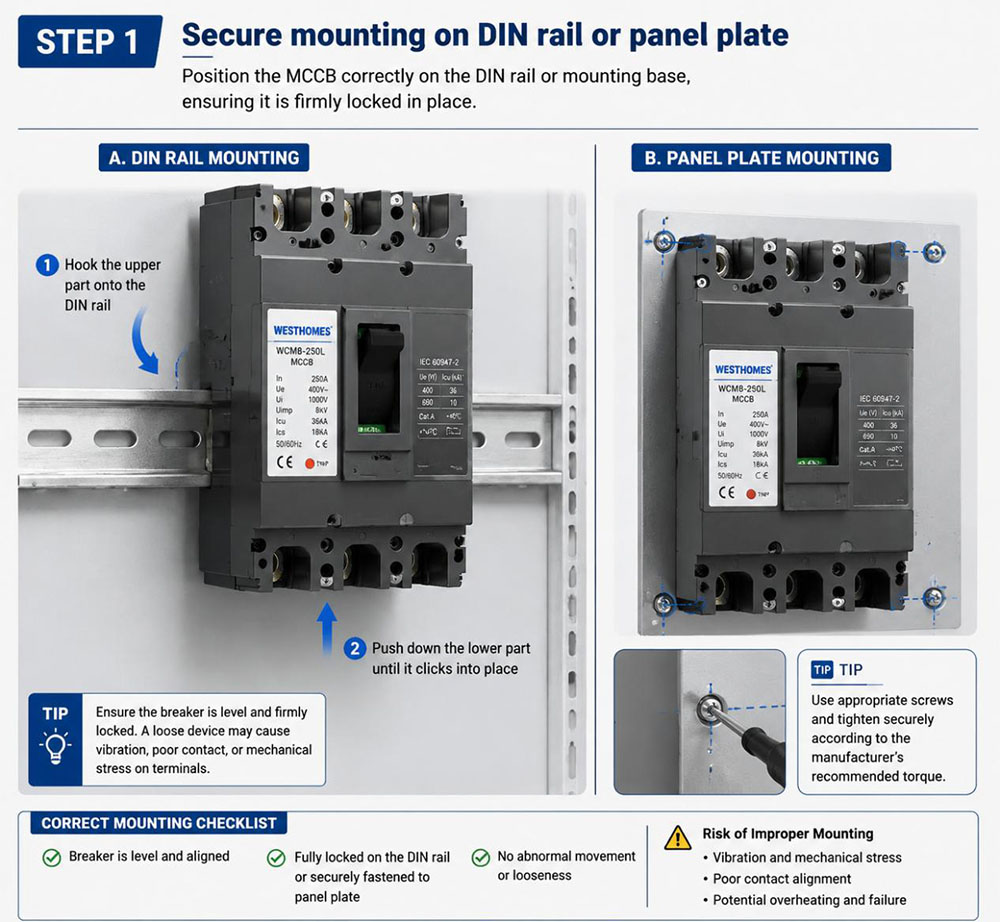
Step 1: Secure mounting on DIN rail or panel plate
Position the MCCB correctly on the DIN rail or mounting base, ensuring it is firmly locked in place. Improper mounting may lead to vibration, poor contact alignment, or mechanical stress on terminals.
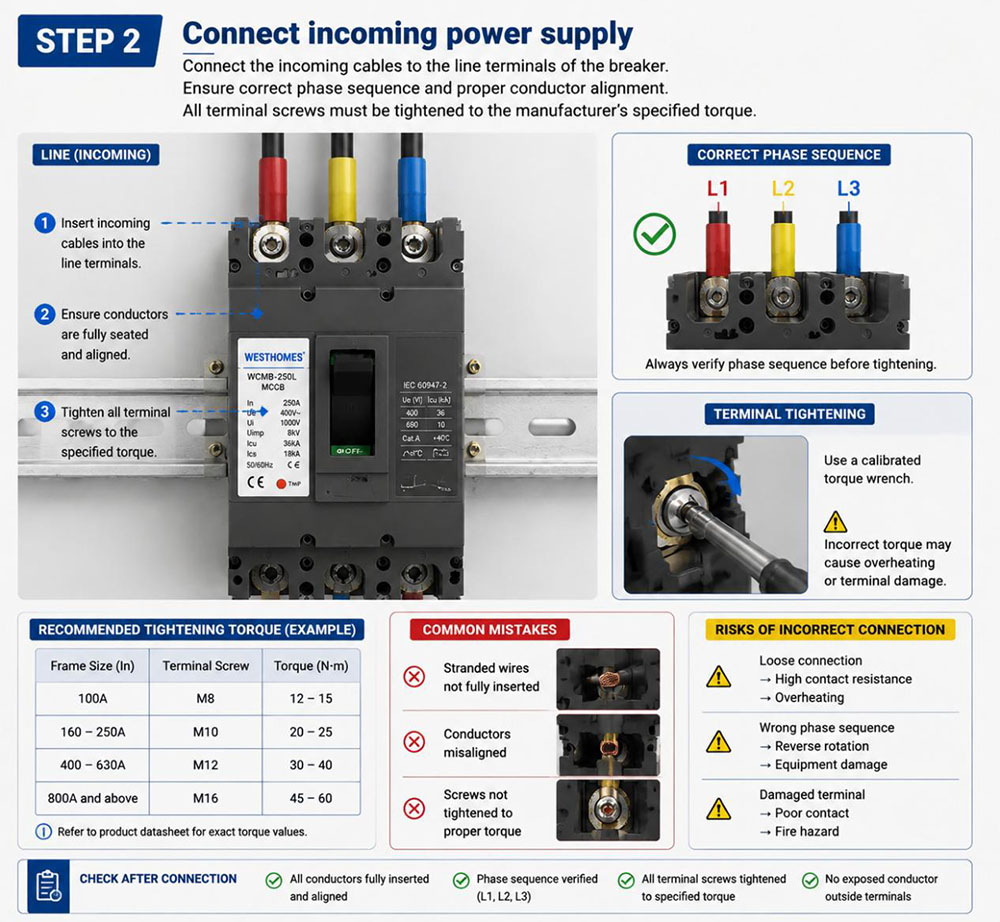
Step 2: Connect incoming power supply
Connect the incoming cables to the line terminals of the breaker. Ensure correct phase sequence and proper conductor alignment. All terminal screws must be tightened according to the manufacturer’s specified torque value.
Incorrect torque may lead to overheating or terminal damage.
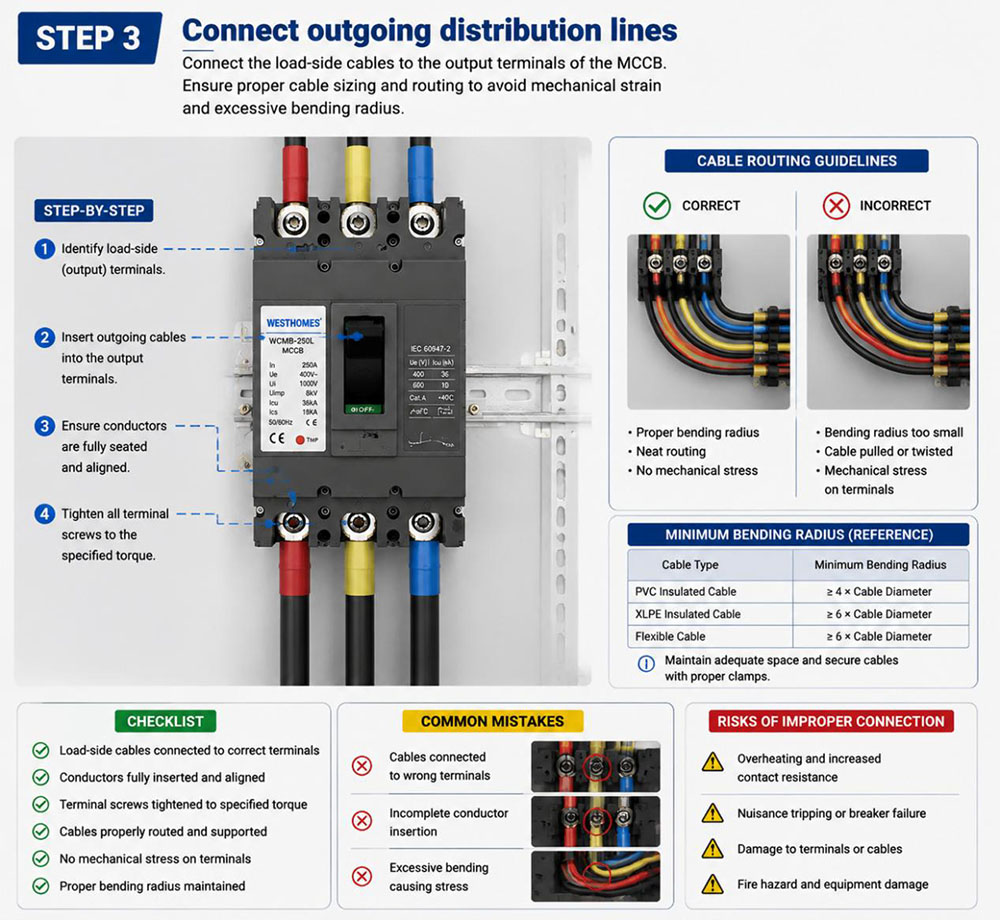
Step 3: Connect outgoing distribution lines
Connect the load-side cables to the output terminals of the MCCB. Proper cable sizing and routing must be ensured to avoid mechanical strain and excessive bending radius.
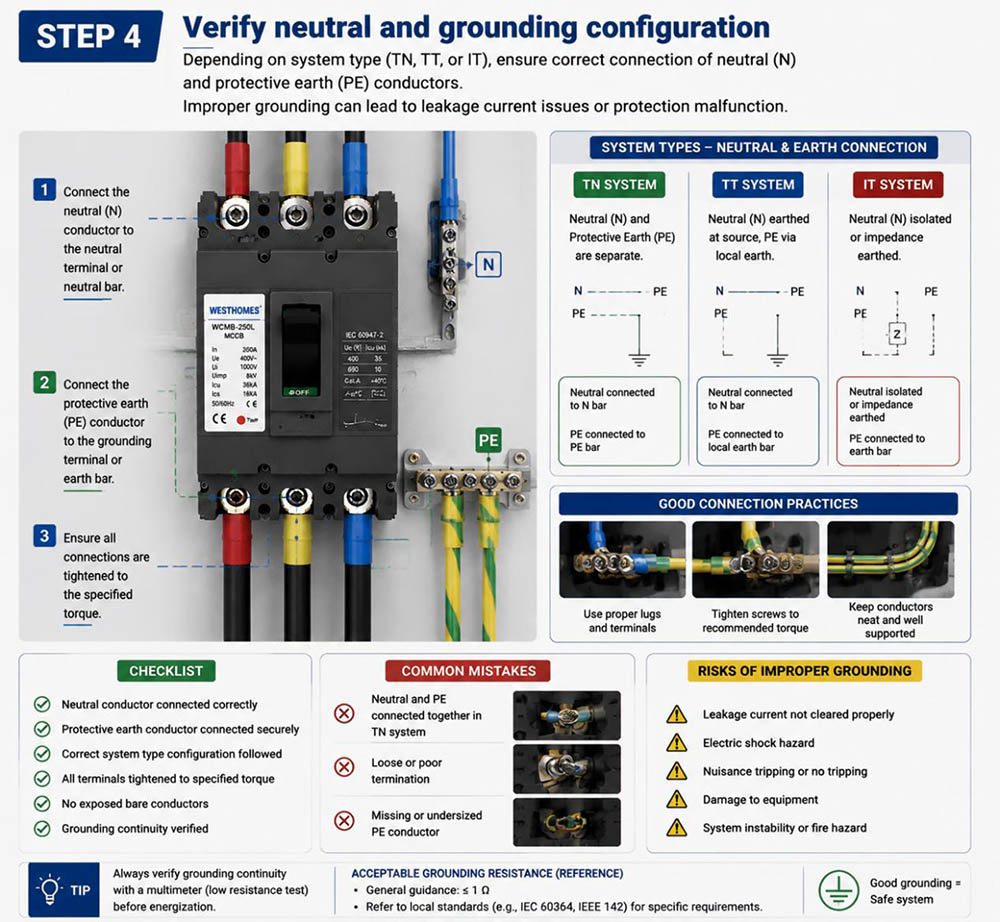
Step 4: Verify neutral and grounding configuration
Depending on system type (TN, TT, or IT), ensure correct connection of neutral and protective earth conductors. Improper grounding can lead to leakage current issues or protection malfunction.
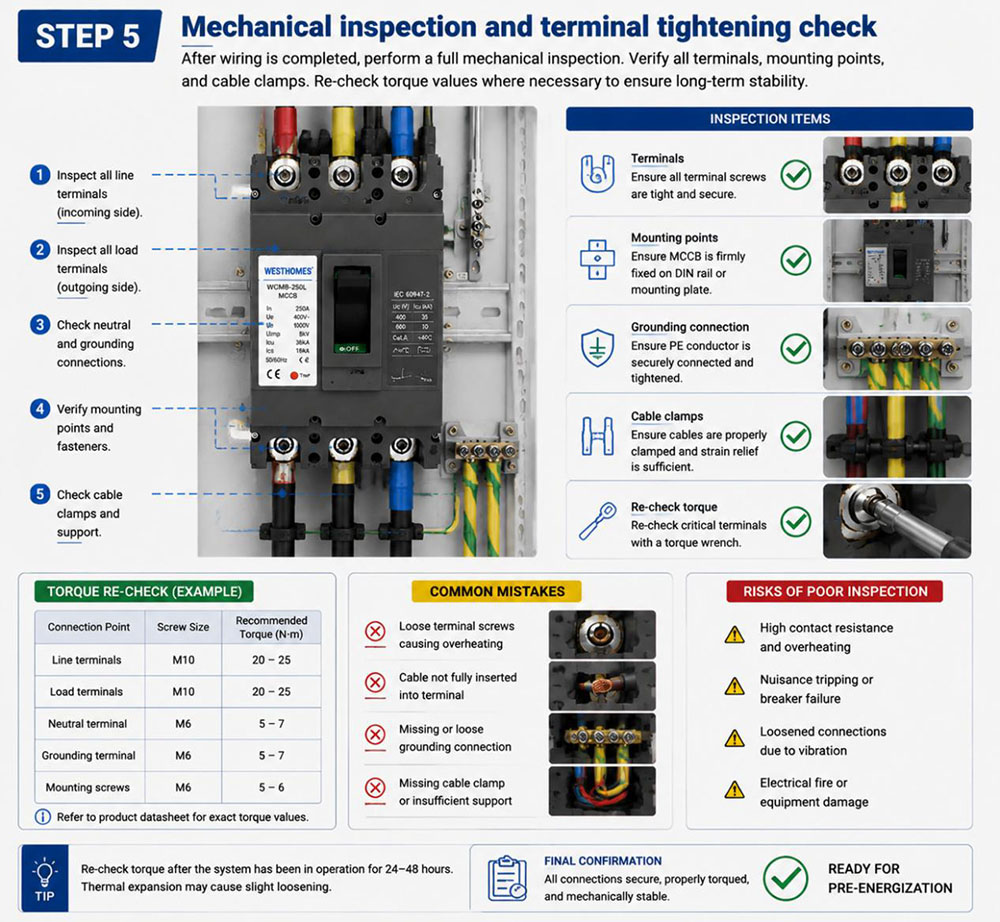
Step 5: Mechanical inspection and terminal tightening check
After wiring is completed, perform a full mechanical inspection. Verify all terminals, mounting points, and cable clamps. Re-check torque values where necessary to ensure long-term stability.
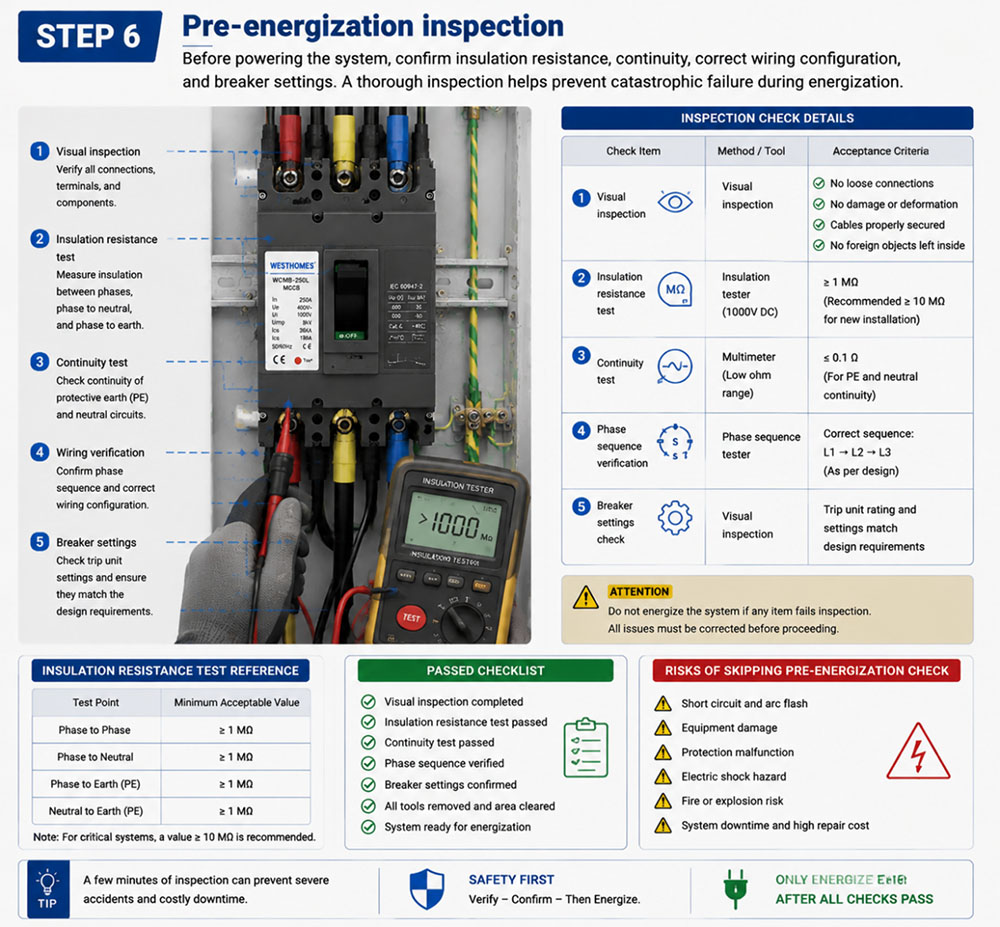
Step 6: Pre-energization inspection
Before powering the system, confirm insulation resistance, continuity, and correct wiring configuration. A dry-run inspection helps prevent catastrophic failure during energization.
Testing and Commissioning
After installation, testing and commissioning are essential to verify that the main circuit breaker and the entire distribution system are operating safely and correctly. This stage ensures that all electrical connections, protection functions, and system parameters meet design requirements before full energization.
Skipping this step may result in undetected wiring errors, insulation faults, or protection malfunction during operation.
Insulation resistance test
Perform an insulation resistance test between phases, neutral, and earth to ensure that the system insulation level meets safety standards. Low insulation resistance may indicate damaged cables or improper installation.
Continuity and wiring verification
Check all electrical connections to ensure correct wiring configuration. This includes phase sequence verification, neutral connection, and grounding continuity.
Incorrect wiring at this stage may cause reverse phase rotation or protection failure.
Mechanical inspection of terminals
Recheck all terminal tightening points to ensure correct torque has been applied. Loose connections can lead to overheating and long-term failure.
No-load energization test
Energize the system without load first to verify correct breaker operation, voltage stability, and absence of abnormal noise or tripping.
Gradual load application
After successful no-load testing, gradually apply load to the system while monitoring current, temperature, and breaker performance.
Common Installation Mistakes
Incorrect installation of a main service circuit breaker is one of the leading causes of system instability, nuisance tripping, overheating, and even electrical fire hazards. Most of these issues do not come from product defects, but from improper installation practices or lack of system-level understanding.
Below are the most frequent installation mistakes observed in real engineering projects, along with their technical consequences.
Incorrect terminal tightening torque
One of the most common issues is under-tightening or over-tightening of terminals. Loose connections increase contact resistance, leading to localized heating, while excessive torque may damage terminals or conductors.
Over time, this can result in insulation degradation or even arc faults.
Reversed phase sequence wiring
Incorrect phase sequence during installation can cause reverse motor rotation, improper load behavior, or malfunction of downstream equipment. In three-phase systems, phase verification is critical before energization.
Undersized or mismatched cable selection
Using cables with insufficient current-carrying capacity relative to the MCCB rating can create a dangerous condition where the breaker does not trip before the cable overheats.
This is a serious fire hazard in power distribution systems.
Skipping insulation resistance testing
Failing to perform insulation resistance testing before energization may result in undetected faults such as damaged insulation, moisture ingress, or incorrect wiring.
These hidden issues often lead to immediate tripping or catastrophic failure during startup.
Poor cable routing and mechanical stress
Improper cable routing, excessive bending, or mechanical tension on terminals can reduce long-term reliability. Mechanical stress may gradually loosen connections and increase resistance over time.
Inadequate grounding system connection
A weak or improperly connected grounding system increases the risk of electric shock, leakage current issues, and protection malfunction. Ground continuity must always be verified before commissioning.
Energizing system without load verification
Energizing the system without verifying downstream loads can result in unexpected inrush currents, tripping, or equipment damage. A controlled no-load energization is always recommended.
Frequently Asked Questions (FAQ)
Q1 Can I install a main circuit breaker while the system is partially energized?
No. Installation must always be carried out under complete power isolation. Even partial energization can result in arc flash, electric shock, or equipment damage. A full Lockout/Tagout (LOTO) procedure is required before any work begins.
Q2 What is the most common cause of main breaker failure after installation?
The most common causes are improper terminal tightening, incorrect wiring, and insufficient cable sizing. These issues lead to overheating, contact resistance increase, and nuisance tripping during operation.
Q3 Why does the breaker trip immediately after installation?
This is usually caused by wiring faults such as short circuits, reversed phase sequence, or insulation failure in downstream circuits. It may also occur if the load inrush current is higher than expected.
Q4 How important is torque tightening during installation?
Torque tightening is critical. Loose connections increase contact resistance and cause overheating, while over-tightening may damage terminals or conductors. Both conditions can lead to long-term system failure.
Q5 Do I need to perform insulation testing before energizing the system?
Yes. Insulation resistance testing is essential to detect hidden wiring faults, moisture ingress, or damaged insulation. Skipping this step significantly increases the risk of system failure during energization.
Q6 What happens if the cable size is smaller than the breaker rating?
This creates a dangerous mismatch where the MCCB may not trip before the cable overheats. It significantly increases the risk of fire in the electrical distribution system.
Conclusion
Proper installation of a main service circuit breaker is essential for system safety and reliability. Following correct procedures ensures stable operation, reduces fault risks, and extends equipment lifespan.

--- END ---
In this blog
Featured Articles
Get A Free Quote
