Get quick appointment for technical support!

How do I select the correct amperage rating for a new circuit protection device?
Jun 19, 2026
Introduction
Selecting the correct amperage rating is a fundamental step in designing any electrical protection system. Whether the device is a circuit breaker, isolator, or switch disconnector, its rated current directly determines how the system behaves under normal load and fault conditions.
An undersized device may trip frequently and interrupt operation, while an oversized device may fail to provide adequate protection. In both cases, system reliability and safety are compromised.
This guide explains how to evaluate load conditions, environmental factors, and installation requirements to correctly determine the appropriate amperage rating.
What Does Amperage Rating Mean in Practice?
The amperage rating of a circuit protection device refers to the maximum continuous current the device can carry under specified conditions without exceeding its thermal limits.
In simple terms, it defines the safe operating boundary of the device—not the point at which it disconnects the circuit.
Key Point
- It defines thermal capacity, not trip behavior
- It must match system load conditions
- It ensures long-term reliability
Key Factors That Influence Amperage Selection
In real-world applications, amperage selection is not based on a single value. Instead, it requires evaluating multiple electrical and environmental conditions.
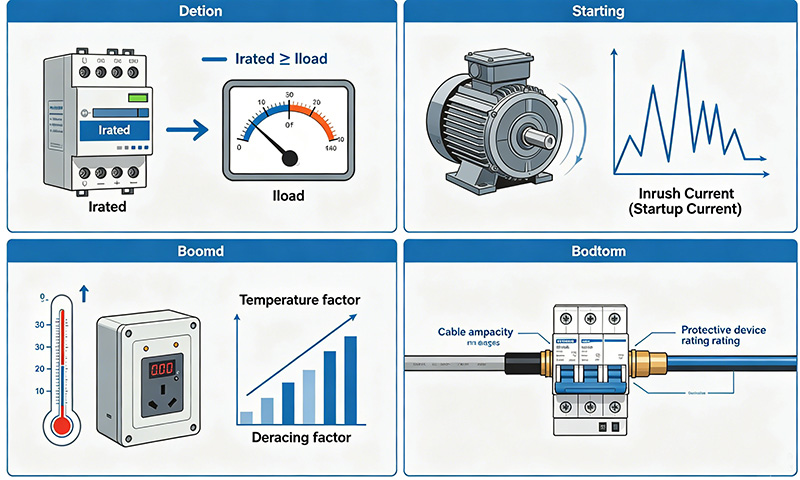
Load Current (Continuous Operating Current)
This is the most important starting point. The rated current of the device must always be higher than the maximum continuous load current.
If the device operates close to its limit for long periods, thermal stress will reduce its service life.
Engineering rule:
Irated≥Iload
Inrush Current (Startup Current)
Certain loads such as motors, compressors, and transformers generate a short but high inrush current during startup.
Although this current is temporary, it must be considered to avoid nuisance tripping.
Ambient Temperature and Derating
Electrical devices do not operate at full rated capacity under all temperature conditions. Higher ambient temperatures reduce current-carrying capability.
In industrial cabinets, derating factors are often applied.
Cable Coordination
The circuit protection device must always coordinate with the cable size. The cable ampacity should never be lower than the protective device rating.
Improper coordination may lead to overheating or fire risk.
Load Type
Different loads behave differently:
| Load Type | Characteristics | Examples |
| Resistive Load | Stable current | Heating, lighting |
| Inductive Load | High inrush current | Motors, compressors |
| Mixed Load | Variable current | Industrial systems |
How to Calculate the Correct Amperage Rating
A commonly used engineering method is to apply a safety margin to the calculated load current:
Standard Formula:
Irated≥1.25×Iload
This margin accounts for variations in load conditions, temperature changes, and system expansion.
Common Mistakes in Amperage Selection
In real electrical design and installation work, incorrect amperage selection is one of the most common causes of system instability and premature equipment failure. These mistakes often come from oversimplifying the load conditions or misunderstanding how circuit protection devices actually operate.
Below are the most frequently encountered issues in practical engineering applications, along with their underlying risks.
Selecting device rating based only on cable size
This is a frequent but incorrect practice. While cable size is an important factor, it does not represent the actual system load. Selecting a device solely based on cable ampacity may result in overprotection or underutilization of the system design.
Ignoring motor starting current
Motors and inductive loads can generate high inrush currents during startup. If this is not considered during selection, the protection device may trip unnecessarily, even when the system is operating normally.
Oversizing without engineering calculation
Increasing the rating “just to be safe” is a common misunderstanding. While it may reduce nuisance tripping, it also reduces the protection sensitivity, which can leave cables and equipment exposed during overload conditions.
Not applying temperature derating factors
Electrical devices are affected by ambient temperature. Without applying derating factors, the selected device may operate beyond its thermal limits in high-temperature environments such as control cabinets or industrial panels.
Confusing breaker rating with actual load demand
The rated current of a protection device is often mistaken as the system’s operating current. In reality, it defines the device’s thermal capacity, not the actual load requirement. This misunderstanding can lead to incorrect system coordination.
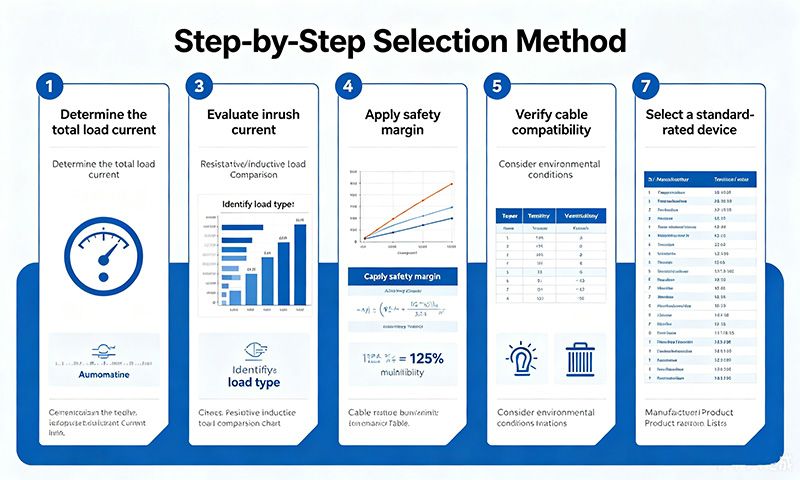
Step-by-Step Selection Method
Selecting the correct amperage rating requires a structured engineering approach rather than a single-value decision. Each step ensures that load conditions, safety margins, and system constraints are properly evaluated before final device selection.
Determine the total load current
The first step is to calculate the total operating current of the system, including all connected loads. This provides the baseline for all subsequent calculations and ensures the device is not undersized.
Identify load type
Different load types behave differently under operation. Resistive loads are stable, while inductive loads such as motors introduce current fluctuations and require additional design margin.
Evaluate inrush current
Certain equipment generates high short-term current during startup. This must be considered to avoid nuisance tripping during normal operation.
Apply safety margin
A commonly used engineering practice is to size the device at approximately 125% of the calculated load current. This ensures stable operation under fluctuating conditions.
Verify cable compatibility
The selected device must always be coordinated with cable ampacity. Incorrect matching may lead to overheating or reduced protection effectiveness.
Consider environmental conditions
Ambient temperature, ventilation, and installation conditions all affect device performance. High-temperature environments often require derating adjustments.
Select a standard-rated device
After all calculations and verifications, choose a standard-rated device from the manufacturer’s range that best matches the application requirements.
Quick Selection Checklist
Before finalizing the amperage rating of a circuit protection device, it is important to run through a quick engineering checklist. This ensures that all critical electrical, thermal, and operational factors are properly considered before selection.
| Item | Requirement | Engineering Consideration |
| Load Current | Measured or calculated maximum load | Forms the base value for all amperage calculations. |
| Safety Margin | Typically 1.25× load current | Compensates for load fluctuation and operational variation. |
| Load Type | Resistive / Inductive / Mixed | Affects inrush current and protection behavior. |
| Ambient Temperature | Consider derating if high | High temperature reduces current-carrying capacity. |
| Cable Size | Must match or exceed protection rating | Ensures coordination between device and conductor safety. |
| Device Type | Circuit breaker / isolator / switch disconnector | Determines functional role in the system. |
| Expansion Margin | Future load growth considered | Prevents undersizing when system expands. |
Frequently Asked Questions (FAQ)
Q1 What happens if I choose a circuit protection device with a higher amperage rating than required?
Selecting an oversized device may reduce the likelihood of nuisance tripping, but it also lowers the sensitivity of protection. In overload conditions, the device may not react quickly enough to protect cables or connected equipment, increasing the risk of thermal damage.
Q2 Can I use cable size to determine the amperage rating?
Cable size is an important reference, but it should not be the only selection factor. The amperage rating must also consider load current, starting current, ambient temperature, and system operating conditions to ensure proper protection coordination.
Q3 How do I know if my load requires a higher amperage rating?
If the system includes inductive loads such as motors, compressors, or transformers, higher inrush currents may occur during startup. In such cases, the selected device may require a higher rating or a suitable trip curve to avoid unnecessary tripping.
Q4 What is the relationship between amperage rating and circuit breaker tripping?
The amperage rating defines the maximum continuous current a device can carry, while tripping characteristics determine how it responds to overload or fault conditions. These are related but not the same parameter, and both must be considered during selection.
Q5 Do environmental conditions affect amperage selection?
Yes. High ambient temperatures, poor ventilation, or enclosed installation environments can reduce the effective current-carrying capacity of a device. In such cases, derating factors should be applied to ensure safe operation.
Q6 Is a higher amperage rating always better for safety?
No. A higher rating does not always improve safety. While it may prevent nuisance tripping, it can also reduce protection effectiveness during overload conditions. Proper selection based on system requirements is always the correct approach.
Conclusion
Selecting the correct amperage rating requires more than just matching a number. It involves understanding load behavior, installation conditions, and safety margins to ensure reliable operation and long-term protection.
A properly selected device not only improves system stability but also reduces maintenance costs and prevents unexpected downtime.

--- END ---
In this blog
Featured Articles
Get A Free Quote
