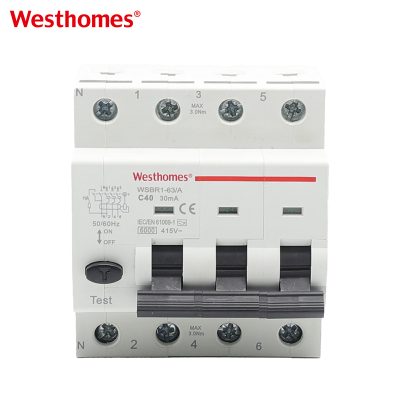
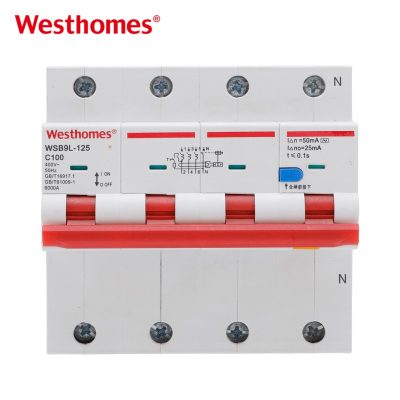
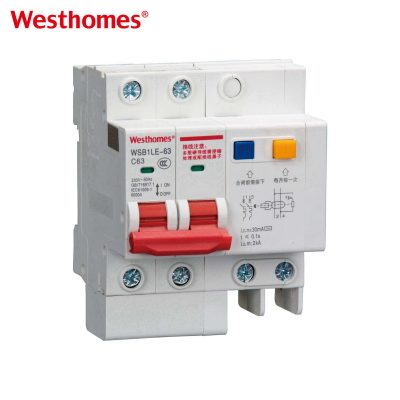
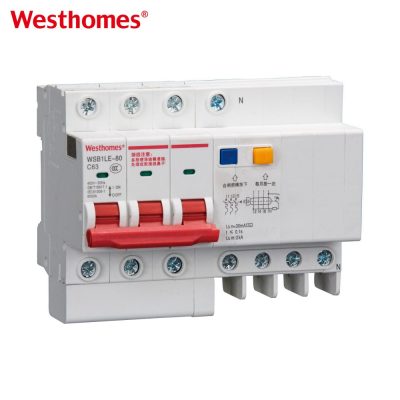
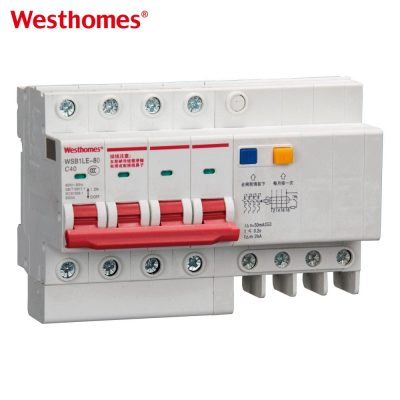
WSB1-63 Moulded case circuit breaker
WSB1-63 series MCB is one of updated type MCCBs researched and developed by the company by using advanced design and manufacture technology internationally.
Get quick appointment for technical support!

WSB1-63 series MCB is one of updated type MCCBs researched and developed by the company by using advanced design and manufacture technology internationally.



WSB1-63 series MCB is one of updated type MCCBs researched and developed by the company by using advanced design and manufacture technology internationally.
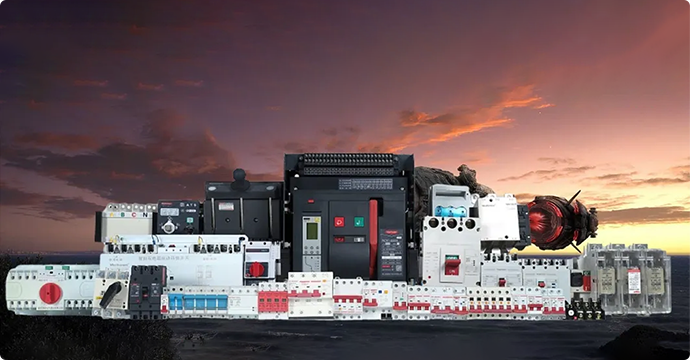
WSB1-63 series MCBs are mainly applied at lines of AC 50Hz or 60Hz, rated operation voltage AC230/400V, rated current upto 63A, for overload and short circuit protection to the lines, also for changeover of infrequent operation to the lines. The MCBs are used at places of commercial office building, residential and similar building etc.
The product meets standards of GB 10963.1 and IEC 60898-1, at international advanced level.

| Frequency | 50Hz/60Hz |
| Pole | 1, 2, 3, 4 |
| Voltage | AC230V/400V |
| kA | 6kA, 10kA |
| Amps | 6, 10, 16, 20, 25, 32, 40, 50, 63 |
| Width | 18, 36, 54, 72mm |
| Mounting | Din rail |
| Standard | IEC/EN 60898 |
| Item No. | WSB1-63 |
| Rated current In(A) | 6, 10, 16, 20, 25, 32, 40, 50, 63 |
| Pole number | 1P, 2P, 3P, 4P |
| Trip characteristics | C type(5-10In); D type(10-20In) |
| Rated insulating voltage Ui(V) | 690 |
| Rated operating voltage Ue(V) | AC230V/AC400V |
| Rated impulse voltage Uimp(kV) | 4 |
| Breaking capacity Icu(kA) | 6 |
| Mechanical life(times) | 20000 |
| Electrical life(times) | 4000 |
| No. | Rated current | Initial state | Test current | Time limit | Expected result |
| 1 | In≤63 | Cold state | 1.13In | t≤1h | Not tripping |
| In>63 | t≤2h | ||||
| 2 | In≤63 | Just followed the last test item | 1.45In | t<1h | Tripping |
| In>63 | t<2h | ||||
| 3 | In≤32 | Cold state | 2.55In | 1s | Tripping |
| In>32 | 1s | ||||
| 4 | Type C | Cold state | 5In | t≤0.1s | Not tripping |
| 10In | t<0.1s | Tripping |

A 2P (two-pole) MCB switches and protects both the line and neutral conductors in one unit, so it breaks both poles simultaneously. Unlike a 1P breaker that only switches live, a 2P device provides true double-pole isolation, which is preferred for dedicated appliances, sub-mains, split-phase supplies and safer maintenance.
Feed the phase (L) into the top terminal of one pole and the neutral (N) into the top terminal of the second pole, and take the corresponding L and N out to the load from the bottom terminals. Observe the input/load direction marked on the body, tighten terminals to the specified torque, and never mix L and N poles. Confirm the internal neutral connection layout before wiring.
It means when the MCB trips or is switched off, both the line and the neutral are physically disconnected from the load at the same time. This removes voltage from the circuit being serviced and prevents back-feed through the neutral, giving a safer isolation point than a single-pole breaker that leaves neutral connected.
The breaker is designed to operate correctly on AC mains at both 50Hz and 60Hz frequencies, so the same unit can be used across Europe/Asia (50Hz) and Americas/Asia-Pacific (60Hz) grids. The thermal and magnetic trip characteristics are not frequency-sensitive in this range, so no derating is needed between the two.
Moderate overloads heat a bimetallic strip, which bends over seconds and releases the mechanism to trip — protecting cables from slow overheating. A large short-circuit current energizes a solenoid that trips the contacts almost instantaneously (within milliseconds) to clear the fault quickly.
Look for IEC 60898-1 compliance for household and similar overcurrent protection, plus CE marking for the European market and a CB (certification body) test certificate that supports acceptance in many other countries. These documents confirm the rated voltage, breaking capacity and trip curves have been independently tested.
A 2P unit is typically used on a single-phase 230V circuit (L+N) or as a double-pole isolator. On a 400V three-phase system you would use a 3P breaker for three phases or a 4P for three phases plus neutral; a 2P is generally not rated to switch two out of three phases on its own. Confirm the rated voltage (Ue) on the label for the exact application.
Motor and transformer inrush currents can trip a Type B breaker instantly. Select a Type C (5–10×In) for small motors and mixed loads, or Type D (10–20×In) for higher inrush devices, and size the breaker above the running current. Also check for simultaneous startup or a genuine fault before blaming the curve.
As a manufacturer low-voltage MCB, it is normally offered for OEM/ODM orders. Typical MOQs run in the range of a few hundred to a few thousand pieces per model/brand, sample orders ship in days, and mass production lead time is commonly 25–45 days depending on quantity and customization. Confirm exact MOQ, logo printing, packaging and private-label options with the supplier.
A reputable factory should follow an ISO 9001 quality system and run routine tests on every batch: operational/mechanical endurance, overload and short-circuit tripping verification, dielectric (high-voltage withstand) tests, and terminal torque checks. Ask for type-test reports, CB/CE certificates and factory audit or inspection options before placing bulk orders.
* indicates a required field

 2 MB