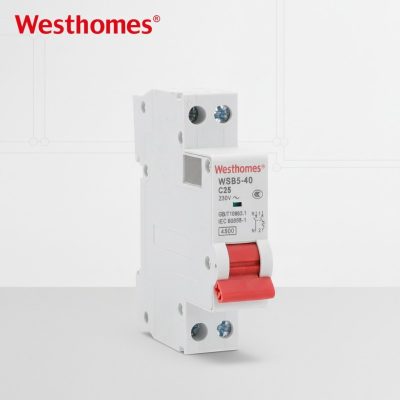
WSB9L Series DIN‑Rail MCB + ELCB Earth Leakage Circuit Breaker
Westhomes WSB9L Series DIN‑Rail Mounted Low‑Voltage Miniature Circuit Breaker with Integrated Earth Leakage (ELCB / RCCB) Protection.
Get quick appointment for technical support!

Rated for AC 230/400 V, 6 to 100 A, with 30/50/100 mA residual current trip. High breaking capacity (6 kA / 10 kA), compliant with IEC 61009 & GB 16917, ideal for residential, commercial and industrial applications.



Westhomes WSB9L Series DIN‑Rail Mounted Low‑Voltage Miniature Circuit Breaker with Integrated Earth Leakage (ELCB / RCCB) Protection.

The WSB9L series provides combined overcurrent (MCB) and residual current (ELCB) protection for AC 50/60 Hz circuits with rated voltages of 230 V (single phase) and up to 400 V (multiple poles). Available in configurations up to 100 A, it is designed to prevent electric shock, overload, and short circuit, while also supporting infrequent manual line switching—ideal for residential, hotel, commercial, and industrial settings.
Key Features:
Rated Current (In): 6, 10, 16, 20, 25, 32, 40, 50, 63, 80, up to 100 A
Residual Operative Current (IΔn): 30 mA, 50 mA, or 100 mA
Poles & Width: 1P+N or 3P+N; available widths: 36 mm or 72 mm
Breaking Capacity: Standard 6 kA (N); High (“H”) version up to 10 kA
Standards Compliance: IEC 61009, GB 16917.1 & GB 16917.22
Advantages
Precision earth leakage detection to reduce shock risks
Integrated overcurrent and short-circuit protection
Compact DIN‑rail design ensures easy panel integration
Customizable current and residual current ratings to fit diverse needs
Fully certified for international and Chinese safety standards
Applications
Suitable for installation on standard 35 mm DIN rails, the WSB9L series offers a modular, compact design with fast installation. Ideal for protecting circuits in homes, commercial buildings, hotels, light industry, and mining facilities.
| Rated voltage (V) |
Initial state | Rated residual action current I△n(mA) |
Rated residual non-action current I△no(mA) |
Max breaking time | Rated short circuit breaking capacity(A) | Type of instantaneous releaser | ||||||
| I△ n |
2I△ n |
5I△ n |
||||||||||
| AC230 | 6, 10, 16, 20, 25, 32, 40, 50, 63, 80, 100 | 30 | 15 | 0.2 | 0.1 | 0.04 | 6000 | C | ||||
| Current rating(A) | Test current | Initial state | Time limit | Expected result | Remarks | |||||||
| 6,10,16,20,25,32,40,50,63,80, 100 |
1.13In | Cold | t≤1h(6-63A) | Not tripping | ||||||||
| t≤2h(80A) | Tripping | |||||||||||
| 1.45In | Thermal | t<1h(6-63A) | Tripping | Current rises to the set value in 5s steadily | ||||||||
| t<2h(80A) | Tripping | |||||||||||
| 2.55In | Cold | 1s | Tripping | In≤32A | ||||||||
| 1s | In>32A | |||||||||||
| C | 5In 10ln |
Cold | t≤0.1s | Not tripping | Connect the current by closing the auxiliary switch | |||||||
| t<0.1s | Tripping | |||||||||||

| Model NO. | WSB9L-100 |
| Arc-extinguishing Medium | Air |
| Structure | MCB |
| Type | Circuit Breaker |
| Certification | ISO9001-2000, CE, CB, CCC |
| Voltage | AC400V |
| Width | 36, 72mm |
| Specification | GB 16917.1&GB 16917.22 |
| Origin | Prc |
| Production Capacity | 15, 000, 000 |
| Speed | Normal Type Circuit Breaker |
| Installation | DIN Rail |
| Poles Number | 1p+N, 3p+N |
| Function | Conventional Circuit Breaker, Circuit-Breaker Failure Protection, Overcurrent Protection, OVP(Overvoltage Protection) |
| AMPS | 6, 10,16, 20, 25, 32, 40, 50, 63, 100 |
| Transport Package | Paper Box |
| Origin | China |
| Production Capacity | 10000PCS/Week |
This topic is covered in more detail in MCB vs Fuse: Which Is Better for Electrical Safety?.
An "earth leakage MCB" is the common name for an RCBO—Residual Current Circuit Breaker with Overcurrent protection. It combines an MCB (overload and short-circuit protection) with an RCD (earth-leakage/residual-current protection) in one DIN-rail unit. The WSB9L thus protects a circuit against both overcurrents and dangerous earth leakage currents, replacing a separate MCB plus RCD combination.
A toroidal (differential) current transformer monitors the sum of currents in the live and neutral conductors; any imbalance (current leaking to earth) induces a voltage that trips the device. Simultaneously, a thermal bimetal strip trips on sustained overload and an electromagnetic/magnetic mechanism trips rapidly on short circuit. Together they give both shock/fire protection and cable/load overcurrent protection in a single modular unit.
The WSB9L mounts on a standard 35 mm DIN rail in a consumer unit or distribution board, just like an MCB or RCCB. Its compact modular width saves panel space compared with fitting a separate MCB and RCD side by side. Ensure the enclosure has adequate busbar rating, earthing, and clearance for the device's rated current.
RCBOs commonly offer residual current ratings of 30 mA (for personal/shock protection), 100 mA or 300 mA (for fire protection on distribution circuits). The 30 mA rating is typical for final circuits supplying sockets, bathrooms, outdoors, or equipment where people may touch live parts. Choose sensitivity based on the circuit's risk and local wiring rules, not on convenience.
In a healthy circuit, the current flowing out on the line equals the current returning on the neutral, so the vector sum through the toroid is zero. If some current leaks to earth (through a person or damaged insulation), the imbalance is detected by the toroid, amplified, and used to release the trip mechanism within milliseconds. The overcurrent functions use the total current magnitude (thermal for overload, magnetic for short circuit), independent of the residual-current sensing.
Snap the RCBO onto the DIN rail, connect the supply phase and neutral to the line terminals, and the protected circuit's phase and neutral to the load terminals, keeping phase and neutral on the correct poles. Bond the earthing conductors to the installation's earth bar (not through the RCBO). Size the device's current rating (In) and residual rating (IΔn) to the cable and load, and verify the earthing type (TN/TT) matches the device's neutral-switching configuration.
Every RCBO has a built-in "T" (test) button that simulates a residual current; pressing it periodically should trip the device immediately. During commissioning and periodic inspection, use an RCD tester to verify it trips at the rated residual current within the required time, and test the overcurrent function as part of the circuit verification. Never rely solely on the test button to confirm proper installation.
An RCBO is standardized under IEC/EN 61009 (residual current circuit-breakers with integral overcurrent protection for household and similar uses), which combines the RCD requirements of IEC 61008 with MCB overcurrent requirements. The WSB9L should be specified to IEC 61009, with the appropriate trip curve (e.g., B or C) and residual-current type (AC/A, and Type F/B where required).
RCBOs are used to protect individual final circuits—socket outlets, bathrooms, outdoor circuits, garages, lighting, and appliances—where both earth-leakage and overcurrent protection are needed. Using one RCBO per circuit means a fault on one circuit does not disconnect an entire board (as a shared RCD would), improving safety and availability. They are also used where panel space is limited.
An RCBO provides both functions in one modular unit, saving space and enabling circuit-by-circuit protection. An RCCB alone only gives residual-current protection and needs a separate MCB for overcurrent; a single RCCB protecting multiple circuits means one earth fault trips everything downstream. The RCBO is the more flexible, space-saving solution for final circuits, while a combined RCCB + MCB arrangement may be used where the device must be retrofitted or where separate devices are preferred.
* indicates a required field


 155 MB