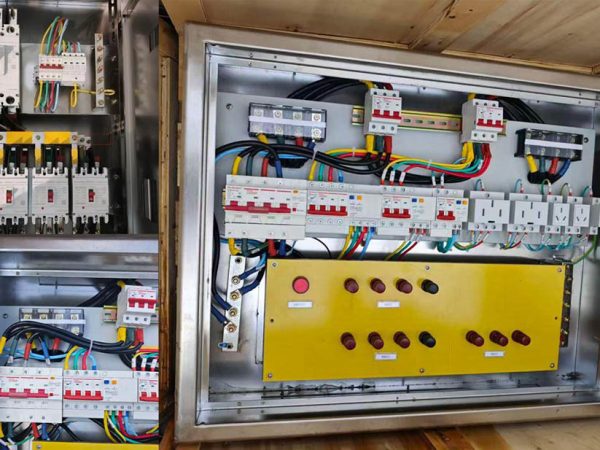
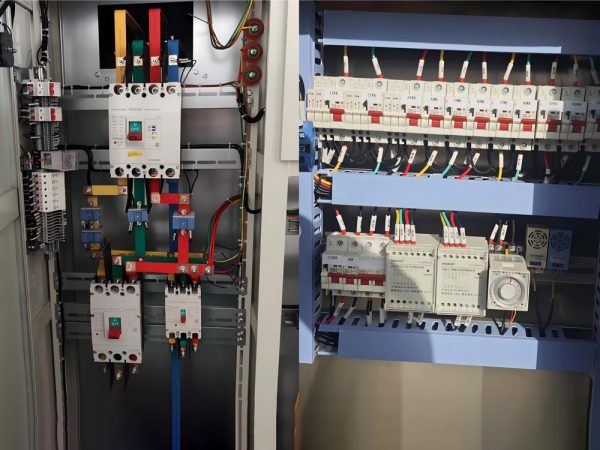
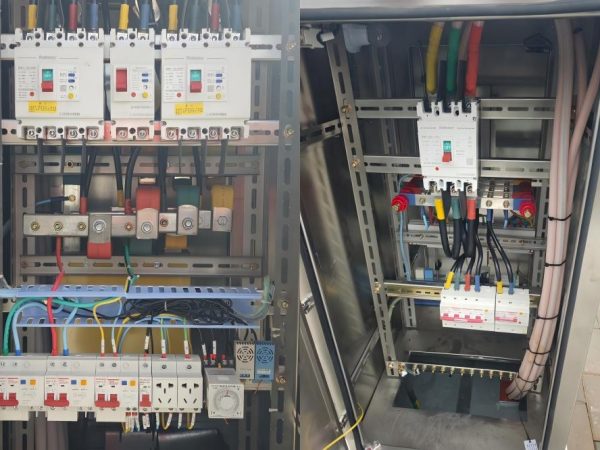
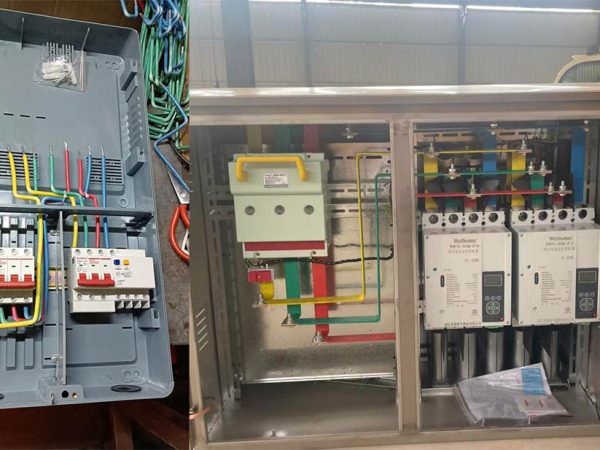
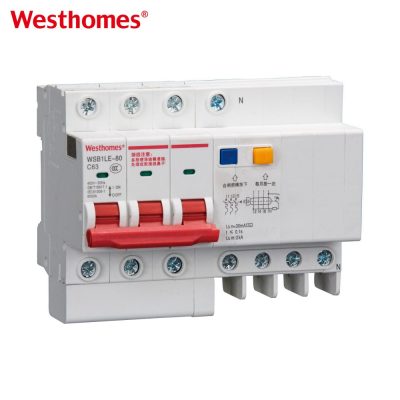
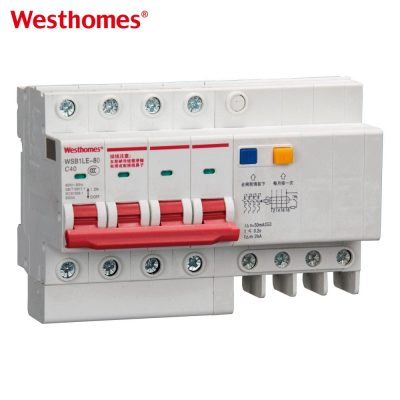
WSB1-125 MCB 63A to 125A Miniature Circuit Breaker
WSB1-125 series MCB is one of updated type MCCBs researched and developed by the company by using advanced design and manufacture technology internationally.
Get quick appointment for technical support!

WSB1-125 series MCB is one of updated type MCCBs researched and developed by the company by using advanced design and manufacture technology internationally.


WSB1-125 series MCB is one of updated type MCCBs researched and developed by the company by using advanced design and manufacture technology internationally.
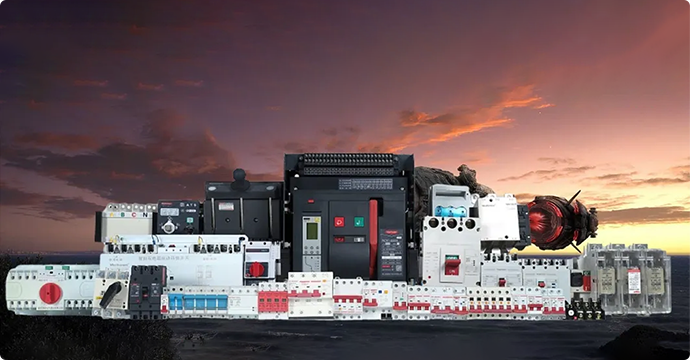
WSB1-125 series miniature circuit breaker has advantage of fine and small in size, light in weight, reliable performance, big breaking capacity, fast release, rail installation, with high flame retardant and impact resistance plastic for frame and parts, and long service life. It mainly applies in lines of AC 50Hz or 60Hz, single pole 230V, 400V for double, three and four poles, for overloading and short circuit protection, meanwhile in lighting lines and infrequent on-off electrical equipments under normal circumstance.
The product meets standards of IEC/EN60947-2, GB14048.2 at international level.


| Pole | 1P, 2P, 3P, 4P |
| Voltage | AC230V/400V |
| kA | 6kA, 10kA |
| Amps | 63, 80, 100, 125 |
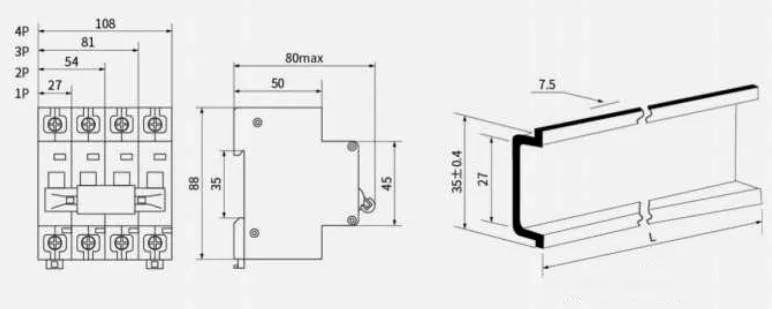
| Width | 27, 54, 81, 108mm |
| Model | Pole (P) | Rated frequency (Hz) | Rated current frame level (A) | Rated voltage (V) | Rated Current (A) | Rated short circuit breaking capacity (kA) | Power frequency withstand voltage | Mechanical and electrical operation performance |
| WSB1-125 | 1P, 2P, 3P, 4P | 50 / 60 | 125 | 230 / 400 | 63, 80, 100, 125 | 6 / 10 | Circuit breaker can satisfy AC 50Hz, 2500V lasting 1min voltage withstand test with no flashover or breakdown | The operation cycle number of the circuit breaker is 10000 times, including loading one 1500 times, and no loading one 8500 times. |
The WSB1-125 is Westhomes' high-current miniature circuit breaker series, rated from 63 A to 125 A in a 125 A frame. Unlike small household MCBs (which typically top out at 40–63 A), the WSB1-125 is engineered for the upper end of DIN-rail distribution: main switches, sub-mains, large branch circuits and light industrial feeders. It keeps the familiar modular DIN-rail form factor but with heavier contacts, a more powerful arc chamber and a larger terminal rating.
Each pole contains two overcurrent releases in series. A bimetal strip heats up under moderate overload and slowly bends to release the trip latch after an inverse-time delay; a high short-circuit current activates a solenoid that magnetically snaps the contacts open in a few milliseconds. A common trip bar links all poles so any one pole sensing a fault opens all of them together. The contacts open into a small arc-extinguishing chamber that cools and extinguishes the AC arc at the next current zero-crossing.
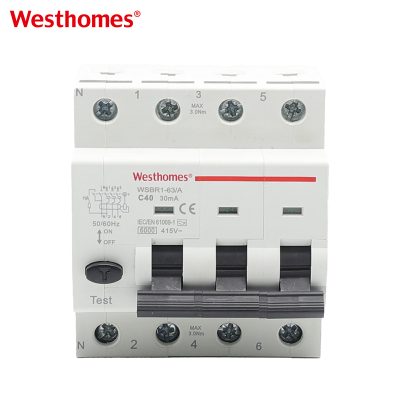
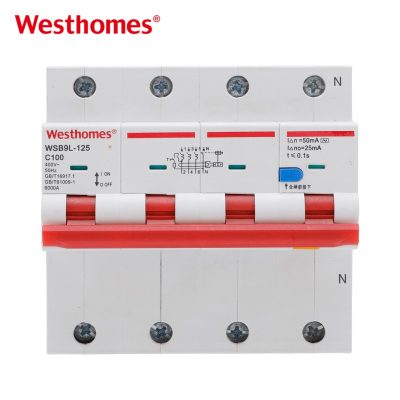
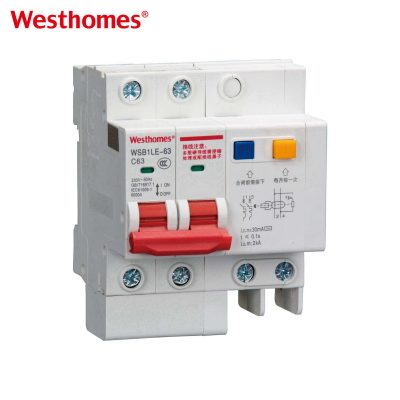
The WSB1-125 is offered in 1P, 2P, 3P and 4P pole versions within the same 63–125 A range. The 1P version is for single-phase phase-only protection; the 2P version switches and protects L+N; the 3P version covers three-phase industrial circuits; and the 4P version adds switched neutral for full four-pole isolation on three-phase+neutral boards. Choose the pole count to match the number of conductors you need to switch and protect.
The series has a rated current In from 63 A to 125 A, a rated operational voltage Ue up to 400 V AC (230 V AC between phase and neutral), a rated frequency of 50/60 Hz, and a rated short-circuit breaking capacity Icn of 6 kA. It is designed for use on low-voltage distribution systems up to the limits covered by IEC 60898-1. Always verify the exact ratings on the product nameplate before ordering a specific variant.
Choose the WSB1-125 MCB when the rated current is between 63 A and 125 A, the prospective short-circuit current is at or below 6 kA, and you want a compact DIN-rail, low-cost, maintenance-free device. Choose an MCCB when the current exceeds 125 A, the fault current exceeds 10 kA, or you need field-adjustable long-time/short-time trip settings. For the 63–125 A range with 6 kA fault levels, the WSB1-125 is usually the most economical and space-efficient solution.
The breaker rating must be equal to or less than the cable's current-carrying capacity (Iz) under the actual installation conditions. A commonly used starting point for copper is: 63 A on 10 mm², 80 A on 16 mm², 100 A on 25 mm², and 125 A on 35 mm², but these figures must be corrected for ambient temperature, cable grouping, insulation type and installation method. Also verify that the cable can withstand the short-circuit energy using the adiabatic formula k²S² ≥ I²t.
Yes, that is one of its primary applications. A 2P WSB1-125 is a common single-phase main switch for apartments, shops and small offices; a 3P or 4P version serves as the main protective device for three-phase commercial distribution boards up to 125 A. When used as a main switch, ensure the upstream fault current at the board does not exceed the 6 kA breaking capacity and that downstream breakers are coordinated so that only the closest breaker trips on a fault.
Nuisance trips are usually caused by inrush currents from motors, transformers or switching power supplies that exceed the magnetic trip threshold of a C-curve breaker. The fix is to move to a D-curve WSB1-125 whose instantaneous trip point (10–20 × In) sits above the equipment's starting current. Other causes include overcrowding the board (which heats the breaker and lowers its thermal trip point), loose terminals, or a breaker that has been weakened after several severe fault operations.
Yes. The WSB1-125 is designed and type-tested to IEC 60898-1, the international standard for over-current protective devices for household and similar installations, and it carries CE marking for the European Economic Area. That certification covers the 63–125 A ratings, the 6 kA breaking capacity, and the B/C/D trip curves typically offered. For specific national markets (e.g. Russia, Middle East, Southeast Asia), confirm whether additional local certification is required at the time of order.
Clip the breaker onto a 35 mm DIN rail in a ventilated enclosure, connect supply to the top and load to the bottom, use ferrules on stranded conductors, and torque each terminal to the value on the nameplate. Keep adequate clearance around the handle and observe the derating curves if the enclosure is hot or crowded. Routine maintenance is minimal: annually operate the toggle by hand to exercise the mechanism, inspect terminals for discoloration, and re-torque after the first year. Never dismantle the sealed unit, and replace it after repeated severe short-circuit operations or any visible damage.
* indicates a required field


 2 MB