Get quick appointment for technical support!

Get in Touch

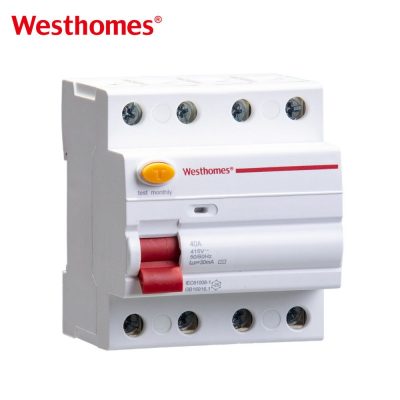
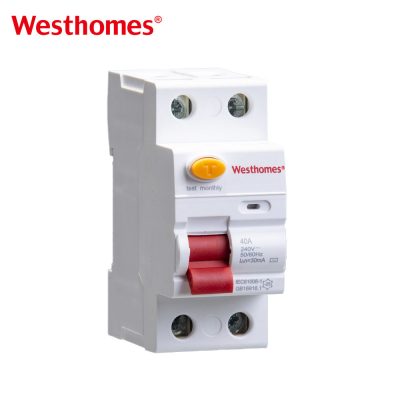
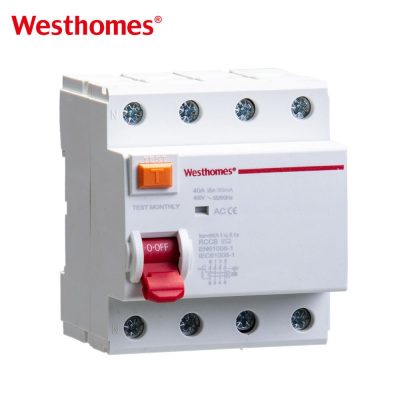
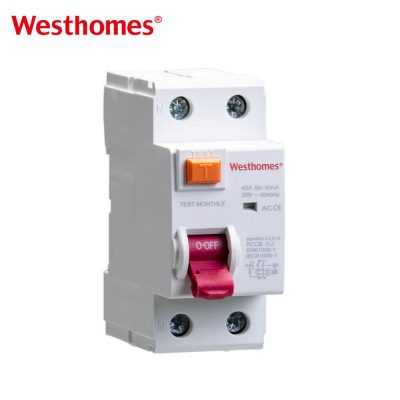
Westhomes WSB1L Series 63A 3P+N RCCB

The Westhomes WSB1L Series 63A 3P+N Residual Current Circuit Breaker (RCCB) is a high-performance safety device specifically engineered for AC 50Hz power distribution systems with a rated working voltage of AC240/400V and a maximum rated current of 63A.

Social focus:

63A 3P+N RCCB | Westhomes WSB1L Miniature Residual Current Circuit Breaker

This 3P+N (Three Poles + Neutral) RCCB is designed to provide comprehensive protection for personnel and electrical installations by detecting abnormal leakage currents and promptly cutting off the power supply.

WSB1L

Ideal for both commercial and residential applications, the WSB1L 63A RCCB is equipped with multiple safety functions including overload, short circuit, and residual current protection. When a leakage current or accidental electric shock occurs, the device ensures rapid disconnection, minimizing the risk of injury and equipment damage.

Crafted with high-impact resistant and flame-retardant housing, the WSB1L RCCB combines durability with a compact structure, making it easy to install in tight spaces such as distribution panels and consumer units. Its advanced internal structure ensures long-term performance stability and reliable tripping accuracy.

Whether used in low-voltage electrical systems or integrated into smart energy distribution networks, the WSB1L 63A 3P+N RCCB ensures optimal safety, efficiency, and reliability in every environment.

KEY INFORMATION

Rated Current 16, 20, 25, 32, 40, 50, 63A
Rated Voltage Ue AC240V (1P+N, 2P); AC400V (3P+N, 4P)
Rated Insulation Voltage Ui AC415
Rated Impulse Withstand Voltage Uimp 4kV
Rated Frequency 50/60Hz
Number of Poles 1P+N, 3P+N
Module Size 36mm, 72mm
Circuit Type AC type, A type, B type
Breaking Capacity 6000A, 10000A
Rated Residual Current I△n 10mA, 30mA, 100mA, 300mA
Rated Residual Operation Current 10, 30, 100, 300mA
Optimum Operation Temperature -5ºC to 40ºC
Terminal Tightening Torque 2.5-4N/m
Terminal Capacity (top) 25mm²
Terminal Capacity (bottom) 25mm²
Electro-mechanical Endurance 4000 cycles
Mounting 35mm DIN rail
The very new tripping structure makes more in safety
Suitable Busbar PIN busbar
Standard IEC61008-1

Basic Info.

Model NO. WSB1L
Arc-extinguishing Medium Air
Structure MCB
Type Circuit Breaker
Certification ISO9001-2000, CE, CB, CCC
Ka 6ka, 10ka
Voltage AC240V/AC400V
Specification 10A-63A
Origin China
Production Capacity 365000
Speed Normal Type Circuit Breaker
Installation Fixed
Poles Number 1p+N, 3p+N
Function Conventional Circuit Breaker,
Circuit-Breaker Failure Protection,
Overcurrent Protection,
OVP(Overvoltage Protection)
Production Line 100% Automic
Cooperation Type OEM ODM
Transport Package Standard
Trademark Westhomes
HS Code 8536300000

FREQUENTLY ASKED QUESTION (FAQ)

What is an RCCB and how does it work? plus-square Created with Sketch Beta. minus-square Created with Sketch Beta.

An RCCB (Residual Current Circuit Breaker, also called an RCD) is a safety switching device that detects earth leakage current and trips rapidly to protect people from electric shock and to reduce fire risk. All live conductors (the three phases plus neutral) pass through a toroidal balance current transformer; under normal conditions the sum of currents is zero, so no flux is induced. When current leaks to earth — for example through a person touching live parts — the imbalance is sensed, a trip solenoid releases, and the contacts open in milliseconds.

What does "3P+N" mean on this WSB1L unit, and how is it wired? plus-square Created with Sketch Beta. minus-square Created with Sketch Beta.

"3P+N" means the device has four poles that switch L1, L2, L3, and the neutral conductor together, giving full four-pole isolation on a 400 V three-phase four-wire system. Incoming L1/L2/L3/N land on the supply side and the same four conductors exit on the load side to the downstream distribution board. The protective earth (PE) must never pass through the internal toroid and must never be switched by the RCCB; otherwise the balance measurement will be corrupted.

What does the 63A rating mean? plus-square Created with Sketch Beta. minus-square Created with Sketch Beta.

The 63 A is the rated current (In) — the maximum continuous current each pole can carry under rated ambient conditions without overheating. It is not an overload or short-circuit threshold: an RCCB has no built-in overcurrent or short-circuit protection, so it must be backed up upstream by MCBs or an MCCB. The 63 A rating sets the maximum feeder current the unit can carry as the residual-protection head of a three-phase distribution board.

What residual sensitivity is used, and why is 30 mA the common value? plus-square Created with Sketch Beta. minus-square Created with Sketch Beta.

A 30 mA rated residual operating current (IΔn) is the standard value for additional shock protection in general household, commercial, and light-industrial installations. At 30 mA the device trips fast enough to clear a fatal ventricular fibrillation risk in a person touching live parts under dry conditions. Higher sensitivities (10 mA) are reserved for special locations such as bathrooms, while 100–500 mA types are used for fire-protection or equipment monitoring rather than human protection.

Type AC vs Type A — which waveform does this unit detect? plus-square Created with Sketch Beta. minus-square Created with Sketch Beta.

Type AC RCCBs detect only sinusoidal alternating residual currents, while Type A also detects pulsating DC residual currents that arise from rectifier-fed loads, variable-speed drives, switching power supplies, and UPS equipment. On three-phase installations containing electronics, inverters, or motor drives, Type A (or higher) is normally required; pure Type AC is acceptable only on purely resistive, linear three-phase loads. Always confirm the exact class marked on the WSB1L datasheet before specifying.

How is the WSB1L 63A 3P+N installed? plus-square Created with Sketch Beta. minus-square Created with Sketch Beta.

It clips onto a standard 35 mm DIN rail inside a distribution enclosure, the same rail used by MCBs and RCBOs; a 3P+N 63 A unit typically occupies four pole-widths. Incoming and outgoing conductors are tightened to the torque printed on the nameplate (typically 1.2–2.0 N·m for 63 A), and the PE conductor runs straight through the enclosure without entering the toroid. Keep wiring space above and below, keep the handle accessible, and fit the terminal covers before energizing.

What is the test button for, and how often should I use it? plus-square Created with Sketch Beta. minus-square Created with Sketch Beta.

The test button (marked "T" or "TEST") injects a simulated residual current so you can verify the trip mechanism actually operates mechanically. Press it once a month with the circuit energized; the RCCB should snap open immediately. If it does not trip, the device has failed and must be replaced, because a non-tripping RCCB offers zero protection even though power continues to flow. Reset by moving the handle fully to OFF and then ON.

What causes nuisance tripping, and how can I prevent it? plus-square Created with Sketch Beta. minus-square Created with Sketch Beta.

Nuisance (unwanted) tripping is typically caused by capacitive leakage from long cable runs, inrush current from switched-mode power supplies, transient overvoltages from lightning or switching, or partial DC residual current from electronic loads that a Type AC device cannot handle. Reduce it by selecting a higher IΔn (100 mA), choosing a Type A or S (time-delayed) device, shortening cable lengths, or adding surge protective devices. Never disable the RCCB to stop nuisance trips; that defeats the safety purpose.

Which standards apply, and what does the CE mark mean? plus-square Created with Sketch Beta. minus-square Created with Sketch Beta.

RCCBs of this type are designed and tested to IEC 61008-1 ("Residual current operated circuit-breakers without integral overcurrent protection for household and similar uses"). The CE mark indicates conformity with the EU Low Voltage Directive (LVD) and EMC Directive, meaning the product meets declared safety, insulation, tripping-time, and endurance requirements before it can be placed on the European market. Local national wiring rules (e.g., BS 7671, NEC) still govern how it is applied in an installation.

How is an RCCB different from an RCBO or MCB, and where is this 63A 3P+N unit used? plus-square Created with Sketch Beta. minus-square Created with Sketch Beta.

An MCB provides only overload and short-circuit protection; an RCCB provides only residual (earth-leakage) protection; an RCBO combines both in one unit. The WSB1L RCCB is therefore used as the upstream earth-leakage head of a three-phase distribution board, with downstream MCBs or RCBOs providing circuit-level overcurrent protection. Typical applications include small commercial buildings, workshops, pump stations, commercial kitchens, and mixed three-phase/single-phase sub-distributions fed from a 400 V supply.

RELATED PROJECTS

REQUEST
YOUR FREE QUOTE

* indicates a required field