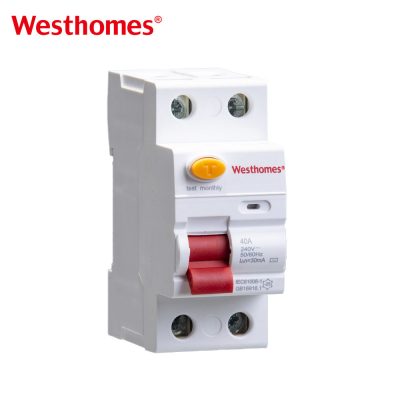
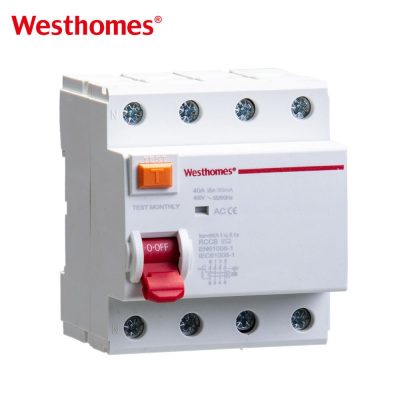
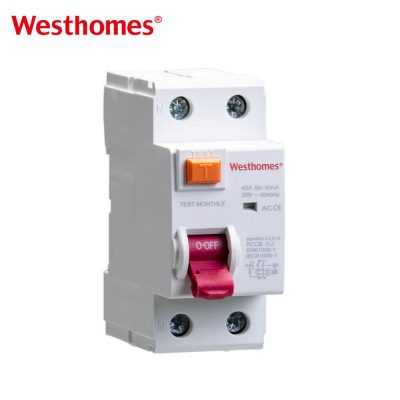
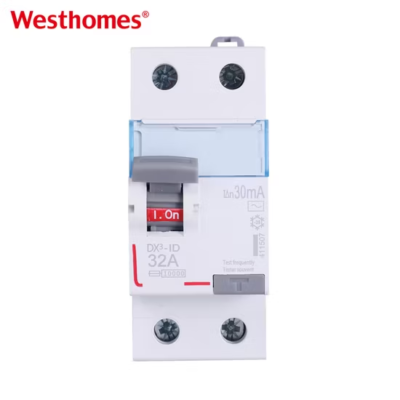
WR1L-63 4P 63A Three-Phase Residual Current Circuit Breaker | AC/Type
Westhomes WR1L-63 4P RCCB – Complete Three-Phase Earth Leakage Protection for Industrial Applications.
Get quick appointment for technical support!

Protect 3-phase industrial systems with the WR1L-63 4P RCCB. 63A rating, 30-300mA adjustable leakage protection. Ideal for machinery & distribution boards.


Westhomes WR1L-63 4P RCCB – Complete Three-Phase Earth Leakage Protection for Industrial Applications.

The Westhomes WR1L-63 Series 4-Pole Residual Current Circuit Breaker (RCCB) is engineered to provide comprehensive protection against earth leakage currents in three-phase electrical systems. Designed for industrial environments, commercial buildings, and large-scale residential complexes, this 4P device ensures maximum safety for personnel and equipment by detecting and interrupting ground faults across all phases and neutral.
Key Features:
True 4-Pole Protection: Monitors and switches all three phases (L1, L2, L3) and the neutral conductor simultaneously, ensuring complete isolation and comprehensive protection for three-phase systems.
Flexible Sensitivity Ratings: Available in 30mA (personal protection), 100mA (fire protection), and 300mA (equipment protection) to meet diverse industrial and commercial safety requirements.
High Breaking Capacity: Rated at 6kA short-circuit withstand capacity, offering robust protection even in demanding industrial settings with high fault current potential.
Robust Construction: Built with high-quality materials to withstand vibration, heat, and electrical stress in demanding three-phase installations.
Protective Functions:
Three-Phase Earth Leakage Protection
Personnel & Equipment Safety
Fire Prevention in 3-Phase Circuits
Applications:
Industrial machinery and manufacturing equipment
Commercial Buildings
Large Residential Complexes
| Standard | IEC/EN61008-1 |
| Protection | Ground fault |
| Type of trip | Electro-magnetic |
| Type of protection(electric leakage) | AC,A,B,G,S |
| No.of poles | 2P(1P+N),4P(3P+N) |
| Rated current In | 6,10,16,20,25,32,40,50,63A |
| Rated sensitivity currents I△n | 10,30,100,300mA |
| Residual current off-time under I△n | ≤0.1s |
| Rated residual making and breaking capacity(I△m) | 500A(In≤40A),10In(In>40A) |
| Rated voltage Ue | 1P+N:230/240V~,3P+N:400/415V~ |
| Rated frequency | 50/60Hz |
| Rated breaking capacity | 6KA |
| SCPD fuse | 600,010,000 |
| Rated impulse withstands voltage(1.5/50)Uimp | 4,000V |
| Dielectric test voltage at ind.Freq.for 1min | 2kV |
| Electrical life | 2,000 Cycles |
| Mechanical life | 4,000 Cycles |
| Contact position indicator | Yes |
| Protection degree | IP20 |
| Ambient temperature | -25℃ to+55℃,Max.95%humidity |
| Terminal connection type | Cable/Pin-type busbar/Fork-type busbar/U-type busbar |
| Max.terminal size for cable | 50mm² |
| Max. tightening torque | 2.5N.m |
| Installation | Mounting on 35mm DIN rail |
| Connection | From top and bottom |
| Selling Units | Single item |
| Quantity (pieces) | 1 – 1,000 | > 1,000 |
| Lead time (days) | 15 | To be negotiated |
| Type | MCB, AC MCB, RCCB |
| BCD Curve | C |
| Rated Frequency (Hz) | 50hz/60hz |
| Material | Copper |
| Application | Circuit-Breaking, Industrial, Households, Protection, Electric Power |
| Model Number | WR1L-63 |
| Rated Voltage | 220V/230V |
| Breaking Capacity | 6 kA |
| Mounting Type | Rail Mounting |
| Protection | LSI |
| Place of Origin | Zhejiang, China |
| Brand Name | Westhomes |
An RCCB (Residual Current Circuit Breaker, also called an RCD) is a safety device that detects earth leakage current and trips quickly to protect people and property from electric shock and fire. It works by passing all phase conductors and the neutral through a toroidal core balance current transformer (CBCT); under normal conditions the outgoing and returning currents cancel, so there is zero net flux. Any leakage to earth creates a residual current that the toroid detects, releasing a trip solenoid to open the contacts in milliseconds.
"4P" means the device switches and monitors all four conductors — three phases (L1, L2, L3) plus the neutral. All four conductors must pass through the internal toroid, so the RCCB correctly measures the algebraic sum of phase and neutral currents on a 380/400V three-phase four-wire system. When it trips, all four poles open together, giving full isolation.
The 63A is the rated current (In), the maximum continuous current the device can carry on each pole without overheating under normal operation. It is not a tripping threshold: overloads and short circuits do not trip an RCCB, because it has no integral overcurrent protection. Branch MCBs or an upstream MCCB must protect the circuit against overload and short circuit separately.
A 30 mA rated residual operating current (IΔn) is the standard for additional shock protection in household and similar installations. At 30 mA the device trips fast enough to protect a person touching live parts under dry conditions. Higher sensitivities (10 mA) are used in special locations such as bathrooms, while 100–500 mA types are reserved for fire protection and equipment-level monitoring rather than human protection.
Incoming L1, L2, L3, and N are connected to the four terminals marked "IN" (typically left side), and the same four conductors exit from the "OUT" side to the downstream distribution. The protective earth (PE) conductor must never pass through the toroid and must never be switched by the RCCB. Outgoing neutral bars on the load side are fed from the switched neutral pole; no other neutral paths must be paralleled on the load side, or the device will see false residual current.
Type AC detects only sinusoidal alternating residual currents, while Type A also detects pulsating DC residual currents that can arise from rectifier-fed loads, variable-speed drives, switching power supplies, and electronics. On three-phase installations with drives, inverters, or UPS equipment, Type A (or higher) is normally required; pure Type AC is acceptable only on purely resistive, linear three-phase loads. Confirm the exact class in the datasheet before specifying.
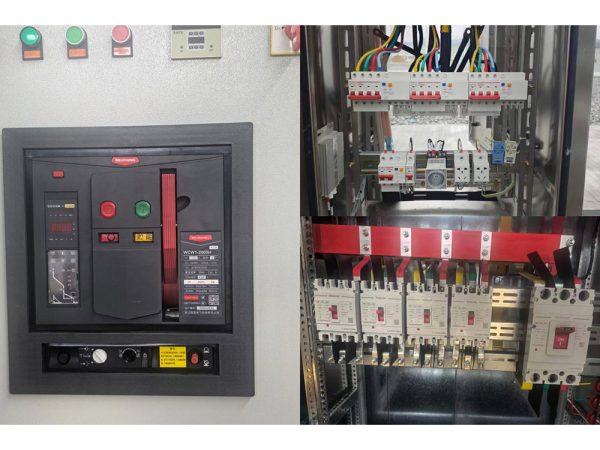
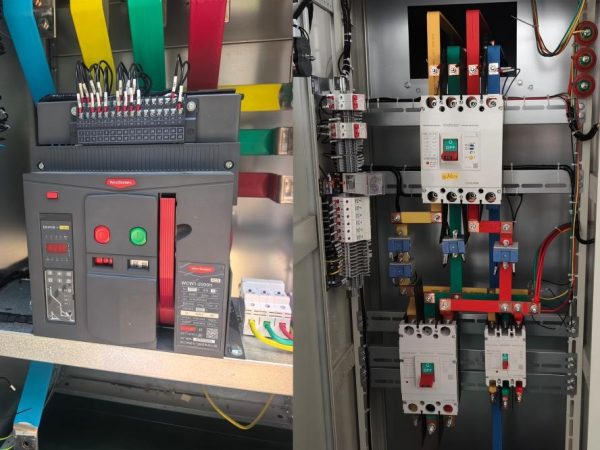
It is used as the main residual protection at the head of three-phase distribution boards in small commercial buildings, workshops, pump stations, and commercial kitchens. It protects three-phase motors, three-phase air-conditioning units, and mixed three-phase/single-phase subcircuits fed from a 400V supply. For continuous-duty equipment with high leakage (long cable runs, inverter loads), select a higher IΔn or a delayed (S) type to avoid nuisance tripping.
It clips onto a standard 35 mm DIN rail inside a distribution enclosure, the same rail used by MCBs and RCBOs. A 4P 63A RCCB typically occupies four pole-widths on the rail. Ensure adequate wiring space above and below, keep the handle accessible, and tighten conductors to the torque value on the nameplate.
The test button (marked "T" or "TEST") injects a simulated residual current so you can verify the trip mechanism actually operates. Press it once a month — with the circuit energized — and the RCCB should snap open immediately. If it does not trip, the device has failed and must be replaced, because a non-tripping RCCB offers zero protection even though power continues to flow. Reset it by moving the handle to OFF then ON.
RCCBs for household and similar uses are built to IEC 61008-1 (the equivalent European EN 61008), which covers non-overcurrent residual current devices up to 440V AC and 125A. CE marking under the Low Voltage Directive and EMC Directive confirms conformity for sale and installation in IEC-aligned markets. Always verify the rated impulse withstand, tripping time/current characteristic, and the correct Type (AC/A/B) against the installation's requirements.
* indicates a required field


 155 MB