WSB7GQ Moulded case circuit breaker
WSB7GQ series MCB is one of updated type MCCBs researched and developed by the company by using advanced design and manufacture technology internationally.
Get quick appointment for technical support!

WSB7GQ series MCB is one of updated type MCCBs researched and developed by the company by using advanced design and manufacture technology internationally.


WSB7GQ series MCB is one of updated type MCCBs researched and developed by the company by using advanced design and manufacture technology internationally.
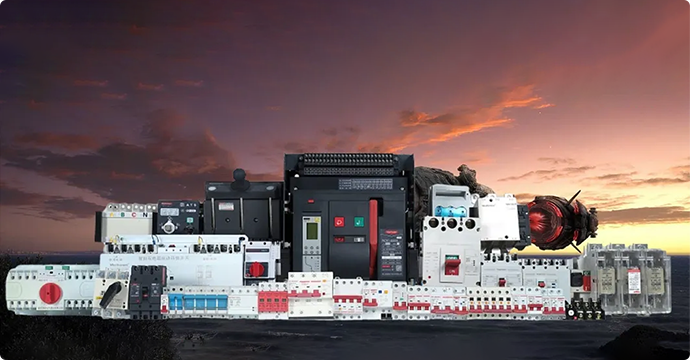
WSB7GQ Miniature circuit breaker (with overvoltage / undervoltage protection) is a derivative product of WSB7-63 Miniature circuit breaker equipped with overvoltage and undervoltage modules. It has the advantages of advanced structure, reliable performance, high breaking capacity, beautiful and compact appearance. It is suitable for residential buildings, office buildings and similar buildings with AC 50Hz, rated voltage up to 400V, overvoltage protection setting value of 280V±5%; undervoltage protection can be added with a setting value of 160V±5%, and rated current below 63A. Overload, short circuit and overvoltage protection for lighting, distribution lines and equipment, and can also be used for infrequent switching of lines and infrequent starting of motors under normal circumstances. This product complies with the requirements of GB10963.1 and IEC60898-1 standards.

| Model | WSB7G | WSB7GQ | ||
| Rated voltage Ue(v) | 230V | 230V | ||
| Rated current In(A) | 20, 25, 32, 40, 50, 63A | 20, 25, 32, 40, 50, 63A | ||
| Breaking capacity lcn (A) | 6000A(6~40A), 4500A(50~63) | 6000A(6~40A), 4500A(50~63) | ||
| Over and under voltage protection setting value (V) | 280±5% | 160±5% | ||
| Action time(S) | 0.1s | 0.1s | ||
| Number of poles (P) | 1P+N | 3P+N | 1P+N | 3P+N |
| Width(mm) | 36 | 72 | 36 | 72 |
It is a combined miniature circuit breaker and over/under voltage protector on a single DIN-rail module for AC 230V single-phase systems. The MCB part breaks overload and short-circuit current, while the electronic part monitors the RMS supply voltage and trips when voltage leaves a preset window. It is aimed at industrial and commercial protection of voltage-sensitive loads such as motors, air conditioners, and electronics.
These are the breaking capacities (Icn/Icu) of the embedded MCB, in kiloamperes at 230V. A 4.5 kA version can safely interrupt a fault current up to 4,500 A, and a 6 kA version up to 6,000 A. The rating must be equal to or higher than the prospective short-circuit current available at the panel. 4.5 kA is typical for domestic and light-commercial boards; 6 kA is used where fault levels are higher or where extra robustness is specified.
The device is designed for nominal single-phase 230V, 50/60 Hz mains—the standard in Europe, Asia, Africa, and much of the world. Its voltage-sensing thresholds and internal coil are calibrated around this voltage, so connecting it to a different nominal system (e.g., 110V) would give incorrect trip points. Always confirm the supply voltage matches the nameplate before installation.
Typical trip points for a 230V unit are an undervoltage trip below about 180V (adjustable, e.g., 160–200V) and an overvoltage trip above about 260V (adjustable, e.g., 250–280V). Some models include a fixed factory setpoint, while others have dials or buttons. These thresholds protect motors from overheating during undervoltage and electronic power supplies from failure during overvoltage or neutral-loss events.
It snaps onto a standard 35mm DIN rail in a consumer unit or industrial distribution box. The supply is connected to the input terminals and the load to the output terminals, with L and N correctly observed. It typically occupies two or three module widths. Installation should be carried out with the upstream supply isolated, by a qualified electrician, following the wiring diagram on the device label.
The protector is inserted in series with the load, like an MCB: incoming L and N to "IN", outgoing L and N to "OUT" feeding the appliance or sub-circuit. The load current must not exceed the device's rated current (e.g., 32A, 40A, 63A). Because it carries the full load current, the conductor cross-section and terminal torque must match the rated current to avoid overheating.
An ordinary MCB responds only to current—thermal-magnetic tripping on overload or short circuit. This device adds voltage monitoring: it will trip even at normal current when the supply voltage is too high or too low, such as during a neutral break that raises phase-to-neutral voltage. That extra function is what distinguishes it from a plain MCB in a voltage-unreliable location.
No. It does not measure the balance between phase and neutral, so it cannot detect earth leakage or provide shock protection. An RCCB (or RCBO) is still required on circuits where direct-contact protection is needed. In practice, an installation might use this protector for voltage quality, an MCB or the embedded MCB for overcurrent, and an RCCB for earth-fault protection.
It is used on circuits feeding air conditioners, refrigerators and freezers, pumps, water heaters, TV and audio equipment, personal computers, servers, and LED lighting in both homes and industrial control panels. These loads are particularly sensitive to sustained overvoltage (which shortens capacitor and electronics life) and undervoltage (which overheats motor windings). It is also used as a main protection for sensitive machinery in regions with unstable grids.
The CE mark confirms conformity to the EU Low Voltage and EMC Directives; the CB certificate shows third-party type testing to the relevant IEC product standard, supporting acceptance in many export markets. Maintenance is light: check the status indicator or display monthly, press the test function if fitted, and verify the voltage reading against a meter annually. Replace the unit if the display is erratic, the test button fails to trip it, or it repeatedly trips without a clear supply fault.
* indicates a required field


 2 MB