Get quick appointment for technical support!

Get in Touch

WSB1-63 MCB Miniature Circuit Breaker

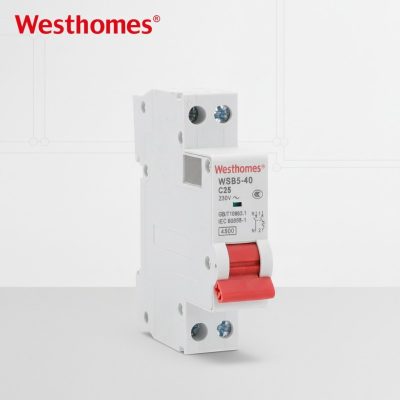
The WSB1-63 1P Miniature Circuit Breaker (MCB) Engineered to deliver 6kA breaking capacity, this compact circuit breaker is ideal for residential, commercial, and similar building installations where 1-pole circuit protection is required.

Social focus:

WSB1-63 MCB Miniature Circuit Breaker for AC230/400V

The WSB1-63 1P Miniature Circuit Breaker (MCB) is designed for reliable overload and short-circuit protection in AC circuits of 50Hz/60Hz, with a rated voltage of 230V/400V and a rated current range from 6A to 80A.

WSB1-63 1p Description

As part of the trusted WSB1-63 series, this 1P MCB ensures dependable electrical line protection and supports infrequent manual switching. It conforms to international standards GB 10963.1 and IEC 60898-1, ensuring high-quality performance that meets global safety and manufacturing benchmarks.

Applications:

Compact moulded case design for panel integration
Commercial office buildings
Residential complexes
Light industrial installations
Control panels and distribution boards

Key Features:

1P (Single Pole) configuration
Rated current: 6A–80A
Rated voltage: AC 230V/400V
Breaking capacity: 6kA
Complies with GB 10963.1 & IEC 60898-1
Safe and efficient protection against overload and short circuits

wsb1-63 circuit breaker
WSB1-63 high reliability
WSB1-63 external specification
WSB1-63 installation buckle

KEY INFORMATION

Item No. WSB1-63
Rated current In(A) 6, 10, 16, 20, 25, 32, 40, 50, 63
Pole number 1P, 2P, 3P, 4P
Trip characteristics C type(5-10In); D type(10-20In)
Rated insulating voltage Ui(V) 690
Rated operating voltage Ue(V) AC230V/AC400V
Rated impulse voltage Uimp(kV) 4
Breaking capacity Icu(kA) 6
Mechanical life(times) 20000
Electrical life(times) 4000

Main technical parameters

No. Rated current Initial state Test current Time limit Expected result
1 In≤63 Cold state 1.13In t≤1h Not tripping
In>63 t≤2h
2 In≤63 Just followed the last test item 1.45In t<1h Tripping
In>63 t<2h
3 In≤32 Cold state 2.55In 1s Tripping
In>32 1s
4 Type C Cold state 5In t≤0.1s Not tripping
10In t<0.1s Tripping

Packaging & Delivery

Package Size 22.00cm * 8.00cm * 8.00cm
Package Gross Weight 1.500kg

Overall and Mounting Dimension(mm)

WSB1-63 1p dimension

Basic Info.

Model NO. WSB1-63
Arc-extinguishing Medium Air
Structure MCB
Type Circuit Breaker
Certification ISO9001-2000, CE, CB, CCC
Voltage AC230V/400V
Production Line 100% Automatic
Trademark Westhomes
Specification 18mm
HS Code 8536200000
Speed Normal Type Circuit Breaker
Installation Fixed
Poles Number 1p-4p
Function Conventional Circuit Breaker,
Circuit-Breaker Failure Protection,
Overcurrent Protection,
OVP(Overvoltage Protection)
Cooperation Type ODM OEM
Rated Current 1, 2, 3, 5, 6, 10, 16, 20, 25, 32, 40, 50, 63
Transport Package Paper Box
Origin China
Production Capacity 10000PCS/Week

Related: Latest Innovations in Miniature Circuit Breaker Technology, which covers breaking capacity step by step.

Related: Best MCB Types for Residential Electrical Panels, which covers circuit breaker step by step.

FREQUENTLY ASKED QUESTION (FAQ)

What is a miniature circuit breaker (MCB) in simple terms? plus-square Created with Sketch Beta. minus-square Created with Sketch Beta.

An MCB is a reusable electromechanical switch that automatically protects an electrical circuit from damage caused by overload or short circuit. Unlike a fuse, it does not have to be replaced after it trips — you simply identify and clear the fault, then flip the lever back to ON. It is the most common overcurrent protection device in residential and commercial distribution boards.

How does an MCB actually work — what are the thermal and magnetic trips? plus-square Created with Sketch Beta. minus-square Created with Sketch Beta.

Inside the MCB are two independent trip mechanisms. A bimetallic strip heats up under sustained overcurrent and bends to release the latch, giving inverse-time overload protection (longer time for small overloads, shorter for large). A solenoid coil generates a strong magnetic field under very high current and snaps the mechanism instantly, clearing a short circuit in a matter of milliseconds.

What do B, C and D tripping curves mean, and which should I choose? plus-square Created with Sketch Beta. minus-square Created with Sketch Beta.

The curve defines the instantaneous (magnetic) trip band relative to rated current (In). Curve B trips at 3–5× In and suits resistive loads such as lighting. Curve C trips at 5–10× In and is the standard choice for sockets, small motors, fans and general commercial circuits. Curve D trips at 10–20× In and is for high-inrush loads such as large motors, transformers and welding equipment.

What current ratings are available in the WSB1-63 range? plus-square Created with Sketch Beta. minus-square Created with Sketch Beta.

The WSB1-63 series covers 6A through 63A in standard values: 6, 10, 16, 20, 25, 32, 40, 50 and 63 A. The "63" in the model name refers to the maximum frame rating. Choose the smallest standard rating that exceeds your calculated design current but does not exceed the ampacity of the cable it protects.

What do 6kA and 10kA breaking capacity ratings mean, and do I need 10kA? plus-square Created with Sketch Beta. minus-square Created with Sketch Beta.

Breaking capacity (Icn) is the maximum prospective short-circuit current the breaker can safely interrupt. A 6kA breaker clears up to 6,000 A, which is sufficient for most residential boards where cable length limits fault level. A 10kA breaker is required for commercial or industrial panels close to a large transformer, where fault currents can reach 10,000 A; using a 6kA device in that situation risks destruction under fault.

What voltage is the WSB1-63 MCB rated for? plus-square Created with Sketch Beta. minus-square Created with Sketch Beta.

It is rated for AC 230V (phase-to-neutral) / 400V (three-phase) at 50/60 Hz, matching standard low-voltage distribution worldwide. The exact rated voltage is printed on the front of the breaker; do not apply DC or higher voltages, as the arc-quenching design is optimised for AC sinusoidal current zero-crossings.

How many poles are available — 1P, 2P, 3P and 4P — and when do I use each? plus-square Created with Sketch Beta. minus-square Created with Sketch Beta.

1P protects a single phase and is used for most single-phase final circuits. 2P switches phase and neutral together for single-phase isolation. 3P switches the three phases of a three-phase circuit without breaking neutral. 4P switches phases plus neutral, used when neutral isolation is required for safety, metering or specific code requirements.

How is the WSB1-63 MCB installed and wired? plus-square Created with Sketch Beta. minus-square Created with Sketch Beta.

It clips onto a standard 35 mm DIN rail inside a distribution board. The supply conductor goes to the top terminal (marked LINE/IN) and the load conductor to the bottom terminal (LOAD/OUT), with correct polarity observed for single-phase units. Strip only the length recommended by the datasheet, insert the conductor fully into the terminal, and tighten to the specified torque to avoid loose connections that cause overheating.

How do I troubleshoot a tripping MCB? plus-square Created with Sketch Beta. minus-square Created with Sketch Beta.

First, note the timing: a trip after minutes of use suggests overload or overheating, while an instant trip on start-up suggests inrush entering the magnetic band or a hard short circuit. Unplug all loads, reset once, then reconnect appliances one at a time to identify the faulty device. If the breaker trips immediately with all loads disconnected, suspect a fault in the fixed wiring and call a qualified electrician — do not repeatedly reset an MCB that trips under no load.

Which standards and certifications does the WSB1-63 MCB meet? plus-square Created with Sketch Beta. minus-square Created with Sketch Beta.

It is designed and type-tested to IEC 60898-1, the international standard for miniature circuit breakers for household and similar low-voltage overcurrent protection, and carries CE marking for the EU/EEA market. Type tests cover overload and short-circuit performance, temperature rise, mechanical endurance and breaking capacity. Always confirm the certificate number on the product label matches the exact model, rating and curve you are installing.

RELATED PROJECTS

REQUEST
YOUR FREE QUOTE

* indicates a required field