Get quick appointment for technical support!

The Ultimate Guide to Choosing Between Type A, B, C, and D Miniature Circuit Breakers (MCBs)
Apr 04, 2026
The integrity of any modern electrical infrastructure relies on a fundamental line of defense: the Miniature Circuit Breaker (MCB). Tasked with protecting mission-critical wiring and expensive equipment from catastrophic overloads and short circuits, the MCB is not a generic commodity. Selecting the correct breaker requires a precise understanding of tripping characteristics, load behaviors, and phase configurations.
Choosing an incorrect breaker specification frequently results in costly nuisance tripping or, more dangerously, a total failure to interrupt a fault. At Westhomes, we provide engineering-backed guidance and premium electrical solutions to ensure you specify the exact protection device for your unique application.
Essential Guidelines for MCB Selection
For professionals seeking definitive answers, adherence to the following core principles is required when specifying Westhomes MCBs. Selection must be meticulously calculated based on exact load current, load type, and pole requirements to eliminate the risks of nuisance tripping or protection failure.
- Specify by Tripping Curve: Utilize Type B for resistive lighting, Type C for commercial applications, and Type D strictly for high-inrush inductive loads such as heavy motors.
- Specify by Phase Requirement: Deploy 1P or 2P breakers for single-phase networks, and reserve 3P or 4P breakers for three-phase systems.
- Verify Breaking Capacity against Wire Gauge: The selected MCB breaking capacity must definitively exceed the maximum prospective short-circuit fault current. Furthermore, engineers must match the breaker strictly to the cable specifications rather than relying solely on the total system power.

Decoding MCB Tripping Curves
In electrical engineering, the Type of an MCB defines its magnetic tripping curve. Backed by our dedicated 10 million RMB full-performance testing laboratory, Westhomes ensures that every MCB delivers industry-leading tripping precision and breaking capacity.
Type A (Trips at 2 to 3 times rated current)
Type A breakers possess extreme sensitivity. They are rarely deployed in standard power distribution and are strictly reserved for protecting highly sensitive semiconductor devices. To meet these specialized demands, Westhomes offers select specialty models within the WSB1 series. When paired with complementary Westhomes fuses, they provide flawless, precision protection for high-end microelectronic infrastructure.
Type B (Trips at 2 to 3 times rated current)
Engineered for environments with minimal inrush currents, Type B breakers are the standard for purely resistive loads and the retrofitting of legacy lighting circuits. To balance uncompromised safety with cost efficiency, Westhomes engineered the WSB9 series, specifically the WSB9L-40 and WSB9L-63 models. Additionally, the compact WSB5-40 miniature breaker serves as a perfect supplementary device for fundamental lighting networks.
Type C (Trips at 5 to 10 times rated current)
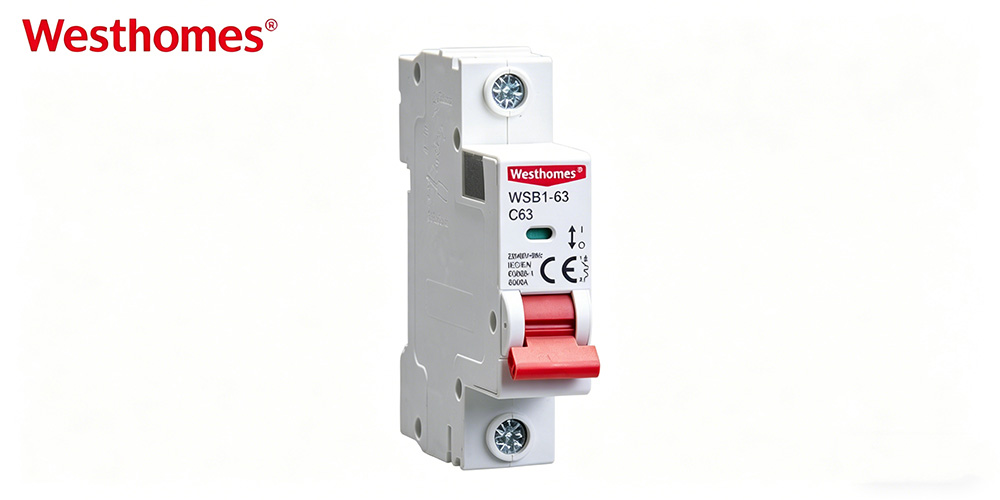
Type C represents the flagship category for commercial and household distribution. Capable of tripping within 0.1 seconds, they handle moderate inrush currents with exceptional precision. The Westhomes WSB1-63, WSB1-80, WSB7-32, and WSB7-63 models form the core of this lineup, offering a comprehensive current range from 1A to 63A. For environments demanding superior safety, Westhomes provides advanced derivatives like the WSB9LE-63 and WSB9LE-80H. These specialized units offer integrated overload, short-circuit, and leakage protection, making them the ultimate choice for stringent commercial and residential requirements.
Type D (Trips at 10 to 20 times rated current)
Type D breakers are explicitly designed for heavy inductive loads characterized by extreme instantaneous startup currents. Westhomes industrial models, including the WSB1-125 and WSB9-100, are equipped with our proprietary arc power lifespan prediction technology. This breakthrough innovation actively guides facility maintenance protocols, drastically reducing long-term operational costs. These units seamlessly integrate with Westhomes fully insulated gas ring main units and primary-secondary integrated switchgear to form a comprehensive industrial distribution network.
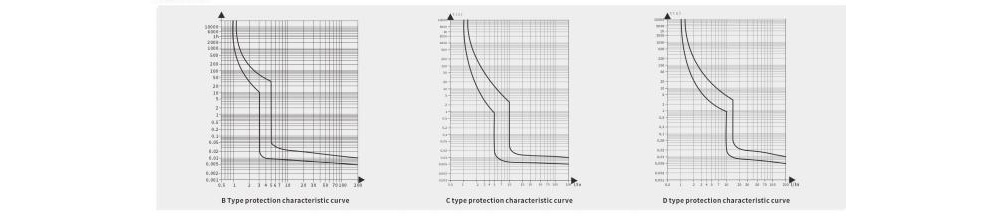
Engineering Insight for Motor Loads: Motor startup currents frequently spike to 7 to 10 times the rated current. Westhomes strictly recommends specifying industrial Type D MCBs, such as the WSB1-125, to absorb these massive transients without nuisance tripping. While a meticulously upsized Type C breaker, such as the WSB1-80, may occasionally bypass startup currents safely, the Type D remains the definitive, technologically superior choice for all industrial motor applications.
Specifying the 1P to 4P Correct Configuration
Beyond the magnetic tripping curve, specifying the accurate pole configuration is dictated by the architectural phase layout of the electrical system.
Configurations for Single-Phase Circuits
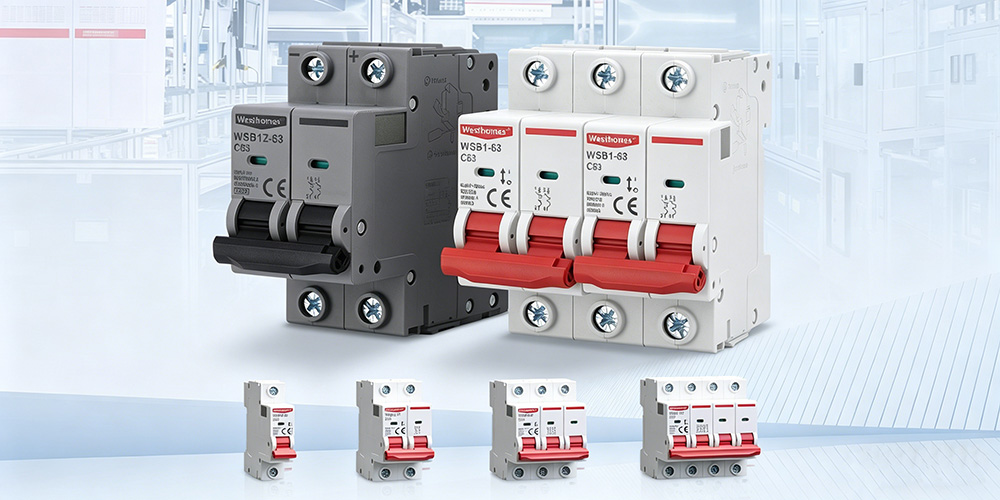
- 1P (Single Pole): Operates exclusively on the live wire. It integrates full thermal-magnetic trip functionality within a standard 18mm modular footprint.
- 1P+N: Controls both the live and neutral wires simultaneously; however, only the live wire contains an active protective trip mechanism. This configuration also occupies an efficient 18mm module space.
- 2P (Double Pole): Provides absolute isolation by controlling both live and neutral wires, equipping both poles with active thermal-magnetic protection within a 36mm module space.
Configurations for Three-Phase Circuits
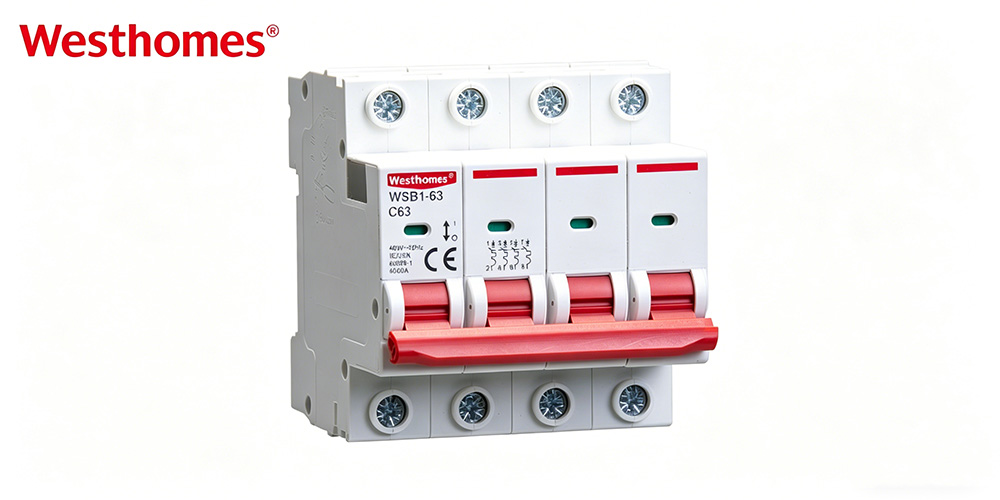
- 3P (Three Pole): Engineered for purely three-phase loads, such as three-phase motors. It executes a trip upon detecting short-circuits between phases or direct faults to the ground.
- 3P+N: Integrates four distinct terminals (L1, L2, L3, N) to manage mixed three-phase and single-phase loads. While all phase lines are fully protected, the neutral functions solely as a switching interrupt without independent overcurrent protection.
- 4P (Four Pole): Features four fully operational terminals, including a comprehensively protected or switched neutral. This is a critical requirement for highly unbalanced electrical networks or specialized, highly regulated industrial environments.
The Secondary Classification: Decoding Four-Pole (4P) Neutral Operations
Technical Clarification: Within international electrical standards, the nomenclature of A, B, C, and D is also utilized to classify the mechanical operation of the Neutral (N) pole in a 4-Pole MCB.
When engineering a 4-Pole MCB solution, the critical variance lies in the behavior of the neutral wire:
- Configuration A: The neutral remains continually unswitched and does not contain an overcurrent trip device.
- Configuration B: The neutral switches simultaneously with the phase poles but operates without a protective trip device.
- Configuration C: The neutral is fully equipped with an overcurrent trip device and switches in unison with the phase poles.
- Configuration D: The neutral contains a protective trip device but remains in a continually unswitched state.
Configurations A and D are commonly recognized in the industry as “pseudo four-pole” or 3P+N devices. While they streamline wiring processes within complex switchgear assemblies, improperly specifying this mechanical configuration can severely compromise facility safety. Westhomes strictly ensures that all four-pole MCBs are rigorously labeled to guarantee compliance with all international safety and application standards.
Advanced Trip Units and Breaking Capacity Verification
Modern miniature circuit breakers rely on highly sophisticated internal trip units to guarantee operational safety. Westhomes integrates industry-leading mechanisms, including:
- Overcurrent Trip Units: Providing dual-layer protection against sustained thermal overloads and instantaneous magnetic short circuits.
- Undervoltage Trip Units: Automatically disconnecting the circuit network if systemic voltage drops below safe operational thresholds.
- Shunt Trip Units: Facilitating the remote tripping of the breaker, a mandatory feature for modern, automated facility safety systems.
Westhomes offers overcurrent trip units in both fixed (integrated) and modular (adjustable) configurations, granting electrical engineers the ultimate flexibility required for complex infrastructure designs.
Furthermore, the breaker’s rated Breaking Capacity (typically designated as 4.5kA, 6kA, or 10kA) is a non-negotiable metric. This capacity must definitively exceed the maximum prospective short-circuit fault current of the protected system. Failure to verify this specification risks the breaker welding shut or catastrophically exploding during a major electrical fault.
Precision is the Ultimate Protection
With the correct engineering specification and rigorous installation protocols, Westhomes MCBs decisively protect critical wiring, eliminate fire hazards, and ensure uninterrupted operational continuity. As electrical infrastructure evolves, our standard MCBs seamlessly integrate with our advanced photovoltaic grid-tied breakers and smart measurement switches, future-proofing your systems for the renewable energy era.
In the realm of electrical safety, precision is not a preference; it is the ultimate protection. Contact the Westhomes engineering team today for expert technical consultation, precise product specification, and access to premium, globally certified electrical components.
See How to Choose the Right RCBO for Your Electrical Panel for a deeper dive into trip curve.
See How to Properly Install a Main Service Circuit Breaker for a deeper dive into circuit breaker.
See How to Read MCB Nameplate: Markings & Ratings Guide for a deeper dive into trip curve.
See Latest Innovations in Miniature Circuit Breaker Technology for a deeper dive into miniature circuit.
See Best MCB Types for Residential Electrical Panels for a deeper dive into circuit breaker.
See Earth Leakage Circuit Breakers (ELCBs) Explained for a deeper dive into circuit breaker.
See Difference Between RCD and RCBO Explained for a deeper dive into circuit breaker.
See Choosing Fused vs Non-Fused Disconnect Switches for a deeper dive into commercial.
See AC Mini Circuit Breakers and C Curve Circuit Breakers for a deeper dive into circuit breaker.
See MCB vs Fuse: Which Is Better for Electrical Safety? for a deeper dive into mcb.
See Difference Between MCB and MCCB – Key Comparisons & Applications for a deeper dive into mcb.
See Top Circuit Breaker Manufacturers Worldwide: Market Focus and Strengths for a deeper dive into circuit breaker.

--- END ---
In this blog
Featured Articles
Get A Free Quote
