Get quick appointment for technical support!

Why Does an MCB Trip? Thermal vs Magnetic Tripping
Oct 19, 2026
When a miniature circuit breaker switches itself off, most people assume it has failed. Usually, it has not. The breaker is doing its job, and it uses two separate mechanisms for two different faults: a slow thermal trip for an overload that lasts, and an instant magnetic trip for a dead short. Knowing which one acted tells you what went wrong.
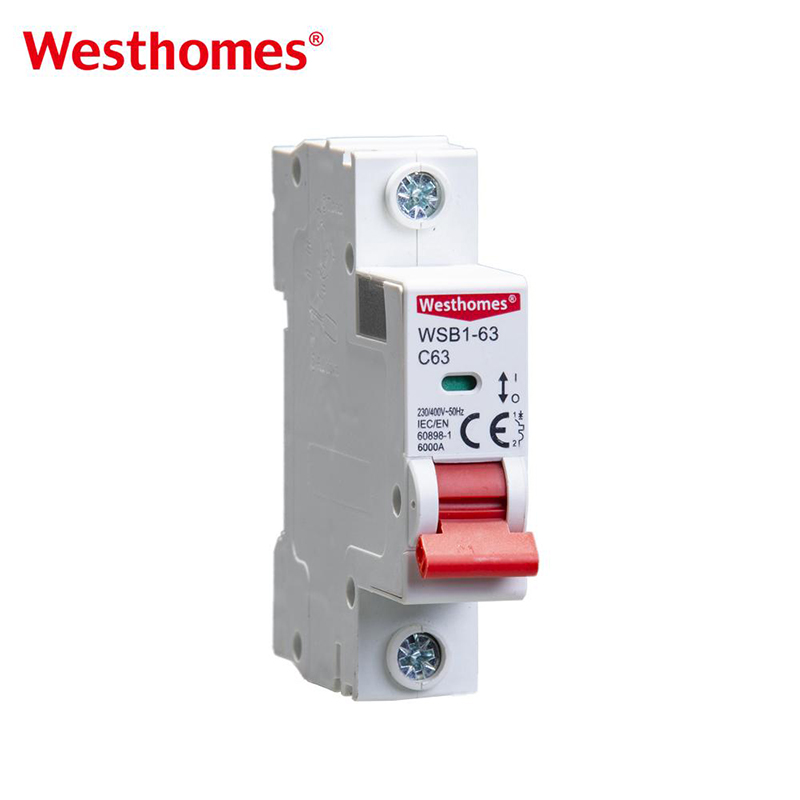
Two mechanisms, two faults
Inside a standard MCB, current passes through a bimetallic strip and a magnetic coil on its way to the load. Neither mechanism reacts to normal current. They only act when current leaves the allowed band, and they act on very different time scales.
| Parameter | Thermal Tripping | Magnetic Tripping |
|---|---|---|
| Trigger | Sustained overcurrent above In | Very high current from a short circuit |
| Element | Bimetallic strip that heats and bends | Electromagnetic coil whose field pulls a plunger |
| Speed | Inverse time: longer at mild overload, faster as current rises | Near instantaneous, opening within milliseconds |
| Protects Against | Overheating conductors from sustained excessive load | Catastrophic fault currents before insulation melts or fires start |
| Everyday Example | A branch running a kettle, space heater, and microwave simultaneously | Live conductor contacting neutral directly inside an appliance |
How thermal tripping works
The bimetal strip consists of two bonded metals that expand at different rates when heated. Current flowing through it warms the strip, and a mild overload bends it slowly over minutes. That delay is deliberate: it lets short bursts such as a fridge compressor starting pass without opening the circuit, while a genuine overload that keeps heating the cable eventually pushes the strip far enough to release the latch.
This is why a heavily loaded socket circuit often trips after ten or twenty minutes rather than the moment you plug in another appliance. The breaker waits to see whether the current stays high, and it trips sooner when the overload is worse. That inverse-time behavior protects the cable from heat that builds up gradually.
How magnetic tripping works
A short circuit produces a current many times the rated value almost instantly, and heat-based protection would be too slow for it. Around the line sits a coil carrying that current; at high current, the coil’s magnetic field pulls a plunger straight into the trip latch, opening the contacts in milliseconds.
This is the trip you hear as a firm snap the moment a wire faults, with no warm-up period. The coil does not care how long the fault lasts; it reacts to the current level itself.
Trip curves set where the magnetic band sits
The magnetic mechanism trips at a multiple of rated current In, and that multiple is what the B, C, and D curve marks define. The thermal side behaves broadly the same across curves; the curve mainly shifts the instantaneous magnetic band.
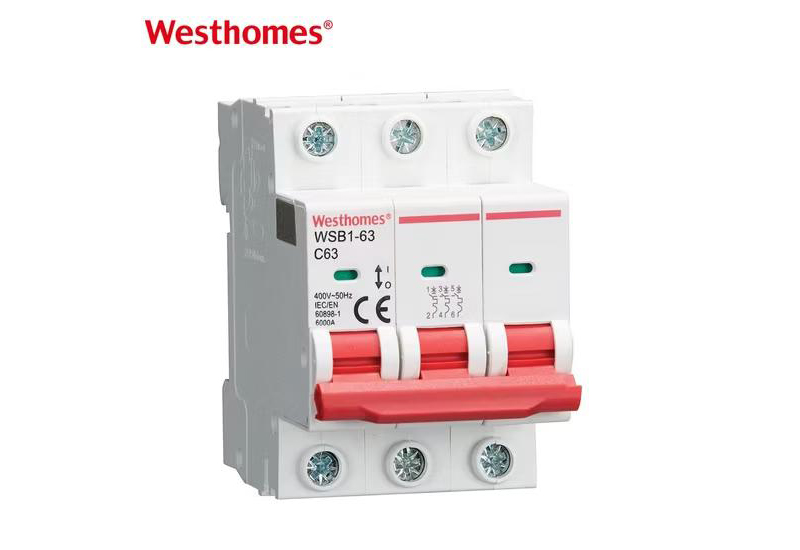
| Curve | Magnetic Trip Band | Typical Load |
|---|---|---|
| Type B | 3 to 5 times In | Light resistive loads, lighting circuits, small fixed domestic heating |
| Type C | 5 to 10 times In | General socket outlets, fans, pumps, small motors, general commercial circuits |
| Type D | 10 to 20 times In | High-inrush equipment: large motors, transformers, industrial welding sets |
A B curve trips on a smaller fault current and suits quiet resistive circuits. A C curve rides through normal motor and appliance inrush before reaching its magnetic band. A D curve holds through the heaviest starting surge and should only be used where the load genuinely needs it, because a wider band also means less sensitive short-circuit protection.
Why an MCB trips when nothing looks wrong
Repeated tripping usually points to the circuit or the load, not a defective breaker. Common causes include:
Too much load on one circuit
Several heaters, kettles, or air conditioners sharing one breaker push current above In for sustained periods, triggering thermal shutdown.
Wrong curve for the load
A B curve on a motor circuit trips on starting inrush; conversely, a C curve on an extended, high-impedance lighting circuit may be oversized.
A failing appliance
A degrading motor winding or heating element drifting toward failure draws gradually rising current before suffering full dielectric breakdown.
Loose or damaged wiring
A loose screw terminal generates severe localized heating and micro-arcing that artificially warms the bimetal strip or triggers fault dynamics.
Rating too small for the cable design
The breaker is undersized for the calculated branch demand, meaning normal operational loads push it into its continuous tripping curve.
Resetting the breaker over and over only delays the diagnosis. If it trips again at the same point, inspect the load and the circuit rather than fitting a larger rating.
MCB trip versus RCD trip
An RCD (residual current device) trips on a completely different physical principle. It monitors the vector sum of currents between live and neutral, tripping instantaneously when current leaks to earth through damaged insulation or accidental human contact.
An RCD does not measure overload or short-circuit current the way an MCB does. In modern panels equipped with both devices, verifying whether the MCB or RCD tripped allows electricians to immediately distinguish between a thermal/overcurrent fault and an insulation ground-leakage issue.
Checks before you specify or replace an MCB
Rated current (In)
Select the nearest standard rating above the design operating current, ensuring it never exceeds the conductor’s derated current-carrying capacity.
Tripping curve (B / C / D)
Match the magnetic tripping threshold to the known inrush profile of the connected equipment rather than relying on standard warehouse inventory.
Breaking capacity (Icn)
Verify against the prospective short-circuit current at the panel; a 6 kA breaker cannot safely clear a 10 kA prospective fault level.
Pole configuration
Specify 1P for single-phase branches, 2P for phase and neutral switching, 3P for 3-phase machinery, and 4P where neutral isolation is mandated.
Standards and destination compliance
Verify certification under IEC/EN 60898-1 for residential and commercial boards, confirming alignment with local national wiring rules.
Frequently asked questions
Why does it trip the instant I plug something in?
That is usually the magnetic mechanism: the inrush or a fault in the device crosses the curve’s trip band. Try the device on another circuit to see whether the appliance itself faults.
Why does it trip after a few minutes instead of immediately?
That is the thermal mechanism on a sustained overload. The bimetal needs time to heat and bend, so mild overloads open after minutes rather than seconds.
What do B, C, and D actually change?
They move the magnetic trip band in multiples of In: B at 3 to 5, C at 5 to 10, D at 10 to 20. The thermal overload protection works on the same inverse-time principle in all three.
Can I fit a C20 instead of C16 to stop the tripping?
Only if the cable and design current support the higher rating. A larger breaker may stop nuisance trips but leaves the cable underprotected, and it can hide a real overload. Check the calculation first.
What is the difference between an MCB trip and an RCD trip?
The MCB opens on overload or short-circuit current; the RCD opens on earth leakage. They protect against different faults and are often installed together.
Closing
A tripping MCB is a signal, not a defect. Slow trips come from the thermal strip on a sustained overload; instant snaps come from the magnetic coil on a short circuit. Match the curve to the load, keep the rating inside the cable’s capacity, and inspect repeated trips instead of resetting through them.
Ready to specify an MCB?
Send us the design current, load type, prospective fault current, poles, and destination market, and we will match a B/C/D curve model with the right breaking capacity and a line-by-line quote.
Standards referenced (verify current editions for the project)

--- END ---


