Get quick appointment for technical support!

Setting a Thermal Overload Relay
Sep 19, 2026
A thermal overload relay is the cheapest protection on a motor circuit and the one most often set wrongly. It is not a circuit breaker and it does not respond to a short circuit. What it does is follow the motor current and open the control circuit when that current has been too high for too long.
The setting is a single number, and the same number produces two opposite failures depending on which way it is wrong. This guide takes the three symptoms that appear on site and works back from each to the setting that caused it.
What the Setting Actually Controls
The dial on the thermal relay sets the current at which its timing begins. Below that current the relay does nothing. Above it, the relay runs a thermal model of the motor and trips when that model reaches its limit.
The model is why the relay does not trip the instant the current rises. A motor draws several times its rated current during a normal start, and a relay that tripped on that would make starting impossible. The delay is what allows a start and what allows a sustained overload to be caught.
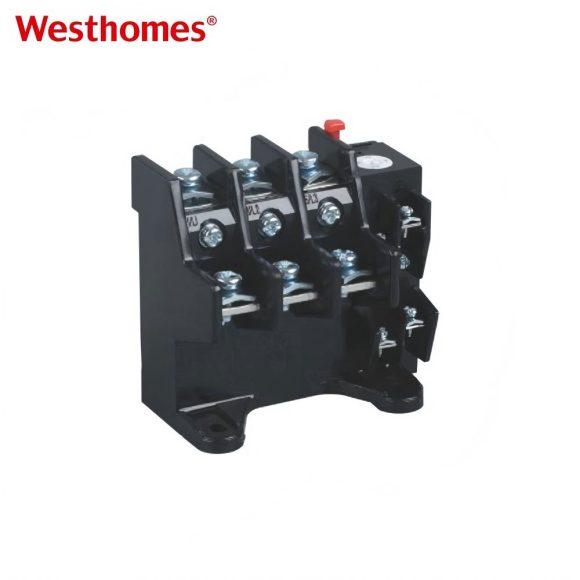
The published range for the relay used here spans 0.1 A to 140 A across several types, with each type covering a narrow band. The published range for the relay used here spans 0.1 A to 140 A across several types, with each type covering a narrow band. The band for a given motor is selected first, and the setting is placed inside it.
| Relay type | Setting range | Paired contactor frames |
| JR28-09301d | 0.1 to 0.16 A | CJX2-09 to 25 |
| JR28-09308d | 2.5 to 4 A | CJX2-09 to 25 |
| JR28-18321d | 12 to 18 A | CJX2-09 to 25 |
| JR28-32355d | 28 to 36 A | CJX2-32 |
| JR28-50357d | 37 to 50 A | CJX2-40 to 80 |
| JR28-140369d | 110 to 140 A | CJX2-115 to 170 |
Symptom One: The Relay Trips on Every Start
A relay that opens during the starting sequence is usually set at or below the motor current. The start current passes through the relay and the timing model advances faster than it should. The motor never reaches running speed and the relay opens part way through the acceleration.
The fix is to raise the setting to the nameplate current rather than to leave it at the lowest position in the band. The fix is to raise the setting to the nameplate current rather than to leave it at the lowest position in the band. Setting a relay low because it feels safer produces a machine that cannot be started, which is not protection. A machine that will not run is not a protected machine.
Where the relay is already at the nameplate current and still trips on start, the cause is elsewhere. Where the relay is already at the nameplate current and still trips on start, the cause is elsewhere. A start that takes longer than normal points at a mechanical problem or a low supply voltage rather than at the setting.
Voltage that sags during a start produces a current that is higher than normal for longer. That condition is covered in the guide on voltage sags and nuisance tripping, which deals with the supply rather than the relay.
Symptom Two: The Relay Never Trips and the Motor Burns
The opposite failure is a relay set so high that it never reaches its limit before the motor insulation fails. The opposite failure is a relay set so high that it never reaches its limit before the motor insulation fails. This is the more expensive fault of the two, because the motor is destroyed rather than the process interrupted.
Setting a relay above the nameplate current to stop nuisance trips is the usual cause. The margin that stops the nuisance trip is also the margin that lets the motor run hot indefinitely. The relay is then present but not protecting.
A motor that has failed from overload carries evidence of it. The guide on motor burnout prevention covers what the winding shows, and how to separate an overload failure from a single phase one.
The check at commissioning is to record the actual running current and confirm it sits below the setting with a sensible margin. The check at commissioning is to record the actual running current and confirm it sits below the setting with a sensible margin. A margin of a few percent is normal and a margin of thirty percent is not protection.
Symptom Three: It Trips After Twenty Minutes
A relay that holds through a start and opens after a period of running is following a current that is genuinely high but not high enough to be obvious. The motor is running overloaded rather than failing.
Causes include a mechanical load that has increased through wear, a bearing that is tightening up, and a supply voltage that is low enough to raise the current for the same output. All three produce the same symptom and different fixes. Causes include a mechanical load that has increased through wear, a bearing that is tightening up, and a supply voltage low enough to raise the current for the same output. All three produce the same symptom and different fixes.
Measuring the current at the panel while the machine runs separates them from a setting problem in a single reading. Measuring the current at the panel while the machine runs separates them from a setting problem in a single reading. A current above the nameplate figure confirms the motor is overloaded, and the relay is doing its job.
The Ambient Correction Nobody Applies
A thermal relay is calibrated at a reference ambient temperature, and a panel that runs warmer than that changes the trip point. A thermal relay is calibrated at a reference ambient temperature, and a panel that runs warmer than that changes the trip point. Most industrial panels run warmer than the reference, which means the motor is protected at a lower current than the dial suggests.
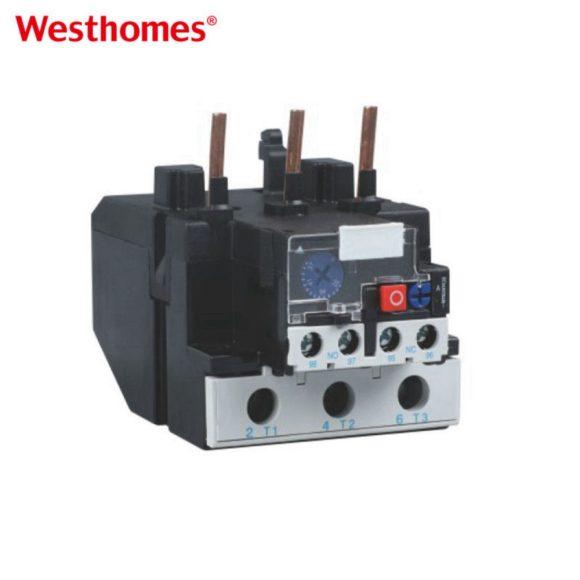
The correction moves the effective setting down as the panel temperature rises, and the amount is published for each relay. The correction moves the effective setting down as the panel temperature rises, and the amount is published for each relay. Where the panel is sealed and the contactor coils are adding heat, the correction is not small.
The relay and the contactor that carries it are mounted together, and the pairing for the range is listed under motor protection relay alongside the setting ranges.
Setting a Relay in Five Checks
- Read the nameplate current at the supply voltage actually in use.
- Confirm the setting range brackets that current rather than sitting at its edge.
- Set the dial at the nameplate current and not below it.
- Start the motor and confirm the relay holds through the start.
- Record the running current and the panel temperature, then compare them at the next service.
A relay that has been set and never measured is only assumed to be protecting. A relay that has been set and never measured is only assumed to be protecting. The one reading taken after the first start is what turns the setting into a fact.
In Closing
The relay is the only device on a motor circuit that follows the load rather than the fault, and its setting is the whole of its behavior. A setting below the nameplate current stops the machine from starting, and a setting above it lets the winding run hot until it fails. Both failures look like a relay problem from the panel and only one of them is. The way to tell them apart is to read the running current once after the first start and write it down with the panel temperature beside it. That single record separates a setting problem from a machine problem, and it costs less than either repair.

--- END ---
In this blog
Featured Articles
Get A Free Quote
