Get quick appointment for technical support!

SPD Installation Requirements: NEC vs IEC Checklist
Oct 23, 2026
There is no single global rule that makes an SPD installation compliant. A defensible job has to satisfy four layers at once: the locally adopted installation code, the product standard the device was tested to, the manufacturer’s own instructions, and the project specification or authority having jurisdiction (AHJ). A UL 1449 listing or an IEC 61643-11 certificate proves the device passed a test; it does not prove this panel, this earthing arrangement, and this conductor route are legal.
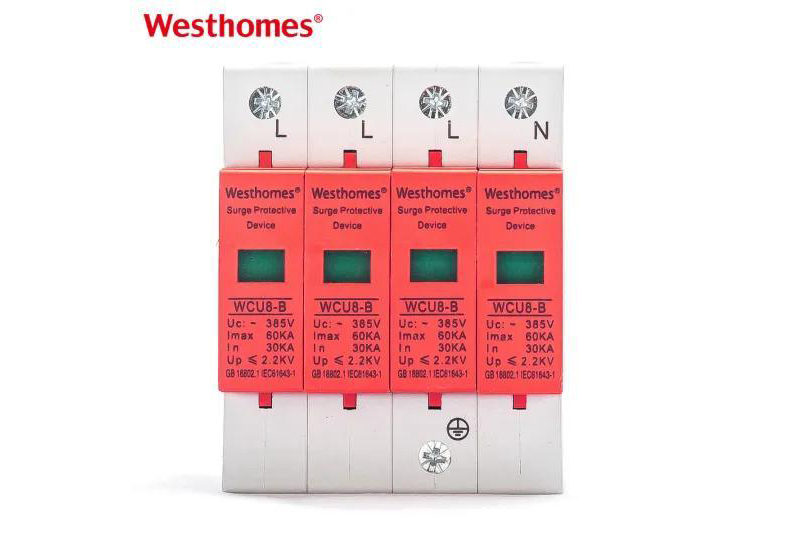
NEC side: UL 1449 types and the adopted edition
In North America, the product standard is UL 1449, and the installation rules live in the National Electrical Code (NEC). The first trap is the edition: NFPA publishes a new NEC on a cycle, but states and cities may still enforce 2023, 2020, or an amended older version. The newest publication date is not proof of what the site legally follows.
UL 1449 sorts permanently connected SPDs into types by where they may sit:
Type 1
Installed on the supply side of the service overcurrent device; evaluated for direct connection to the incoming service conductors without requiring external branch backup protection.
Type 2
Installed on the load side of the main service overcurrent device; typically connected at distribution panelboards, switchboards, or sub-feeders.
Type 3
Point-of-use surge protective devices installed with a designated conductor lead length directly adjacent to the protected sensitive equipment.
NEC clauses drive the mandate rather than the device. Section 230.67 calls for a Type 1 or Type 2 SPD on services to specified occupancies such as dwelling units, dormitories, and hotel rooms; Section 215.18 covers feeder-supplied versions; Section 700.8 requires a listed SPD on emergency-system switchboards and panelboards. These are examples from one edition; the project must use the exact adopted edition and local amendments.
On the NEC side, the buyer also checks MCOV (maximum continuous operating voltage) against system voltage, SCCR against available fault current, a disconnecting means where required, and short, straight connection conductors per Section 285.12. The often-quoted 6 ft lead figure applies under specific conditions, so it should not be copied onto every drawing.
IEC side: product standard and installation standard are separate
Under the IEC system, the product test and the installation rules are different documents, and buyers often mix them up:
IEC 61643-11
Specifies how the SPD is tested and marked for low-voltage AC power networks, applied alongside the core testing requirements of IEC 61643-01.
IEC 60364-5-53
Provides the structural installation framework governing the selection, wiring, and erection of surge devices within building electrical systems.
IEC 61643-12
Details application engineering, precise physical placement, operational boundaries, and dynamic energy coordination across cascaded SPDs.
IEC 60364-4-44 & IEC 62305-4
Identifies where transient overvoltage protection is legally required and integrates internal SPDs with external structural lightning protection.
IEC classifies SPDs by test duty, not just location: Class I devices handle lightning impulse current (Iimp, 10/350 μs waveform) at the entrance; Class II devices handle induced and switching surges (In, Imax, 8/20 μs) at distribution; Class III combination-wave devices sit near equipment. The datasheet declares Uc (continuous voltage), In and Imax (discharge currents), Up (protection level), and the protection modes L-N, L-PE, N-PE, or L-L.
How NEC types map to IEC classes
The two systems look similar on paper, but the marks are not interchangeable. A Type 2 UL listing and a Class II IEC declaration describe comparable roles, yet their test waveforms, marking rules, and certification bodies differ.
| Position in the Building | NEC / UL 1449 | IEC 61643-11 | Typical Duty |
|---|---|---|---|
| Service entrance, direct lightning | Type 1 | Class I (Iimp, 10/350 μs) | Diverts high-energy direct lightning current |
| Main / sub-distribution panel | Type 2 | Class II (In, Imax, 8/20 μs) | Clamps induced surges and utility switching transients |
| Near protected equipment | Type 3 | Class III (combination wave) | Delivers final point-of-use voltage clamping |
Specify to the market: a project shipped to an NEC market needs UL evidence and NEC clauses; a project shipped to an IEC market needs IEC 61643-11 evidence and IEC 60364 placement. Do not treat the labels as synonyms.
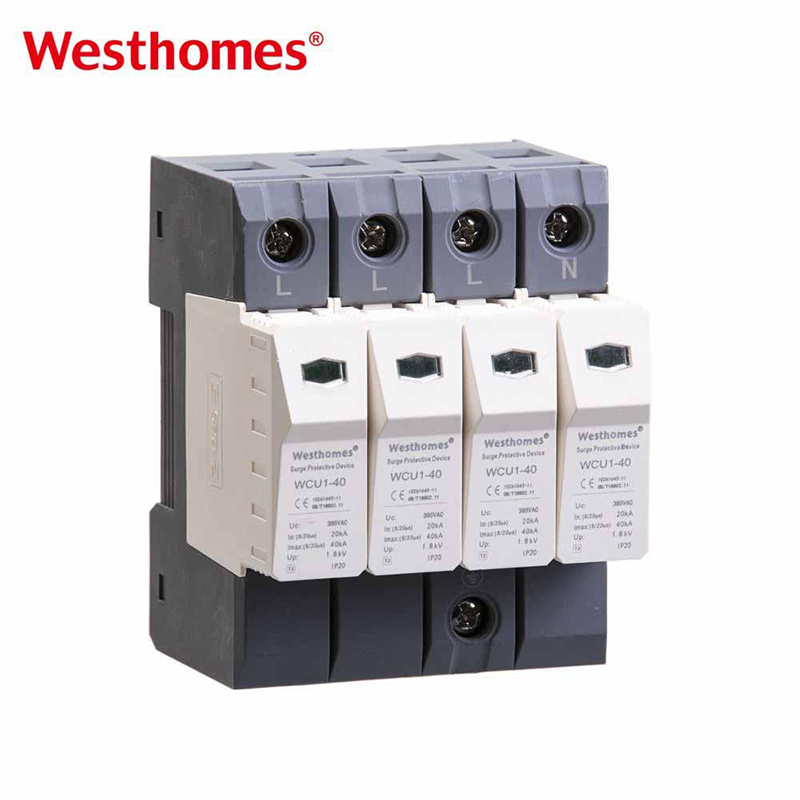
Where the SPD actually goes
One SPD at the meter does not cover a whole building on its own. Surges enter at the service, travel down feeders, and are picked up again by long internal circuits, so a coordinated chain is normal:
Entrance SPD
Handles the primary high-energy duty closest to the main service entrance, intercepting direct lightning impulses and severe utility network switching.
Distribution SPD
Installed at main and sub-distribution panelboards to attenuate residual let-through energy for downstream machine panels and specific floor distribution.
Local SPD
Positioned immediately adjacent to sensitive automation, PLCs, or data terminals where long feeder cables allow transient voltage reflection.
When two SPDs sit in series, they must coordinate: the upstream device takes the large energy, the downstream clamps the residual voltage. Mismatched models can leave the smaller device carrying more than it was tested for.
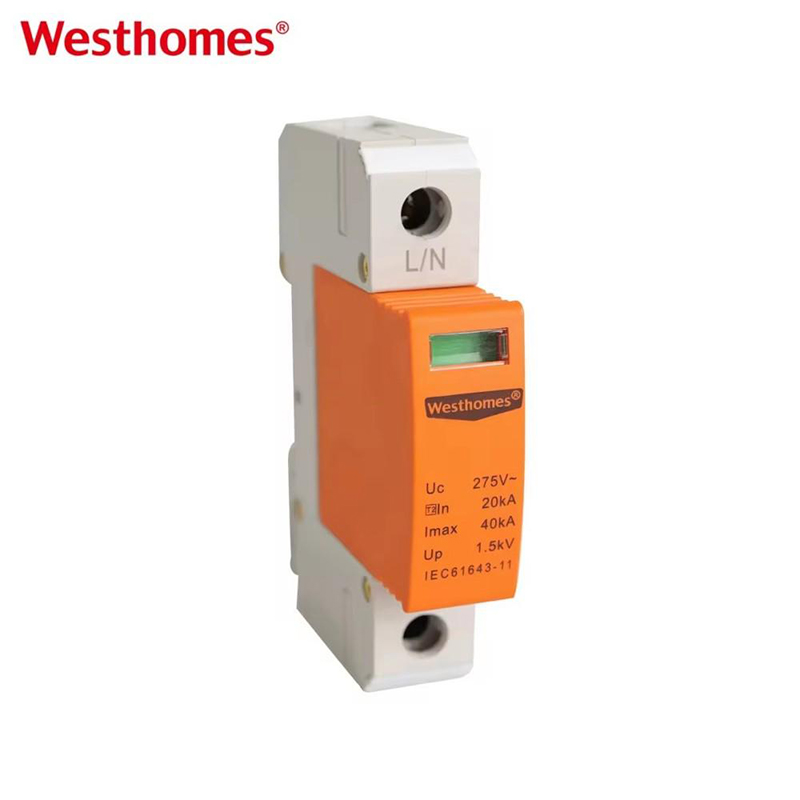
Wiring, bonding, and the earthing system
Connection conductors add inductance, and a fast surge develops extra voltage across that inductance even when the SPD itself clamps well. Keep the route short and direct, avoid loops, use the conductor size in the datasheet, and follow the terminal and bend rules. There is no universal maximum lead length that overrides the manufacturer or the adopted code.
The earthing arrangement changes the protection modes. TN-S, TN-C-S, TT, and IT systems place neutral and protective conductor differently, so an L-N-only SPD that belongs in one setup may be wrong in another. Confirm TN/TT/IT, neutral treatment, and bonding before fixing the pole count and modes.
Backup protection and fault current are separate checks
In, Imax, and Iimp describe surge test duties. They do not state how the device survives power-frequency short-circuit current. The available fault current at the installation point still has to match the SPD’s SCCR (NEC) or its Isccr / short-circuit declaration with the prescribed disconnector (IEC). A high kA surge rating does not prove short-circuit safety.
The SPD also needs a defined backup: internal thermal disconnector, an external fuse or breaker specified by the manufacturer, or a coordinated combination. Copying a 20 A breaker from a neighbor’s SPD ignores the exact model’s instructions and can void the rating.
Pre-energization checklist
| Check Item | Evidence to Record |
|---|---|
| Jurisdiction | Adopted code edition, local amendments, AHJ requirements, and project engineering specification. |
| Device Match | Exact catalog model, Uc/MCOV, Up, In/Imax or Iimp, and declared protection modes against the electrical one-line diagram. |
| Position | Verify that the Type/Class listing permits installation at the service entrance, sub-panel, or equipment terminal. |
| System Architecture | Operating voltage, frequency, phase count, earthing scheme (TN/TT/IT), and neutral/PE configuration. |
| Fault Current | Prospective short-circuit current at the panel versus rated SCCR or Isccr with the approved disconnector. |
| Backup Protection | Confirm the upstream or dedicated fuse/breaker type, rating, and breaking capacity strictly per manufacturer instructions. |
| Wiring & Lead Route | Conductor cross-section, total lead route length, torque values, bonding path, and absence of inductive loops. |
| Operational Status | Visual window indicator check, remote auxiliary signaling contact logic, and commissioning sign-off. |
Frequently asked questions
Is an SPD required on every circuit?
No. The mandate comes from the adopted code, occupancy, risk assessment, or equipment instruction, not from the device itself. Some clauses require it on specified services; others leave it to the risk review.
Can I replace a UL Type 2 with an IEC Class II SPD?
Not automatically. The roles are comparable, but test waveforms, marking, certification body, and installation rules differ. Use the evidence required by the destination market.
How long should the SPD leads be?
As short and direct as the datasheet and code allow, without loops. A fixed number like 6 ft applies only under the stated conditions of the adopted edition.
Is MCOV or Uc the same as system voltage?
No. It must be at or above the steady system voltage with tolerance for temporary overvoltage; picking the lowest clamping value instead leaves the device stressed by normal voltage rises.
Does one SPD at the meter protect the whole building?
It handles the incoming surge, but long feeders and sensitive loads downstream often call for coordinated distribution and local SPDs as well.
Closing
Buy an SPD to a certified rating, but install it against a written code basis, the exact datasheet, and the real fault current at that point. Match the device type to the market, keep the wiring honest, and document the backup arrangement before energizing; that record is what the next technician uses when a module fails or the panel changes.
Ready to specify an SPD?
Send us the market and adopted code, system voltage, earthing arrangement, installation point, available fault current, required type/class and modes, and we will match a model with Uc, Up, In/Imax, and backup data for a line-by-line quote.
Keep reading
Standards referenced (verify current editions for the project)

--- END ---