Get quick appointment for technical support!

Get in Touch

3p 4p 630A 800A 1000A 1250A 1600A 2000A 4000A 3200A 6300A Acb Air Circuit Breaker

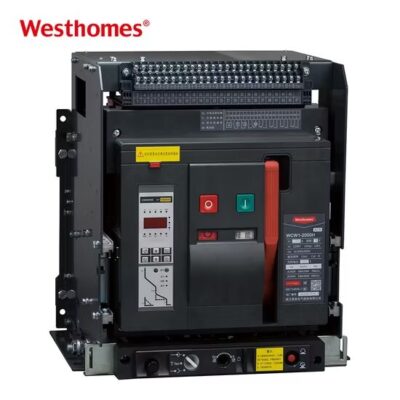
The WCW1 is an intelligent air circuit breaker covering 630A to 6300A at up to 690V AC. Used as a main incoming or bus-tie breaker in low-voltage distribution systems, it provides electronic trip protection with programmable settings for industrial, commercial, and infrastructure power networks.

Social focus:

WCW1 Series 630A–6300A Intelligent Air Circuit Breaker for LV Distribution

The WCW1 series intelligent universal circuit breaker operates in AC 50Hz distribution networks at rated voltages up to 600V (maximum 690V), with rated currents from 200A to 6300A. It distributes power and protects against overload, short circuit, undervoltage, and ground fault conditions. The microprocessor trip unit supports selective coordination across multi-tier distribution architectures.

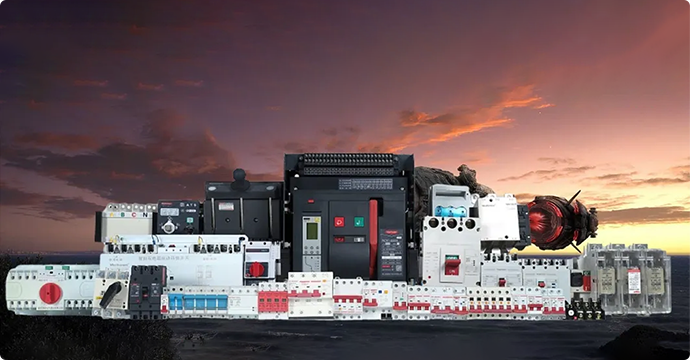
Westhomes ACB and MCCB circuit breaker product series overview

The WCW1 is available in three frame sizes: 2000A, 3200A, and 6300A. Each frame covers a range of rated currents with the same physical footprint, reducing spare parts inventory and simplifying switchboard design. Frame-rated currents (Inm) are 2000A, 3200A, and 6300A, with specific current ratings of 200A, 400A, 630A, 800A, 1000A, 1250A, 1600A, 2000A, 2500A, 2900A, 3200A, 4000A, 5000A, and 6300A.

The electronic trip unit offers adjustable protection parameters including long-time delay, short-time delay, instantaneous trip, and ground fault pickup. Settings are configured via a front-panel LCD display or through the communication interface for remote programming. The breaker supports 3-pole and 4-pole configurations with optional neutral pole protection.

Rated insulation voltage reaches 1000V with an impulse withstand of 12kV. Breaking capacities range from 65kA to 100kA at 400V depending on frame size, meeting the demands of main switchboards in power plants, data centers, hospitals, and heavy industrial facilities. A stored-energy operating mechanism with motor charging ensures fast close and trip speeds regardless of operator action.

Standard accessories include shunt trip, undervoltage release, auxiliary switches, door interlock, and motor operator. Communication modules support Modbus, Profibus, and DeviceNet protocols for integration into SCADA and building management systems. Each unit is type-tested to IEC 60947-2 with mechanical endurance exceeding 10,000 operations and electrical endurance of 5,000 cycles at rated current.


KEY INFORMATION

WCM9Z

Pole  1P, 2P, 3P, 4P
Voltage  AC400V/690V
kA  10, 20, 30, 40, 60, 80, 100
Inm  1000A, 2000A, 3200A, 6300A
In  200A-6300A

MAIN TECHNICAL DATA

Frame level rated current Inm (A) Rated current In (A)
1000 200, 400, 630, 800, 1000
2000 630, 800, 1000, 1250, 1600, 2000
3200 2000, 2500, 2900, 3200
4000 3200, 3600, 4000
6300 4000, 5000, 6300
Frame level rated current Inm (A) 1000 2000 3200 4000 6300
Rated ultimate short circuit breaking capacity Icu (kA) O-CO 400V 42 65 80 80 120
690V 25 50 65 65 85
Rated operation short circuit breaking capacity Ics (kA) O-CO-CO 400V 30 40 50 50 100
690V 20 40 50 50 75
Rated short time withstand current Icw (kA) 1s, delay 0.4s, 0-CO 400V 30 40 65 65 100
690V 20 40 50 50 75
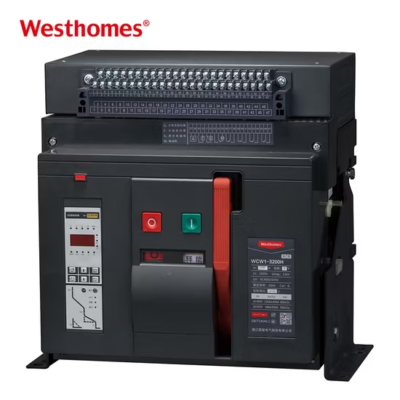
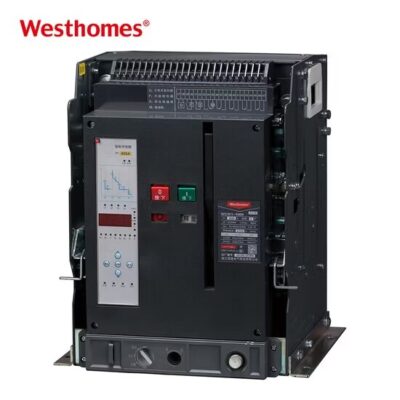
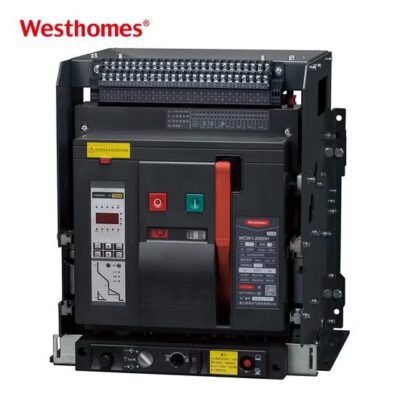
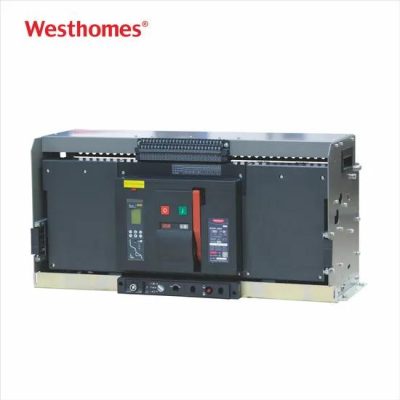
WCW1 630A 3P air circuit breaker product photo on white background

FREQUENTLY ASKED QUESTION (FAQ)

What is an air circuit breaker (ACB)? plus-square Created with Sketch Beta. minus-square Created with Sketch Beta.

An air circuit breaker is a low-voltage power circuit breaker that uses air as the arc-quenching medium, designed for the highest current levels in low-voltage distribution. It is typically used as the main incoming breaker or bus-tie breaker in a main switchboard. It combines a robust operating mechanism, a magnetic-blowout/arc-chute system, and a microprocessor-based trip unit.

What current range does this ACB series cover? plus-square Created with Sketch Beta. minus-square Created with Sketch Beta.

This series spans 630 A, 800 A, 1000 A, 1250 A, 1600 A, 2000 A, 3200 A, 4000 A, and 6300 A, covering the full low-voltage main-switchgear band. The rated current (In) is chosen to match the installed load and transformer rating, while the frame size determines the maximum current and breaking capacity. ACBs are the standard protection for incoming feeds from large transformers (typically 1000 kVA up to several MVA).

What does 3-pole and 4-pole mean? plus-square Created with Sketch Beta. minus-square Created with Sketch Beta.

A 3-pole ACB switches the three line conductors (L1, L2, L3), while a 4-pole ACB also switches the neutral conductor. Three-pole units are standard for three-phase main incomers; four-pole units are used where neutral isolation is required, for changeover/bus-tie arrangements, or where neutral switching is mandated by the installation rules. The pole count must match the system earthing and switching arrangement.

How does air arc quenching work in an ACB? plus-square Created with Sketch Beta. minus-square Created with Sketch Beta.

When the contacts open under fault current, an arc forms and is driven by a magnetic field into a stack of splitter plates in the arc chute. The plates split the arc into many short arcs, and the hot ionized air is forced out through exhaust vents, cooling and de-ionizing the plasma until the arc cannot re-strike. Air is the interrupting medium, as opposed to oil, vacuum, or SF6 used at medium voltage.

What is the drawout design of an ACB? plus-square Created with Sketch Beta. minus-square Created with Sketch Beta.

Most high-current ACBs are drawout units: the breaker can be racked OUT on its cassette to a disconnected, isolated position while the primary and secondary contacts remain connected to the switchboard. This allows safe withdrawal, maintenance, and replacement without de-energizing the whole board, and provides a visible isolation gap. Fixed (withdrawable-less) versions are also available for smaller ratings and simpler layouts.

What is a microprocessor trip unit? plus-square Created with Sketch Beta. minus-square Created with Sketch Beta.

A microprocessor trip unit is an electronic control that measures current (and often voltage and power) via current transformers and calculates the trip time according to programmable protection curves. It replaces the older thermal-magnetic block and offers adjustable long-time, short-time, instantaneous, and earth-fault protection, plus metering, event logging, and communication (Modbus, etc.). It provides far more precise and selective coordination than a thermal-magnetic MCCB.

What is LSI protection? plus-square Created with Sketch Beta. minus-square Created with Sketch Beta.

LSI stands for Long-time, Short-time, and Instantaneous protection. Long-time (L) gives inverse-time overload protection; Short-time (S) gives a time-delayed short-circuit trip with a selectable delay and I²t character, enabling downstream MCCBs to clear faults first (selectivity); Instantaneous (I) trips immediately on very high faults. A fourth element, Ground-fault (G), is added on LSIG units for earth-leakage/earth-fault detection.

Where is an ACB typically installed? plus-square Created with Sketch Beta. minus-square Created with Sketch Beta.

ACBs are installed in main low-voltage switchgear (PCC/MCC rooms) as the main incomer from the distribution transformer, as bus-tie breakers between two sections of busbar, or as generator/utility intertie breakers. They are mounted vertically in drawout cassettes, busbar-connected, and usually equipped with shunt/tripping releases and under-voltage releases for remote and emergency tripping.

Which standard applies to an ACB? plus-square Created with Sketch Beta. minus-square Created with Sketch Beta.

ACBs are built and type-tested to IEC 60947-2, the same low-voltage circuit-breaker standard as MCCBs, but they typically fall under utilization Category B — meaning they have a defined short-time withstand current (Icw) and can withstand (and coordinate through) short-time faults rather than tripping instantaneously. This short-time rating is what enables selective grading with downstream MCCBs.

How does an ACB differ from an MCCB? plus-square Created with Sketch Beta. minus-square Created with Sketch Beta.

An ACB handles much higher currents (630–6300 A vs. typically ≤1600 A for an MCCB), uses drawout construction for maintenance, and always includes a microprocessor trip unit with adjustable LSI/LSIG curves and short-time withstand (Icw). An MCCB is usually Category A (instantaneous only, no Icw), fixed-mounted, and cheaper for feeder duty. Rule of thumb: use an MCCB for feeders and an ACB for the main incomer/bus-tie.

RELATED PROJECTS

REQUEST
YOUR FREE QUOTE

* indicates a required field